Software
Houzz Logo Print
trine_rask

What is wrong with my cactus?

11 years ago

I just purchased this cactus today. When I got home, I started researching the type of cactus (I believe it's a Opuntia Ficus-Indica; correct me if I'm wrong) and I noticed that other ones aren't this pale and don't have these brown and light, mainly round marks. Is this just scarring from damage or does it look like some kind of a disease?

Comments (19)

  • 11 years ago

    That doesnT look very good does it? Whilst I have no idea on what type it us as I tend to only grow Jades and 'jungle type cacti', I would be very suspect about it, in fact to be honest I would have passed it by. Does the whole plant have these marks? Could I suggest returning it and asking for a refund? I hope that someone more 'cacti based' will come in and tell you it's mechanical damage, and not a fungus or virus type thing....but I do wonder...I would defo return it.

    Gill UK


    Trine Rask thanked greenclaws UK, Zone 8a
  • 11 years ago

    I didn't ask for the receipt, so I won't be able to take it back. Unfortunately. Because it really isn't very pretty. I'm glad to hear that it's probably just psychical damage and not a bug or something like that. Palmbob, do you know whether the markings will reduce or stay the same for good?

  • 11 years ago

    Trine- Your cactus appears to me to have been attacked by parasitic insects such as scale or coccineal insects, mealy bugs, spider mites, any or all of them. The brown spots appear to be a type of "corking" a condition usually attributed to older cacti and is normal with age.

    Just in case there are still insects on the plant, I would bathe it in a solution of lukewarm soapy water (dish detergent) in a large basin..and mix in a capful of 70% isopropyl alcohol. I would use a soft-head toothbrush to gently scrub the dermis of the plant. I also bathe the roots and then rinse the entire plant with plain lukewarm water.

    After the bathing procedure allow the plant to dry. Usually a day or two before replanting in a fast-draining gritty soil or soil-less mix.

    After re-planting I would wait another day or two at least before watering it well.

    I believe there is hope for this cactus although the brown spots or corking if that's what it is will remain permanent. The good news evident from your photo, is that there is new growth appearing. Whether it's an offshoot or a new leaf or even a bud is a good sign.

    I have acquired cacti such as this for one reason: Propagation.

    Each segmented piece of opuntia can be rooted and propagated quite easily as long as you allow each segment to properly callous over for at least a couple of weeks which, I am in the process of doing myself with a "santa rita" variety.

    Keep it in full sun. I water mine monthly. When you water, water thoroughly. This is my routine in San Diego. You may have to do things a bit differently depending on where you are.

    Here is a link (below) to a site I have found quite useful in the past. - Good Luck - Neil : )

    http://cactiguide.com/cactipests/

    Trine Rask thanked Neil
  • 11 years ago
    last modified: 11 years ago

    Neil, thank you so much for your detailed reply. I really appreciate it.

    I have been researching today and I did think that it could be scale. The cactus has a LOT of those round marks with a darker middle. Kinda looks like pimples. It's all over it, except for on the new shoots. They look completely healthy.

    Since this is my first big cactus and I have never repotted/replanted anything before, I think this will serve as a learning experience instead of an attempt to save it, and I will definitely keep those new shoots.

    I've been looking into the propagation process and I get what to do, except for one thing that seems to be a little unclear. Should I leave the new shoots (while they are getting the callous) in a dark and cool place, or should I leave them in the sun or at least in a bright spot? Should I keep them dry or should they be misted with water? It appears that people are very divided on this.

    I live in Copenhagen, Denmark (Scandinavia, Northern Europe). The sun is pretty bright and it gets to an average of about 80 degrees F at the moment, as it's the summer period. I don't know if that makes a difference.

    Thanks again!

    Trine

  • 11 years ago
    last modified: 11 years ago

    Trine

    Don't expose roots or any fresh cuttings to sun - keep in shady (not necessary to be very dark, just not direct sun) and well ventilated place. And don't mist them either, that could cause rot.

    After bathing them as Neil recommends, don't let them sit around soaking wet - if you put them on some newspaper or kitchen towels, excess water will soak away faster.

    When you pot them up, it is also recommended to keep them in shadier spot and only introduce to more and more light gradually.

    All the steps suggested will not hurt the plant. They are very hardy, just don't like to sit in too much water.

  • 11 years ago

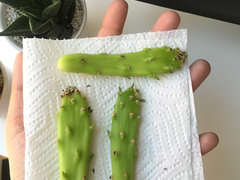
    Rina, thank you so much for the tips! I will stick to what you said and hopefully they will grow into beautiful, healthy plants. Should I put them in separate pots or spaced but together in one pot? I'll attach a picture of their size.

    Thanks again,

    Trine

  • 11 years ago

    Those look very clean-healthy.

    You can pot them separately or few together - that would be personal preference. Another thing to consider is that if plant is happy, it may grow very fast and you'll need to re-pot it soon again if few are together.

    Btw, are you planning on growing them indoors year-round?

  • 11 years ago

    Thank you for getting back to me.

    I'll do a pot with one and a pot with two, and see how it goes. I don't mind having to re-pot. It will make me learn. :)

    They will be indoors year-round, yes. Gotta make it work in my little urban apartment garden.

  • 11 years ago

    Trine

    Good luck with re-potting and growing, hope you'll post photos of their progress. Just give them (eventually) as much light as you can.

    (If it is o. ficus-indica a.k.a cactus pear, I believe they could have edible fruit?)

    Rina

  • 11 years ago

    All cactus fruit is edible. Try it, you'll like it. :-)

  • 11 years ago

    I didn't know that! (shame on me :) should have googled it, right?) One of these days I'll have to buy it and taste it.

  • 11 years ago

    Rina, thank you so much. I appreciate the tips and I will definitely post progress photos.


    That is cool. I thought the Opuntia Ficus-Indica and the Cactus Pear were two different varieties. Well, I'm learning every day. :)

  • 11 years ago

    Ficus indica is one of the most prized for culinary uses with its fruit. Too tender for my growing zone though. A neighbor let me dig some of her prickly pear and plant it at home this year, but she has no info on species and has never cooked with its fruit or paddles. I hope to be testing that in a couple of years.

    ez

  • 11 years ago

    Breathnez; Are the paddles edible too? That's so interesting. But yeah, the fruit is meant to be really nice.

  • 11 years ago

    Pads from Opuntia are edible. They are called nopales in Mexican markets. You have to remove all spines/ glochids before cooking.

    Trine Rask thanked paracelsus
  • 11 years ago

    There's a trick to getting all the glochids, but I can't remember what it was off the top of my head, it's been a long while since I've grown any opuntia. I do miss them though.

    Trine Rask thanked laticauda
  • 11 years ago

    I think I might know,Thirps they attack my E.englmanii every year make the plant look bad but dosnt really harm it and continues to grow. Do what is recommended another option is useing a hose on jet mode

    noah

    Trine Rask thanked spikef35
  • 11 years ago

    Thank you all for your comments, help and tips. They are greatly appreciated. I have decided to propagate the new shoots and pass the plant on to someone else. The shoots have successfully been potted and they seem to be thriving.