Software
Houzz Logo Print
rooftopbklyn

bigger crassula surgery advice

11 years ago
last modified: 11 years ago
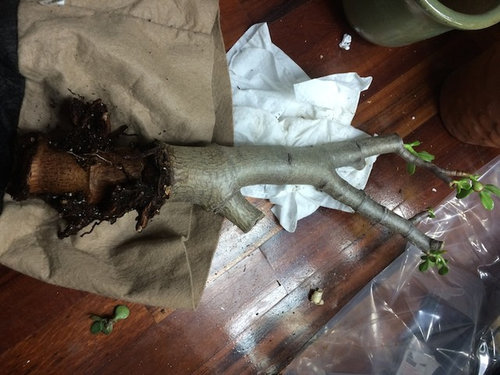
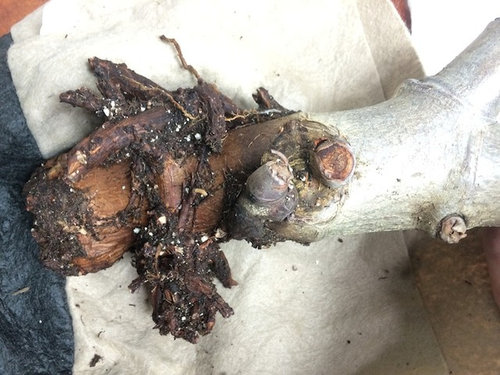
I finally got my hands on decent sized crassula ovata and am very excited. It was in ancient compacted completely hydrophobic peat that I have now mostly removed, taking a majority if the still living roots with it. (not purposefully, but unavoidable. soil remained hydrophobic after soaking for 10 minutes in a bucket of water).

I have worked with smaller succulents before and am comfortable cutting and propagating for the most part, but have not ever dealt with something this chunky and could use some advice. I do have a very sharp tree saw that I'm good with, so not worried about getting a nice clean cut.

I'd like to remove a majority of the remaining large chunky roots, and then cut back the below soil portion a significant amount.

For scale, it's about 2 3/4 inches in diameter at the soil line, and 20 inches in height above the soil line.

I was thinking about cutting at the red line, and removing all the large woody roots above it. Or maybe the blue line would be better?

I could also use some advice with after-cut care. I happen to have cinnamon, wood glue and bonsai cut paste all on hand, and want to know if one or more should be applied and in what order, or if I should just let the cut callous over in open air before potting. I'll be putting it in to-spec gritty mix, keeping it indoors under flourescents, and leaving it undisturbed for at least a month.

Thanks!

Daniel

whole enchilada

roots side 1

roots other side

Comments (17)

  • 11 years ago
    last modified: 11 years ago
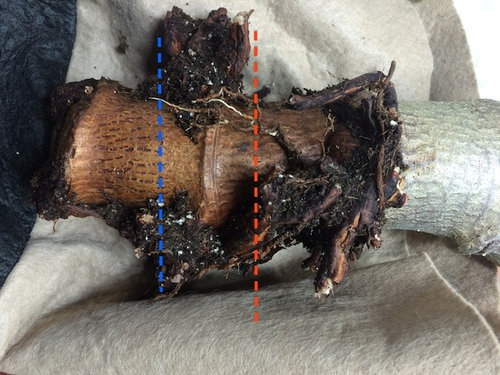
    The stem is segmented. When you cut through a segment, the remaining portion will die back to the next segment line. New roots and branches come from the segment junctions, not from the bottom of the stem.

    Your plant has roots coming from the first and second segment lines. The blue cut will get rid of the bottom segment, but retain the lowest roots. The red line cut will discard the second segment, which will require raising the soil line from the current position or leaving the plant no underground stem to help it stay upright. Removing roots at the second segment line would not be wise since all new roots will come from that level after a red line cut.

    Give it three days to dry in the air, plant in dry soil, and wait for it to grow new roots. No surgery will mean quicker recovery. I don't see any benefit from reducing the underground stem. At most I might make the blue cut since all existing roots are retained at the lowest two segment lines, and at least one segment remains undergound.

    Alternately, you could raise the plant by lowering the current soil line one segment, cutting back all the large roots at the now above ground second segment line and exposing all of the second segment. It makes the base even larger in diameter, and leaves some stem underground for stability. After thinking this through, I think this last option would be my choice.

    Brad

    rooftopbklyn (zone 7a) thanked paracelsus
  • 11 years ago
    last modified: 11 years ago
    Daniel

    I was going to suggest to keep the roots and expose them - it may work? But they needs to be healthy...

    I have used powdered cinnamon on large cuts (just a dusting) number of times, successfully. Glue only on ficus (didn't care for results - I probably didn't use it correctly) and I don't know anything about bonsai cut paste.

    As long as the trunk is healthy (no sign of rot),and needs to be cut, I dust the fresh cut with cinnamon, let it callus well and then pot into a gritty mix. Just as what you are thinking.

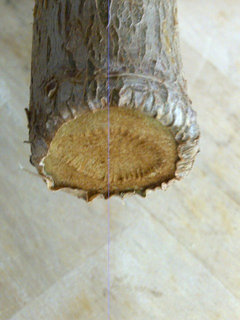
    Here is the dusted and callused jade (smaller than yours, just under 2" dia and about 16" tall) - I left it 'heal' for about 3weeks or so:. This was a branch cut off the low-branching plant.

    Rina

    edited to add:

    Brad posted just as I was typing...

    rooftopbklyn (zone 7a) thanked rina_Ontario,Canada 5a
  • 11 years ago

    All good advice above. I'll add that cut paste is made to hold moisture in. If you cut an above-ground branch and don't want the bark and cambium to dry/pull back, using the paste helps and allows quicker healing of the cut scar. In the case of jades, you want cuts to dry so avoid anything along the lines of cut paste or glue.

    I'm curious why you want to cut away some of the trunk below-ground. I would probably cut at the blue line if I was going to use a shallow bonsai pot, but if using a deeper pot I would probably just leave it as is.

    I love these kinds of projects so hope you post pictures of it's development from time to time. Wish I could be there to get my hands dirty!

    ez

    rooftopbklyn (zone 7a) thanked breathnez
  • 11 years ago

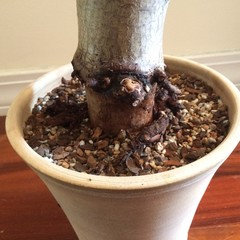
    Thanks to all of you for the thoughtful advice! I'm glad I posted before doing anything, as you have made me realize there is no need to cut off the bottom. I think I wanted to initially because its not very nice - its somewhat shriveled and yucky (looking) especially at the very bottom, however its solid and while maybe partly dead, it is not rotten at all.

    Anyway, didn't cut at all, except to break off a few of the more convincingly dead roots.

    I raised what was the soil level by about 2 inches, and left a majority of the larger (mostly dead) roots there - they do act as a great anchor for this guy, especially in gritty mix where you really need one until the roots take hold. Given how tall it is I expected to need to tie it in, but its quite solid without any staking.

    I'll keep this thread going as things progress.

    I've been experimenting building my own LED fixtures recently, and this guy will spend the winter under a quite bright virtual sun, so as soon as there's some feet under him I expect relatively quick progress. For now he will sit in the spill off from a t5ho fixture lighting a shelf.

    Daniel


  • 11 years ago

    Daniel, I think it would look better if it were potted an inch or two deeper to hide the dark brown part of the trunk. It's not already touching the bottom of the pot is it?

    ez

    rooftopbklyn (zone 7a) thanked breathnez
  • 11 years ago

    ez,

    There is indeed plenty of space in the pot.

    Is your suggestion purely based on aesthetics, or do you think it could also help plant vitality?

    I have started to come around to liking the way it looks, though, really I think I'm just happy to see it in a pot and maybe it would be preferable with the bottom more hidden. I'm hopeful that over time the color will fade to match the rest of the trunk through exposure to sun/light, but, I have no real experience or knowledge to back that up.

    thanks again for all of your thoughts,

    Daniel

  • 11 years ago
    last modified: 11 years ago

    I don't think it is necessary to pot it deeper - unless you dislike the color, but I think over time (could be a while) it will blend in better. It's probably personal preference - darker looks older...As long as the trunk is firm, it should grow well. The scars and bumps could be cleaned off eventually if you don't like them. From the photo you posted, there seems to be enough in the mix (all the way to red line?)

    rooftopbklyn (zone 7a) thanked rina_Ontario,Canada 5a
  • 11 years ago

    Yes, the red line is about where it enters the mix now, and there's still quite a bit of trunk in the pot even though I raised it. I was pleasantly surprised how stable it ended up, with no wiring/staking/etc, given how tall it is. Most everything I move into gritty mix is very unstable for the first month or so until the roots really dig in.

    For now, I think I'll leave it alone and see what happens. Will be back here to share progress as it happens.

  • 11 years ago

    You are quite right ez, maybe a good spot for some nice rocks?

    rooftopbklyn (zone 7a) thanked rina_Ontario,Canada 5a
  • 11 years ago

    Please, keep us posted on it's progress as time goes by

  • 11 years ago

    I will, hellkitchenguy. And Rina, I think that's an excellent idea. Now to find some rocks. I'm almost afraid to even google, as I'm sure I'll end up coveting some rare kind of unobtainably expensive japanese blahblah rock ;)


  • 11 years ago
    last modified: 11 years ago

    Daniel,

    don't google anything! Go to 'wherever' they sell gravel-rocks in bulk in your area, and ask for few different samples! As long as you don't want too much and say that you are happy with what you can find 'discarded' they will let you have few different ones...(personal experience :)

    Rina

    rooftopbklyn (zone 7a) thanked rina_Ontario,Canada 5a
  • 11 years ago

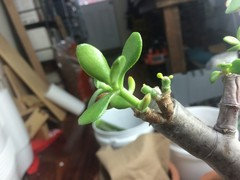
    I still need to find some rocks, which I'll work on soon, but wanted to share the start of recovery with all of you. Was really hard to get a well focused pic of new growth but it's starting to happen in a bunch of places, this was the best I could do with my phone camera.

    I think I'll water today.

  • 11 years ago

    In my experience with repotting, it's such a mixture of joy and relief when that new growth starts! Thanks for sharing, and I hope you managed to avoid buying expensive blahblah rocks:-]

    ez

    rooftopbklyn (zone 7a) thanked breathnez
  • 11 years ago

    Indeed I did spend a bit too long looking at suiseki (mainly out of interest, not with intention to purchase) and thankfully they aren't meant for this application :)

    I do still need to go rock shopping around town, I think there's at least an aquarium store or two not too far and some places that sell all manner of marble and granite who might have something. My local big boxes don't have anything that is appealing.


  • 11 years ago
    last modified: 11 years ago

    Based on your screen name this probably isn't an issue for you, but a friend of mine with squirrels that loved to dig in his pots started using lava stones as top dressing. No more squirrel digging after that. So if animals love to dig in your pots, maybe lava stones.

    ez

    rooftopbklyn (zone 7a) thanked breathnez
Sponsored
Haus Studio
Average rating: 4.8 out of 5 stars28 Reviews
Franklin County's Preferred Custom Cabinetry & Design Studio