Software
Houzz Logo Print
kdrago

Need help with garden map/layout

Hi everyone!

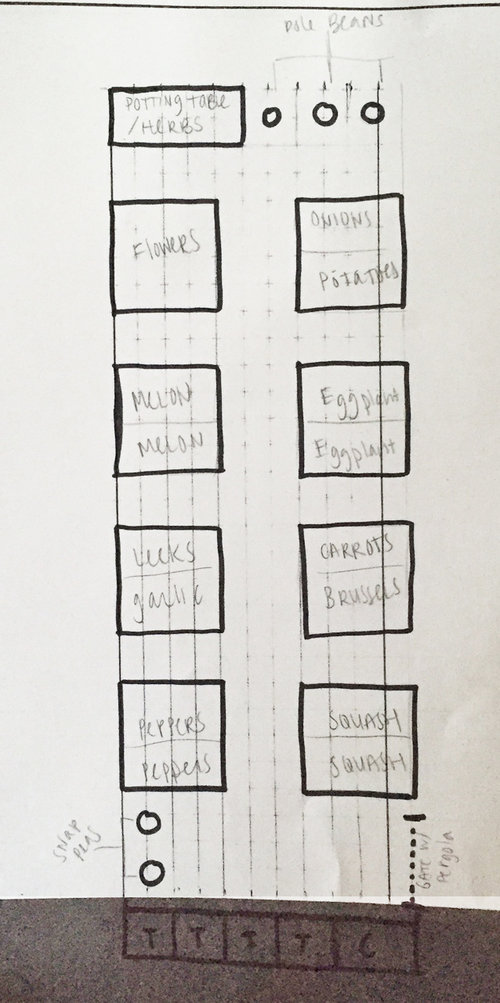
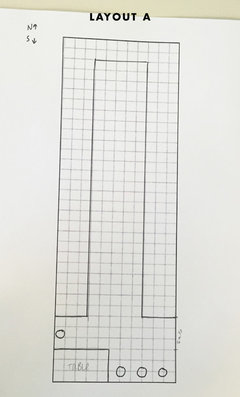
My husband and I are building a new vegetable garden this year and I need some help deciding where to plant what. The overall space is about 11 ft x 33 ft. You'll see in my drawing I chose to split it up into 8 main 4x4' boxes, and on the south side of the garden (in the black space at the bottom of the picture - sorry it's hard to see!) there are four 2x2' boxes (i plan to put these on wheels so i can wheel them around the garden to face the sun more if they need it) and one 2x3' wheeled box (was planning to make an attempt at trellising some cucumbers in that one to make use of some vertical space). the little circles are just extra planters I thought I could do smaller tomato varieties or pole beans/snap peas in. The rectangle at the top left is a potting table where I could also place some potted herbs to grow.


While I do have experience with vegetable gardening this is my first attempt at doing such a large garden - and I am so excited and overwhelmed by all the possibilities! Any suggestions on different pairings for the larger 4x4' boxes, or a different arrangement? I've never done the square foot gardening method before but have been taking out books from the library and reading up on it and may try my hand at that this year if you have any thoughts on that.


North is at the top-left of the picture, South is to the bottom-right. I have read that tomatoes may do better on the North side of the garden as they made shade out plants next to them - but the area on my map where the potting table + first two 4x4' beds are get about 1-2 hours of shade starting around 10am, so I thought the tomatoes might do better on the other end of the garden where I know there will be full, direct sunlight all day. I also left 5 feet of space between the tomatoes and the 4x4' beds, hoping that would be enough space in case the tomatoes grow tall...

Would love any and all input, suggestions, and advice! Thank you all so much.

Comments (18)

  • 10 years ago

    If you haven't already started construction on the beds, you may want to rethink their size. In my opinion, longer beds are better from both a practical standpoint as well as an economical one. Sizes such as 4'x8', 4'x10', 4'x12', whatever. First, longer beds are more versatile. You can plant more in them and you are using (read that as wasting) less space on pathways. Second, it will take less lumber to build one 4'x8' bed than it does to build two 4'x4's. But, bed size and garden design are all up to the individual doing the gardening. Meaning you are free to completely disregard my opinion if you want. :)


    As to the actual layout and what you've got where, I'd rather not comment. I do, however, very loosely follow the square foot plant spacings. Some things are fine at the spacings Mel (the guy who wrote the book on square foot gardening) suggests. Although they'll always do better with a bit more room. Other things like tomatoes, melons, and squash I would never even attempt to plant as close together as he does.

    Rodney

  • 10 years ago

    Agree the size of the boxes 4x4 could end up being very restrictive when it comes to planting. 1 squash plant in a 4x4 bed. Plus that is an awfully lot of wasted growing space in between those beds. Based on your picture I'd go at least 4x8 and probably 4x12 like Rodney. Your planting flexibility would increase 10 fold.

    Dave

  • 10 years ago
    Thank you both so much Rodney and Dave! One thing I forgot to mention is that this 11x33' are is literally all the space I have to work with right now - so the pathways you see in that picture are the only pathways - there is a fence directly around this space. (So I can't walk around the exterior edge of the garden area) I do like the idea of increasing the amount of actual gardening space but I would like to keep a 3' path for my wheel barrow to move through - so if I did long rectangular gardens, say, 4x8' - up against the left side of the fenced in area, I would then have my 3' path on the right side of the garden, but I would still be utilizing the same amount of physical garden space ( eight 4x4 beds vs four 4x8 beds). Are there any other pros to converting to that shape other than saving on cost of building the bed? Thank you!!
  • 10 years ago

    I, too, would recommend making the beds longer, if you haven't already committed. In addition to the other reasons stated, every bed/ground edge is an edge that adds to your weeding difficulty. For this reason, I no longer do beds with sides at all, but I do agree that they're very pretty. Someday when I have more weeding time, I might do a raised-beds-with-sides garden again.

    My first thought is just to have two long narrow beds replacing your eight square beds, but that assumes that you won't run out of patience walking around them. :) So maybe four instead of your eight, allowing you to reclaim two paths? (Or you could plop a stepstone in the center of the bed. I did that once.)

    I'm also puzzled about the wheels. That suggests that your boxes have bottoms, and I don't think that's a good idea--unless you're paved or have toxic soil down there, you're better off having contact with the ground, so that the roots dive down and so that you have a bigger mass of damp soil to reduce the frequency of required watering.

  • 10 years ago

    Oh. Fence. Hmm.


    My view is that minimizing edges is always good, though of course it has to be balanced around ease of reaching into the bed to work it. Edges are a pain to weed both inside and outside.


    Two 4X4 beds have 24 feet of exterior edge (when you subtract the fence) and 32 feet of interior edge.


    One 4X8 bed has 20 feet of exterior edge (again, when you subtract the fence) and 24 feet of interior edge.


    Of course, then you have to weed the fence that you just freed up, but now that that fence isn't growing plants, you can attack it ruthlessly with a weed whacker, or dump gravel on the ground, or lay landscape fabric. (I choose to ignore the existence of herbicides.)


    And bigger beds give you more flexibility in plant arrangements. If you want to grow something that demands a three foot spacing, you have a "spare" foot if you plant one in one short bed, but a spare two feet if you plant two in one long bed. It makes no difference if you're filling in with plants that want a one-foot spacing or less, but a big difference if you want one with a two-foot spacing.


  • 10 years ago

    "Are there any other pros to converting to that shape other than saving on cost of building the bed?"

    Yes, as mentioned above the BIG pro is the flexibility the bigger beds will give you in planting. 4x4 is really a difficult to use space simply because of the size of many plants. It is difficult to explain if you haven't ever experienced it but it is just an inefficient size when it comes to the size of many plants.

    Dave

  • 10 years ago

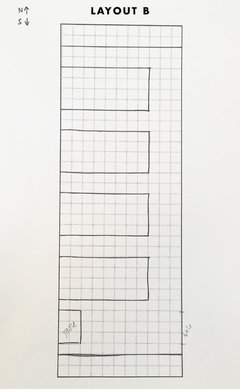
    thank you! so i could potentially do one of these two revised layouts which would take advantage of of the extra unused space. i do miss the symmetry of all the tiny boxes but i definitely understand that these would provide more flexibility! what do you think of these options?


    also - in terms of doing larger beds vs smaller beds, would you say there is any detrimental effect in terms of crop rotation or disease striking one crop? for example, i had thought smaller boxes might be good for me so that i could easily rotate crops and if disease struck one box, i could easily avoid planting any vegetable there (by moving my ornamental flowers to that box the following season) until the disease living in that box is gone. But if I use a larger bed, does this become more difficult to do? Does disease/pest spread more easily in a larger bed?


    Thank you for all your help!


  • 10 years ago

    Layout A confuses me, because it looks either like the table is in the bed, or like you have a five-foot-wide path between two three-foot-wide beds?

  • 10 years ago
    last modified: 10 years ago

    I have a 4x4 bed, I built as a carrot bed, and it does great for that purpose, and as a small space for easy covering as a hoop house. Lettuce fits nice in it too. But for most things I agree you want some bigger beds.

  • 10 years ago

    M. Wilson - Layout A has a five foot wide path between two three-foot-wide beds. (a U-shaped bed). I don't want to go more 3 feet wide in terms of bed width if they are going to border the fenced in area, as i am fairly small in size and my reach is quite tiny. (I won't be able to access the beds from the other side due to the fence)


    Peter - Thank you!

  • 10 years ago
    last modified: 10 years ago

    What kind of fence is around the area and how tall is it? And does the gate swing in towards the garden or out?

    Rodney

  • 10 years ago
    last modified: 10 years ago

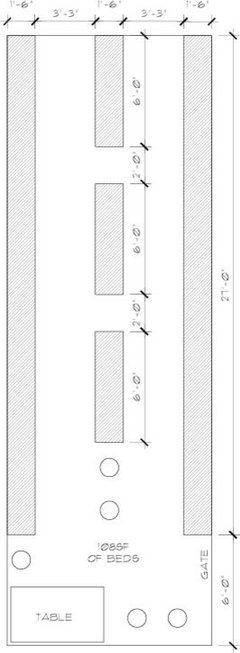
    "A" will give you a quick view of the entire garden. "B" provides a bit more visual interest and depth to the space. Here is another option (below) with 18" beds.

  • 10 years ago

    Looks like a lot of wasted space to me. 1'-6" is a really narrow bed. I usually do it the other way around and wind up climbing through plants, but I am ok with that.

    Why are you using raised beds? I am a fan of planting in the ground myself.

  • 10 years ago

    Plan A has some appeal for me from a landscaper POV - attractive and still leaves some open space for other activities while still gives lots of room for gardening. And as a landscaper I don't like bare fences.

    I like Plotters new suggestion as it has some of the same asthetic appeal. But I do not care for only 18" beds from an efficiency POV. 24" wide I could deal with but not 18" (and yes I have 1 bed that is 40'+ by 18" wide and it only works for certain trellised crops without problems.

    So I guess I'd vote for Plan B but with one modification. Eliminate the North end horizontal bed and move each of the others north by 1' so you have a 3' path between each. Many plants will hang over the sides of the beds using up your 2' space and 3' makes it much easier to get a wheelbarrow and mower in there for routine maintaining.

    And I'm also going to suggest that, given the time of the season and the fact these aren't even built yet, you get started on building at least 1 part of which ever plan you choose. You do not have to construct all of the yard at one time. Not only will it overwhelm you but you won't have time to plant much this year. So if you go with A get started on the west side. If you pick B get the one nearest the table underway now and the others can come later.

    Dave

  • 10 years ago

    18 inches really is tiny and will severely restrict the amount and type of vegetables you can grow. I agree that there seems to be an awful lot of wasted space which could be productive for you.

  • 10 years ago

    so far all the proposed designs seem to waste a lot space for paths.

    the path should be at least 2ft or more for heavy traffic places (such as tillers and wheel barrels) and no less then 18 in where you would need kneel to weed.

    All the plans seem be very inefficient on planned plantings as well.


  • 10 years ago

    I agree it is a big project to attempt all at once. Can be overwhelming and costly. To avoid that, get less caught up on a set design and allow for adjustments. Get two back beds in asap so you can get some early crops it and see how they do. Think about going vertical allowing for some climbing starting in the back 40. Even in the middle make some room for a couple chairs so you can enjoy and harvest and plan. Once your first area is planted...salads, squash garlic onions leeks kales etc then plan phase 2 then 3. Break up the workload so you will have crops coming up.

    Here is a pic i just ran across...http://thegardeninspirations.biz/vegetable-garden-design-layout/narrow garden

    A narrow path will quickly fill in. If your aggressive growers are near the back of your space it is less of a problem....do a google image search for 'landscaped vegetable gardens' or 'edible gardens'.

    katemartha (z5/6 nj) thanked sleevendog (5a NY 6aNYC NL CA)
Sponsored
AIS Renovations
Average rating: 4.5 out of 5 stars15 Reviews
Custom Craftsmanship & Construction Solutions in Franklin County, Ohio