Software
Houzz Logo Print
pdoody1

Smoke detector wired to light switch

10 years ago

I recently replaced two old hardwired smoke detectors in our downstairs rooms with hardwired Nest detectors. As soon as they were hooked up, I started getting a steady stream of "power outage" alerts on my Nest app. Turns out whoever wired the alarms in originally had connected them to the light switches in their rooms; every time the switch is turned off, the detectors aren't getting any power (although they do have backup batteries).
Our house is older (i.e., pre-1910), but has gone through quite a bit of renovation. In particular, the downstairs underwent a significant renovation back in 2003, 11 years before we bought it. I've contacted the previous owner to see what he can tell me about the people who handled that project, b/c I assume they're the ones that wired things up wrong. I tracked down the contractor, and he says he didn't do it, and that he remembers installing battery-only alarms. This seems like a load of CYA, b/c 1) the hardwired alarms I took out were dated 2003 and 2) it's a little odd to immediately remember that you installed battery-powered alarms in a house you worked on 13 years ago.

I've brought in an electrician to advise us on how to handle this, and he's offered up a $700 option with visible wires running along the ceiling walls and a $1,200 option with the wires hidden. We briefly discussed simply capping the wires and installing a battery-powered alarm, but my understanding is that this wouldn't be code-compliant since the downstairs was renovated within the past 20 years.

So, with that long and rambling introduction out of the way, does anyone have any suggestions on how I can handle this, and whether I have recourse against the contractor who (common sense would dictate) was responsible for wiring things up wrong? Does it constitute a code violation to put hardwired detectors on a light switch?

Thanks for any and all information.

Comments (13)

  • 10 years ago

    Battery operated alarms are allowed,in CA, if the battery has a 10 year life.

  • 10 years ago

    If it's wired to the light switch, can't you just connect it to the other terminal on the switch, which is always powered? Or was it wired to the light itself?

    Patrick thanked mtvhike
  • 10 years ago

    "whether I have recourse against the contractor"

    No

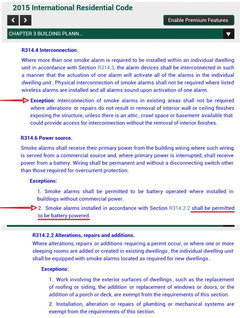
    "Does it constitute a code violation to put hardwired detectors on a light switch?"

    Only in new construction, yet it does not gain any advantage over a battery powered smoke detector if the power is off most of the time.

    http://premiumaccess.iccsafe.org/document/code/272/4596652

    Patrick thanked User
  • 10 years ago

    If you're lucky, you may have an "always" hot wire there and the a switch loop out to the switch, but I suspect an electrician would have checked for that.


    Patrick thanked Ron Natalie
  • 10 years ago

    You would not be remodeling (not opening up walls), and not subject to the code enforcement. You would be able to use the battery powered. Also depends how it was wired as Ron notes, it may be possible to just reconfigure the connections to make it live all the time, but unlikely.

    Patrick thanked Vith
  • 10 years ago

    Thanks to everyone for the responses.

    Re the possibility of using the other switch on the terminal, I'll have to check with the electrician, but since they didn't mention that among the various possibilities on their initial visit I worry that's not an option.

    Re the code issue, the section cited above is from the international residential code. Is there a possibility that San Francisco has a more stringent standard? If wiring isn't required, I wonder about why they put it in during the remodel. I obviously love the idea of just putting in battery-powered detectors and being done with it.


    Also, apropos of nothing, I contacted the contractor who did the work in 2003, and he immediately responded by saying he remembers putting in battery-powered only detectors, so the wiring must have been done after he did his work. He's almost certainly lying b/c 1) the installed detectors were stamped with a mid-2003 date, 2) no significant work was done on the downstairs after that date, and 3) seems fishy to immediately remember that kind of detail about a project you did 13 years ago. I realize it's unlikely anything would come of following up on work done that far in the past, but annoying to see how quickly he went for the disingenuous CYA.

  • 10 years ago

    Regarding battery operated, they are not compliant in newer homes or homes that have been remoldeled.

  • 10 years ago

    @Jim Mat, you obviously have not read the exceptions in the codes, and the codes were even more lenient 13 years ago.

    Patrick thanked User
  • 10 years ago

    Thanks for posting that section, Fred! I've been having trouble finding the right section in the codes, most of the things I've come across have been from secondary sources writing about the codes. Always loses some detail in the translation.

    I think exception 3 should apply to my situation, but with a twist (there's always a twist). I looked through the permit documents the city has available online, and it looks like there were two separate permits for downstairs work.

    The first permit related to the portion of the downstairs where the alarms are actually located, and was described as "Remodel existing space behind garage, no enlarge of existing habitable space." I'm assuming if walls had been removed, that would have been indicated in the description (no idea if that's a safe assumption or not).

    The second permit was a issued a year later, and relates to the other end of the downstairs area, i.e., away from the alarms. That permit was described as "Remove bearing wall next to stair on ground floor."

    So there was a wall taken out downstairs at some point. Did removing that wall negate the code exception for the entire downstairs, such that removal triggered the need to install wired alarms throughout the downstairs area? Such an outcome would seem pretty draconian, since it would require a significant tear down of areas that are nowhere near the permitted work area.

    I'm really impressed by the responses on here as a whole. My wife and I had used Houzz in the past primarily to get ideas for decorating/remodeling, had no idea there was such a great user community.

  • 10 years ago

    Did removing that wall negate the code exception for the entire downstairs, such that removal triggered the need to install wired alarms throughout the downstairs area?

    No. the detector wiring could not be a accessed without the removal of interior finishes. This can probably be a judgement call sometimes by the inspector. Since it passed inspection, I can guess that the inspector could not see a way to get the proper wiring to the detectors without removing drywall.