Software
Houzz Logo Print
dissonance7

Bare wire is hot

9 years ago

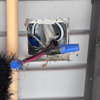
Hello! My house was built in 1908, but I think the wiring was redone in the 1960s or 70s. Most of the house is wired with black, white, bare wires.

As part of a bathroom remodel, I'm replacing the wall heater. It's 220 volts. When I turn off the circuit breaker, the bare wire remains hot. My little cheap meter is telling me this bare wire is 110 volts. There's a different circuit breaker that shuts off the power to the bare wire.

Would someone please advise me about how to proceed? I've done a bit of wiring in the process of remodeling my house over the last few years, but everything was always as it is supposed to be. I'm wondering if I should have an electrician.

Comments (14)

  • 9 years ago

    What are you using as a reference voltage (ground)? If you are using an electronic meter, start out by teasing the wires with a test lamp.

  • 9 years ago

    A bare wire should never be hot, nor should it ever be used as a neutral. If the bare was properly connected to ground, the circuit breaker would trip and not reset. I'd start by checking that second circuit, tracing the connections on that bare, until I found where it becomes energized and why it doesn't go to ground.

    If the wiring, or later modifications, looks like someone's DIY project, you should get a qualified electrician to check out everything.

    Paul Lombardi thanked randy427
  • 9 years ago

    ionized-

    If you tease the wires they might get mad at you. The response could be shocking...

  • 9 years ago

    With circuit breaker 21 on, black/ground give 110 volts.

    With circuit breaker 23 on, none of the wires give a
    signal.

    With circuit breakers 21 and 23 on, black/white give 220
    volts, black/ground give 110 volts, and white/ground give 110 volts.

    I'll see if I can trace the wire back to the breaker box. It's only one room over.

  • 9 years ago

    It looks like it's a poor-man's 220. Black is connected to one breaker and white is connected to another. My new heater automatically switches between 110 and 220. I'm going to put the heater on a dedicated 110 breaker so I don't have to run 220 romex. If there's anything else in the house on the line, I'll put it on the other breaker.

  • 9 years ago

    Vith, this is really good information--thanks! The heater pulls 6.7 amps at 240 volts and 8.3 amps at 120 volts, so the 14 gauge wire that's there should be sufficient. I verified that nothing else in the house is on the same breaker. I'm going to install a double pole breaker tomorrow. This has been a good learning experience for me.

    To get the 120 volts, I would just need to move the white wire to where all the other white wires go in the breaker box.

    I get everything you say except I want to verify one thing. If I were to reverse the black and white wires on the separate breakers, would get twice the voltage? (I'm not going to, just trying to understand.)

  • 9 years ago

    Paul-

    I'm confused about your situation after reading everything through. I'm not an electrician, but I have done my share of electrical wiring. In your first post you talk about white, black, and bare wires, and a bare wire that is hot. But further on in the discussion, I see you talking about white wires, and you make no more mention of an energized and/or bare wire.

    At the risk of getting too basic here, proper wiring in a house requires blacks (and reds) to be connected only to the breakers, whites only to the neutral bar, and bares only to the grounding bar. If a white is color-coded black at both ends (usually with a tape wrap), it can go to a breaker. You ask about moving "the white wire to where all the other white wires go in the breaker box," which presumably is the neutral bar. I presume you know that each of these wires must have its own set screw, and you can't put two wires under one set screw.

    However, my major concern is that you have some unconventional, non-code compliant wiring that has been done by someone previously, and I am not clear from this discussion if your changes will rectify this. I am particularly bothered by your saying there is an energized bare wire, as randy427 warned about in his response early on. I have also found that when one discovers a problem like this, it is often not in isolation. DIY folks who make mistakes like the one you discovered often don't make just one, including splitting wires from cables and running them to separate circuits in ways that are inadvisable if not downright dangerous.

    For piece of mind, and your safety, it would be prudent to have an electrician check everything out. Otherwise, you could end up using the advice here to make things appear to function properly, but still have potentially dangerous code violations.

  • 9 years ago

    Phil,


    It looks like it's a poor-man's 220. Black is connected to one breaker and white is connected to another.

    I'm confused by that statement. What you describe would be the correct way to wire a 240v circuit assuming you're house is wired with some kind of cable (e.g., NM-B). A 240v circuit does not require a neutral wire. In your case, the white wire should have been re-identified with a black marker. The correct voltage readings would be 120v between either of the "hot" legs (in your case, black and white) and ground and 240v between the two hot legs.

    You're description of what's happening seems off when you troubleshoot the circuit. With one breaker on, you're not getting a "signal" but with both breakers on, you're getting 240v between the two hot legs. That sure doesn't sound right. What tool are you using to test?

    While you could rewire the circuit for 120v, you're going to reduce the output of the heater by half (I think it's half but I'm working on 2/3 of a cup of coffee). You won't save any money, if that's what you're thinking.

    As someone else suggested, it might be a good idea to bring in a licensed electrician.

  • 9 years ago

    Reversing the wires on the breakers would probably give you the same thing you currently have. I am thinking the breakers are right beside each other similar to a double pole breaker. This is how you get two separate 110v to become 220v. In the panel there are four main wires coming in. Two hots, neutral, and ground. Your panel supplies each side of the AC hot to different breaker slots. This pic I found shows how it works. The blue side is one wire, the black side the other.

  • PRO
    9 years ago

    To begin you said that at 120 volts the amperage load is 8.3 amps and at 240 volt the amperage drops to 6.7 amps? Ok now if that is the case than (wattage/voltage=amperage). Something is not adding up here as you can reverse the amperage formula with the different voltages to learn the actual wattage of the heater. (voltage X amperage=wattage) 120 X 8.3 = 996 watts or 240 X 6.7 =1608 watts. Usually by raising the voltage the amperage drops. Look at the spec sheet that came with the heater and see what the wattage rating really is? As for the substandard wiring I would recommend to replace with with new wiring and a double pole 240 volt breaker rated to the wattage load. Tinkerbell wiring will always be just that and unsafe.

  • 9 years ago

    mike_kaiser_gw, I was quoting someone else, and I now see that that statement is wrong.

    D B Electric, the volts and amps I gave are from the wall heater's manual. The watts you give nearly match what's in the manual too, but is just rounded to 1000 and 1600 watts.

    I had an electrician in my house today for an unrelated matter, and I had him look at this. Everything he said agrees with Vith. We put in a 15 amp double pole breaker.


  • 9 years ago

    Glad you had a pro look at this. Did he notice anything else that was not ok?

  • 9 years ago

    Everything else was fine.