Software
Houzz Logo Print
jared_delawder

Moving the gas line over a couple inches

9 years ago
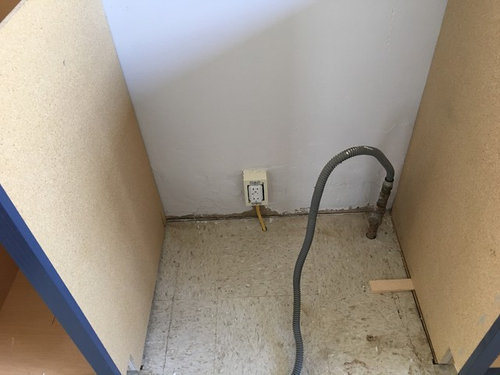
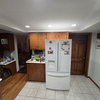
my kitchen remodel is in full swing however I ran into a problem with the gas line behind the stove. The slide in stove I purchased back in November will not slide in due to the placement of the gas line coming up out of the floor. The gas line is 2.5 inches from the cabinet on the right and a little over 3 inches from the back wall. If the gas line was back against the wall and over the to the left a couple more inches it would fit perfectly because there is a notched out space behind the new stove. The stove hasn't been delivered yet so I am unable to provide a picture of the backside however attached is a picture of the gas line placement in my kitchen. Is this something that I could tackle myself or does a plumber need to come out?


Additional information:

-the stove that was in there before stuck out very far (4+ inches) due to this exact issue.

-there is a crawlspace under the kitchen however it is very little clearance under there. I am not even sure if i would have enough room to work on the gas line from the crawlspace.


Comments (17)

  • 9 years ago

    You HAVE to have a plumber for this.

  • 9 years ago

    Yeah, what E-H HP said.

    BUT--the plumber could go in from the top. Just cut out a section of the kitchen floor and patch it when he's done. That's really easy. And if you use an oscillating saw you could drop the original section of floor right back in with a minimal seam. Plus it's going to be under the stove forever.

  • PRO
    9 years ago

    In my book, this comes under the category of "if you have to ask the question, then the answer is hire a pro."

    If I was working by myself, I would hire out that task. I know a semi-retired plumber who would do it for well under a hundred bucks and save me the effort and the swearing.

  • 9 years ago
    Absolutely a plumber must do this and then repressurize the line. Gas is dangerous in the hands of an amateur, no matter how talented.
  • 9 years ago
    A utility company hit a gas line in a residential backyard in my community about 15 years ago. Luckily, a worker was able to warn the residents to run for it moments before the house blew to smithereens. The explosion was heard miles away and bounced cars traveling on a nearby freeway. Don't mess with gas lines, period.
  • 9 years ago

    You'll need an electrician as well to move that questionable outlet. All specs for everything are online these days. Pull them up, and print them out. Then use a paint pen to indicate the needed utility locations required by the appliance.

    Then call a plumber with a gas endorsement, and an electrician. One for one day, another for another day. Pay them the money and then you can finish the floors and cabinets. You should never have either unfinished next to a range, and the finished flora height impacts the range. It all has to be planned properly.

  • PRO
    9 years ago

    You need a gas fitter not just any plumber but yes not a difficult thing to do by a pro

  • PRO
    9 years ago

    " Is this something that I could tackle myself or does a plumber need to come out?"


    This depends on your mechanical ability and tool selection. Gas line work must be done correctly; the stakes are potentially catastrophically high. If you tackle this yourself, after you've made the alterations, turn the gas back on and mix a little Dawn dish soap in a cup and whip it to bubbles. Scoop the bubbles over every joint you've made. If the bubbles lie still over the new joints, the joints aren't leaking.


    I was in an attic once when an HVAC man tested the gas line with a lighter. Sure enough, it was leaking. He prohibited his guys from doing this, but didn't apply the rule to himself. I'd never do this; it is not recommended.


    Natural gas has no smell; the gas company puts the stink in for safety's sake.


    Your electrical box has exposed Romex, a code violation. You can disassemble it and cover the Romex with armored cable or run the Romex inside the wall when you relocate the box.

  • 9 years ago
    last modified: 9 years ago

    "Your electrical box has exposed Romex, a code violation. You can disassemble it and cover the Romex with armored cable or run the Romex inside the wall when you relocate the box."--

    Exposed Romex is not a code violation by itself. The installation as pictured used to be acceptable because the gas pipe keeps the range from being pushed back. Therefore, the NM cable was not subject to physical damage. The range also makes that space not exactly "exposed", but concealed work where "passing through the floor" is not required to be protected... At any rate, flexible metal conduit (what was mistakenly called armored cable earlier) is NOT an approved conduit for protecting Romex in 334.15(B). (Armored cable is cable. Cable already has wire inside. Conduit does not)

    ARTICLE 334 – NONMETTALIC-SHEATHED CABLE; TYPES NM, NMC AND NMS

    II. Installation

    334.10 Uses Permitted. Type NM, Type NMC, and Type NMS cables shall be permitted to be used in the following:

    (1) One- and two-family dwellings.

    (2) Multifamily dwellings permitted to be of Types III, IV, and V construction

    (A) Type NM. Type NM cable shall be permitted as follows:

    (1) For both exposed and concealed work in normally dry locations.

    .

    334.15 Exposed Work.

    In exposed work, except as provided in 300.11(A), cable shall be installed as specified in 334.15(A) through (C).

    (A) To Follow Surface. Cable shall closely follow the surface of the building finish or of running boards.

    (B) Protection from Physical Damage. Cable shall be protected from physical damage where necessary by rigid metal conduit, intermediate metal conduit, electrical metallic tubing, Schedule 80 PVC conduit, or other approved means.

    Where passing through a floor, the cable shall be enclosed in rigid metal conduit, intermediate metal conduit, electrical metallic tubing, Schedule 80 PVC conduit, or other approved means extending at least 150 mm (6 in.) above the floor.

    .

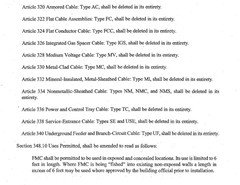
    Article 320 Armored Cable

    320.12 Uses Not Permitted.

    Type AC cable shall not be used in the following locations:

    (1) If subject to physical damage.

    .

    Article 348 Flexible Metal Conduit

    348.12 Uses Not Permitted.

    FMC shall not be used in the following locations:

    (7) If subject to physical damage.

    .

  • PRO
    9 years ago

    Fred:

    I appreciate your technically accurate response, but I'm more of a real world guy. You probably know more than the inspector. From my experience, he's not going to want to see exposed Romex. For $1.50 and fifteen minutes, I could make him happy. It's moot anyway, because the box is probably getting relocated with the Romex unexposed.

  • 9 years ago
    last modified: 9 years ago

    As someone that has had an electrical licence for over 25 years, my experience tells me that any inspector that thinks AC cable or Flexible Metal Conduit is any better than Romex should be fired immediately. I can, and usually do, break either with my bare hands. There is no way a real inspector would favor them over Romex in this situation, and neither does the NEC. None of them are allowed in exposed work where subject to physical damage. So, the inspector must not think that cables concealed by the range are considered exposed to physical damage, or they would not have allowed AC or FMC either.

  • PRO
    9 years ago

    It isn't just the inspector's professional opinion of the material that matters, the policies of his authority regulate what is permissible. Romex is not allowed here, end of discussion.

    Obviously there's politics, union rules and history involved in that subject as you only have to travel 10 miles west to cross the border into Romex land.


  • 9 years ago
    last modified: 9 years ago

    "Romex is not allowed here, " - Neither is Armored Cable, or many other wiring methods accepted by the rest of the country, and FMC is very limited in its use. Illinois is an extreme exception to the rule.

  • 9 years ago

    Is the wall a concrete block wall? Maybe that is why the electrical and gas lines are coming up from the floor.

  • 6 years ago

    I have a similar issue. The only difference is the gas line, Not the stub, prevents my range to be flush against the wall as well. Couldn’t I just cut the drywall to tuck the line behind the drywall Without disconnecting or messing with the gas pipe?

  • PRO
    6 years ago
    last modified: 6 years ago

    Sure, but that seems kinda hillbilly. Something's off somewhere.