Software
Houzz Logo Print
dennisgli

Tieing neutrals together

9 years ago
last modified: 9 years ago

I have a question about an electrical installation where I work.

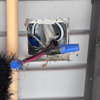
This job has two separate 120volt feeds coming into a custom distribution panel. The panel has two buses with six breakers on each. While there are two hot and two ground bus bars that are separate the neutral bars come tied together from the factory. The electrician on the project (and I) thought that the neutral bars needed to be separated but the electrical engineer on the project says that we can leave them tied together.

Any of the "pro's" here have any comments?

Comments (10)

  • 9 years ago
    last modified: 9 years ago

    ISTM they should be separated. If one neutral feed became disconnected, and both hots were from the same leg/phase, the remaining neutral feed could be overloaded. I'd expect the ground bus bars to be bonded together, though.

  • 9 years ago

    I'm confused by "two separate 120v feeds". Are you saying there are 2 circuits (hot and neutral per circuit) feeding this panel? Where are these feeds coming from? Or is this just a single phase panel (main or sub) being fed by two 120v legs? Could you clarify please?

  • 9 years ago

    Yes, the two separate circuits each have a hot, neutral and ground, And they come from two 7.2KVA inverters.


    So the two hots are independent. But of course the neutrals and grounds are all tied together at some point.


  • 9 years ago

    Like randy427 said, I'd separate the neutrals, for the reason he stated.

  • 9 years ago

    It matters not if the neutral and grounds are connected together "somewhere" (indeed they are), but the code FORBIDS you connecting neutrals from different circuits together. There are a whole slew of reasons for this. In addition to the quite likely possibility of overloading one of the conductors (as previously mentioned), if there are AFCI or GFCIs involved, it's not likely to work anyhow.

    It matters not if they are from "different legs" or not. If they are from different branch circuits, you are REQUIRED to keep the current carrying conductors (hots and neutrals) separate from any other branch circuit.


  • 9 years ago
    last modified: 9 years ago

    I would question the logic of trying to tie two separate systems together in the first place. Each system should have its own distribution panel. I doubt that this distribution panel came "from the factory", "LISTED" for this application.

    It sounds like someone should have specified one 120/240 15Kva inverter instead of two separate inverters, or two panels instead of one. What if some fool decides to try and add a double pole breaker??? Or is that why someone is trying to put them in the same panel? If not, then why, or just trying to be cheap? Your question should never need to be asked in the first place.

  • 9 years ago

    Thanks all. The first response was helpful. I think the electrician has already wired things up with the neutrals tied together. But I've asked to have our in-house electrical engineer review the installation. Unfortunately he was out last week - I'll post his response when I hear back.

    The maker of the panel (GE) specified it and their engineer did the design. There are two, redundant power plants and that is why there are two inverters.

    A lot of the comments here have added "facts" to justify their opinions - not really helpful. I didn't say anything about "branch circuits" - or GFCIs - or "double pole breakers" - not that I understand why a GFCI breaker or a double pole breaker would cause a problem.


  • PRO
    9 years ago

    Inverter Electrical Power

    (Yes, the two separate circuits each have a hot, neutral and ground, And they come from two 7.2KVA inverters)

    OK what type of inverter? Either modified or pure sine wave inverter? Is the voltage is 120 volt single phase per inverter and can it be stackable for 3 phase or single phase operation like 2 inverters for 120 240 volt? Is the inverter type split phase on the neutral for stacking in either single phase or 3 phase?

    The way I under stand your issue is to do some research on split phase inverters. A UK company called Victron Energy has pure sinewave split phase inverters that are so fast that clock or computer resets are not necessary from various voltage sources like grid, alternative or generator energy sources on the switching from one source to another. This all is accomplished thru ATS (automatic transfer switch) which is no more than a contractor normally open or closed to the situation required.

    When adding AC neutrals from various voltage sources into either grid tied or off grid electrical distribution, electrical engineering maybe required for possible neutrals balance issues to make all items play nicely together.

  • 9 years ago

    As I think I've said - these are two independent, redundant 120volt inverters so I assume all your questions are irrelevant.

    The rest of the post just seems to be cut and paste from some literature so I assume this was just marketing spam. But I did find the "electrical engineering maybe required" comment ironic!