Software
Houzz Logo Print
tiffany_sailler

Help with wires

9 years ago
last modified: 9 years ago
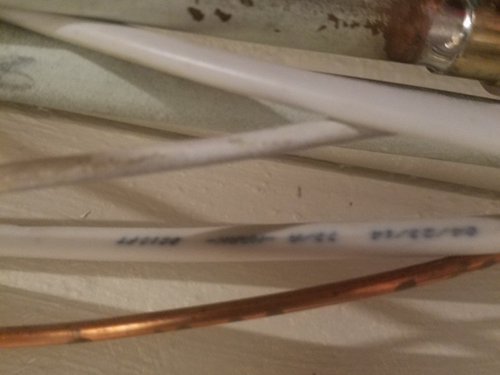
Hello. This might be a dumb question, but I bought my first house and I am trying to make sense of all these hoses/wires/items in my utility room.

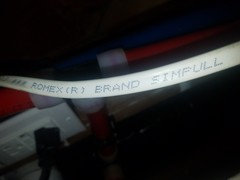
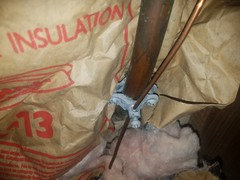
I think the three white wires are electrical wires. What is that small copper wire thing?

I have read that copper should not touch copper and there is an area where this wire runs along a section of copper plumbing I have. Should I tape one of them so they are not touching? Thank you for your advice.

Comments (8)

  • 9 years ago

    It's a little difficult to tell from the picture but it looks like the white wires are what are called non-metallic cable (type NM-B). It's often referred to as "Romex" after a popular brand of the product (much like facial tissues are called Kleenex). A cable is a group of wires inside of a common jacket, in this case the jacket is made of a tough plastic that doesn't conduct electricity. One or more the the wires could also be white coaxial cable (COAX) that's used to carry the signal to televisions. If you want more details about the cables, then try to take clear pictures of the writing on the cables.

    The copper could be a solid ground wire. If that is the case it should start at your electrical service panel and be connected a copper water pipe somewhere near where water pipes enter the home with a clamp. It could also be small diameter copper tubing (pipe) that's used to provide water to household appliances like refrigerators and humidifiers. Again, you'll have to follow the pipe to see where it goes.

    Hope this helps and post more pictures if possible.

  • 9 years ago

    There's a bigger copper line there as well. It could be the high/low pressure lines to an outside heat pump/air conditioner.


  • 9 years ago

    Thank you all!! I've attached some more photos. There are two flat wires and sure enough I found the word romex on them. So those are electric?

    The other white wire is completely round with no writing.

    I noticed that the small copper wire did follow the main water line from the street. I looked just now, and sure enough is is clamped to them out front. So this is a grounding wire? What is it's purpose?

    Ron, that bigger copper pipe is a water line going to my washer. I noticed that that copper grounding wire was touching it and wasn't sure if that was ok or not (or even what that little copper wire thing was).


  • 9 years ago

    Wow, the perspective on that close up shot messed me up. I thought that bare copper was way too big to be a wire, but now it's obvious that it is.


    Plumbing System Electrical Ground

  • 9 years ago
    last modified: 9 years ago

    I believe the ground wire should only touch the pipe near the service entrance for bonding purposes. In that case it shouldn't touch the pipe elsewhere. The exception is if you have a meter, you would want a bond clamp at the entrance and one past the meter. The purpose of bonding is to make the potential of the water lines the same or less of the rest of the house in an effort to make stray voltage go back on its own dedicated ground instead of through the water pipe. Hard for me to explain, I might not be 100% right on that but its something along those lines.

  • 9 years ago

    I'm sorry Vith, but I'm afraid everything you've said above is pretty much wrong.

    First, there are two issues GROUNDING and BONDING. A metal water pipe that comes in from underground can serve as part (or perhaps all) of the GROUNDING system. That must be connected to the grounding system within feet of it entering the building.

    All metal piping (with the exception in the later codes of gas piping), is required to be BONDED. The purpose of BONDING is to prevent the pipe from being energized. There's no "single point" stipulation on this and certainly, any pipe that gets separated from where the bond is connected needs it's own bond.

    The comments about things using their own dedicated ground are gibberish. Faults don't care where they find ground. In fact, lowering the potential of the water pipe most likely increases the affinity for current to flow that way.

  • 9 years ago
    last modified: 9 years ago

    Ty for the motivation to look it up and learn (and still be slightly confused :P). I do like the way this article notes there have been entire books on the subject. So it is not simple in any form. I found this to be a good read and a good summary.

    You probably know about most of what im putting below, I am just adding to the discussion, and working to a better understanding of it.

    http://www.ashireporter.org/HomeInspection/Articles/The-Word-Grounding-and-Bonding/1906#WordE3501-01.jpg

    - "In newer homes, the connection to a water pipe grounding electrode may
    not occur more than five feet from where the pipe enters the home."

    - "Bonding jumpers must be installed around interruptions such as plastic
    boxes, water meters and sometimes components such as water softeners and
    filters. Bonding wires must usually be the same size as the grounding
    electrode wire."

    - "How does bonding help clear ground faults? Suppose a rat sits on a
    copper water pipe and chews through insulation on an electrical cable.
    If the pipe is bonded, as it should be, the pipe and the rat become the
    conductive material that returns the electricity to its source. The
    unfortunate rat is fried and the current in the pipe should quickly
    increase past the circuit breaker’s limit. The circuit breaker trips and
    clears the fault. But what if the pipe were not bonded? Well, the rat
    lives to chew another day because without a return path, no current
    flows. The pipe is still energized even when no current flows. That is,
    until someone touches a metal water supply fixture. If the person is
    grounded, the person becomes the conductive material and the return
    path. Current flows and the results may be unfortunate."

    - "Myth two is that electricity takes the path of least resistance back to
    its source. It really takes all available paths. The current carried by
    each path is determined by the resistance in each path. Assume that the
    resistance in an effectively bonded water supply pipe is 0.5 ohms and
    the resistance through a person touching a metal water supply fixture
    connected to the pipe is 10 ohms. The current in the bonded water supply
    pipe is 120/0.5=240 amps and the current through the person is
    120/10=12 amps. The person will certainly get lit up, but only for a
    fraction of a second because the current flowing through the bonded path
    will quickly trip the circuit breaker."

Sponsored
Buckeye Basements, Inc.
Average rating: 5 out of 5 stars40 Reviews
Central Ohio's Basement Finishing ExpertsBest Of Houzz '13-'21