Software
Houzz Logo Print
schreibdave

No ground wire

9 years ago

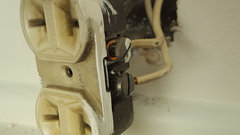
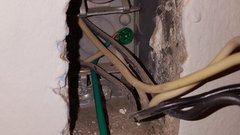
1950s construction. Metalic box and metalic sheath on cable going back to panel. I want to replace old outlets with new ones but there is no grounding wire. Can i just connect my hot and neutral? Or do i need to also go from green screw to box with a clip and piece of wire?

Comments (16)

  • 9 years ago

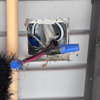
    dunno why picture came out so funny

  • 9 years ago

    Check if your box is grounded. If so, look for an unused screw hole, attach the ground to the screw hole, then attach the wire to the receptacle.

  • 9 years ago

    Is that the only way to ground the ground prong on the receptacle? So theres no path from that ground prong to the box through the screws holding the receptacle in? Thanks

  • 9 years ago

    There are self grounding receptacles. Your box must be grounded.

  • 9 years ago

    thanks at HD now.

  • 9 years ago

    The stinger is useless if the box is not grounded. IF it is not grounded, and your concern is safety/code compliance, then you have a few options ...

    -Run a new wire w/ ground to the box.

    -Back in the day when only a hot and neutral were run in the cable, metal boxes were linked together with a grounding wire. You could fish a green thhn wire to the box from a known grounded box ... not preferable, but at least then you'd have ground in that box.

    -Install a gfi receptacle in the box. This is the workaround for ungrounded boxes.

  • 9 years ago

    The boxes are groinded. And with my tester it shows a complete circuit when i go from hot to the box. And with the receptacle screwed to the box the tester shows a circuit between hot and the groumd prong. That being the case am I good?

  • 9 years ago


    I installed one of these too so I am really, really grounded.

  • 9 years ago

    Not to burst your bubble, but if you have old armored cable without a bonding strip, it might not be as good of a ground as it seems. Early BX would develop corrosion between the coil crimps so that the effective grounding conductor was the entire sheath unwrapped. In that case the ground resistance would be high. This is not good.

    Tested now, a ground like that would still light a neon light tester, but it might not open the breaker or fuse in the event of a ground fault. Instead the sheath would heat up and could start a fire!

    You might want to test that ground with something that draws more current. I'd probably use a 100 or 150 watt incandescent bulb; others may have better ideas. While the bulb is lit, read the voltage across the bulb with your AC voltmeter. It should be pretty close to the H/N voltage.

    schreibdave thanked DavidR
  • 9 years ago

    Thanks. I dont mean to be callous but at this point I just need it to pass inspection. This is my inlaws home that we are sprucing up to put on the market. I am not in a position to improve on the quality of the ground. If it were my house ... that would be different.

  • 9 years ago

    So screw the new owners! Who cares if they die in a fire.

    :)

  • 9 years ago

    Greg_2015 - what do you propose I do? Test each ground and, even if they pass code, rewire the circuit? This is a cinderblock and brick home. I would likely have to break up concrete block walls in order to do that. Is that what you would do? While I am at it should I also remove the lead based paint that would have been the first couple of coats back in the 50s? How about the floor tiles in the basement that likely have asbestos?

    Maybe I should just knock the house down and turn it into a public park.

  • 9 years ago

    Another public park for the kids to play in would be a great idea! :-) Just kidding.

    It's not like you have no alternative. I would consider installing GFIs instead of receptacles, and mark them "no equipment ground." I use Brother labels for marking GFIs this way.

    Or do the test I described above. Maybe the grounds are totally fine. You don't know until you check them. (Check all of them.)

    As for the lead paint, if it's encapsulated under solid newer paint (not peeling) I'm pretty sure it's acceptable, though I'm not an expert on that stuff (and this is not really the proper forum for discussing it).

    Asbestos tiles: if they're in decent condition, from what I've read, they're not a hazard (ditto).


  • 9 years ago

    Many of the GFCIs come with a sheet of "GFCI PROTECTED" and "NO EQUIPMENT GROUND" stickers.

    As for the lead, you'll need to have it tested. If you're going to disturb stuff that's more than a minimal amount, you'll have special procedures/= under Federal law.. As David says, it's not necessarily removal. However, some states have much more stringent rules and may mandate removal up to a certain height above the floor.

  • 9 years ago

    You are modifying the circuit from something that is code compliant to something that is possibly not (assuming the ground isn't proper which you don't know unless you test it) and trying to hide it from the future owners.

    Just because the inspection doesn't catch the error, doesn't mean it passes code.

    If you don't want to check for a proper ground, just leave the 2 prong outlets (or buy new ones if you want them to look fresh) or use GFCIs.

    While I am at it should I also remove the lead based paint that would have been the first couple of coats back in the 50s? How about the floor tiles in the basement that likely have asbestos?

    Nope, but you should disclose those things to the new owners. Not hide them and hope that nobody notices.