Software
Houzz Logo Print
mcbrideoly

Concrete Slab:Ductless Mini Split with Electric mats for cold floors?

8 years ago

Hi there,

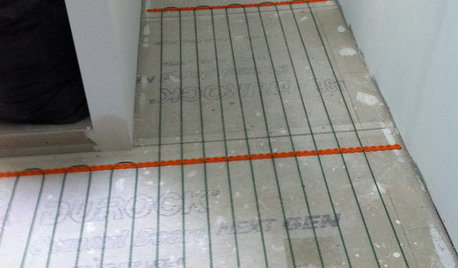
We are doing a major remodel on an older house and have decided to go with ductless mini splits for energy efficiency and the heating and cooling capabilities. Our house is on a concrete slab however, and I am worried about having cold feet. I'm considering adding electric mats throughout the main floor just to use as supplemental heat--to take the chill off of the cold floors--but to still utilize the ductless as the primary heat. I'd love to know anyone's thoughts on this. Also:

  • Can a ductless mini split heat the house and slab sufficiently so that the floor mats wouldn't be necessary? I can't imagine that the slab will get heated this way, but maybe I'm wrong.
  • Do I have to go with tile floors in order to maximize the electric mat radiant capabilities? Would they still work with carpet over slab?
  • Will the mats work to take the chill off if set at a lower temp--I really don't want to pay a lot to use them as a heat source. I want to rely on the ductless but just have the ability to warm the floors if they are particularly cold.
  • The main floor is 2400 sf. Are there particular products what will work well on a larger scale (not just a bathroom)?

Thank you so much!

Comments (6)

  • 8 years ago

    How about insulating your floor? at that point, you can keep the slab at the indoor air temp and not have to be using resistance heat in the slab.

  • 8 years ago

    The home is 50 years old so we can't insulate under the slab, but we are going to add perimeter insulation. Will this be sufficient to keep it from being really cold?

  • 8 years ago

    I think the reference was to insulating on top of the slab with a closed cell foam underlayment.

  • 8 years ago

    As you know, resistance electric heat is much more expensive than heat pump. Almost surely, natural gas-fueled heat is significantly less expensive than heat pump.

    My experience with high-wall mini split heat pumps (seven of them in a seven-room home) is that they are great ceiling heaters. Your experience might be better with slab. I have a raised home with virtually no insulation under the floors. (Coupling the home to the earth can work better since the temperature is more moderate than air.) In my house, the air temperature gets very polarized when the fan speed slows as the units approach set temperature. Ceiling fans improve the situation. With mini splits, you have no heat during defrost cycles. (I honestly don't miss it, but some people might. Note that sinceI have three outdoor units not all in defrost at the same time.)

    A bunch of mini splits are going to increase maintenance and probably repair costs compared to a central system. Just think about it, multiple filters to get up on a ladder and clean, multiple blower motors, control boards, vane motors and such that potentially go South and need to be replaced,.... Mine need a lot of laborious cleaning to get the crud out that accumulates on the blower cage, in the coils, in the drip tray,.... You have multiple drain lines that can clog and there is no overflow safety.

    Putting heat on your slab, as is, will heat your slab and the earth beneath very effectively. The earth is an infinite sink for bleeding off heat or cool. Heat transfer by conduction through the concrete is much more effective than by convection into the living space. You need to maximize heat transfer to the living space and insulate below it. Radiant heat, especially on a slab, is not responsive. It is the least responsive compared to radiators/convectors (middle) or forced air (fastest). You don't just turn up the t-stat and have warm floors a few minutes later.

    What type of heat do you have now and why are you abandoning it? In other words, how are your floors, and everything else being heated now? What is your climate like?

  • 8 years ago

    Wow, great thoughts so far. Thank you. So...I keep saying that our house is a "puzzle" and when we think have something figured out, something shifts and we're back to trying to figure out the best path forward. So, our house originally had hydronic radiant floor heat but it was a very old system powered by a very old boiler. We had many professionals in the field take a look at it, and although all said that radiant was the best heat, there was no way to know whether our current 60 year old system would last another 2 years or twenty years. We chose not to dig out the existing slab and replace the radiant because of budget reasons, and the mini splits seemed like the best option. We live in the Pacific Northwest and the weather is USUALLY fairly mild.

    We are currently having the perimeter of the slab insulated, but I don't think we'll be able to do an insulation layer on top of the slab because the ceilings are pretty low and we have been doing all that we can to raise the height, not lower it.

    The living room and dining room have a crawl space and we can do hardwoods there, but the back 2/3 of the house are on a slab. I'm considering a cork flooring over the slab to avoid cold floors, but would the engineered hardwoods be just as good?

    We're spending quite a bit on this remodel and my biggest fear is that in the end...I'll be COLD. Am I overworrying this?


    On a different note, there may be a portion of the slab perimeter that they may not be able to access and insulate, so there will not be a complete envelope around the slab. How big of a deal is this? Will the partial insulation still be effective?

    Thanks so much--

  • 8 years ago

    I don't know the propensity of pipes in slab to fail. I assume that is what you are worried about failing rather than a relatively easy to replace boiler. What fuel are you using for the boiler now? Do you know what the soil temperature is in your neighborhood? Is it humid there? If so, what do you use for dehumidification?

    I suggest that you add another pro to your reno team, an energy rater. They can tell you where to put your money for energy efficiency and how long the payback period is for the investment.