Software
Houzz Logo Print
loongtalltexan

Weird self-destruct-looking switch/light on wall of old house

8 years ago
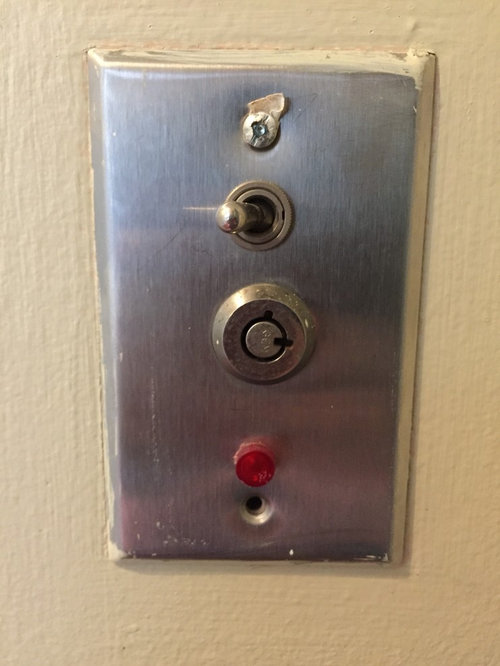
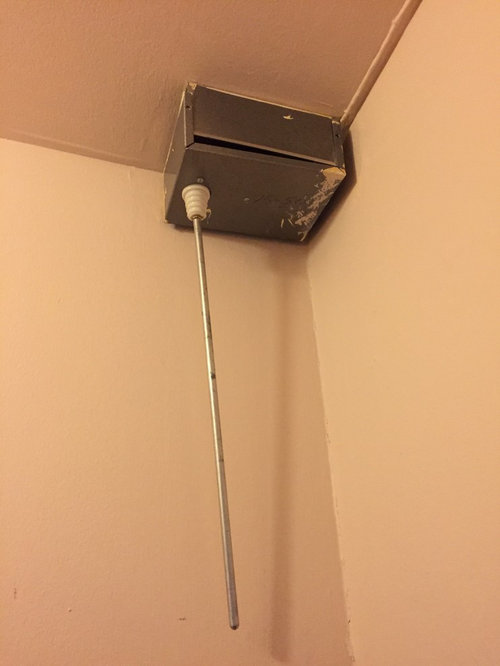
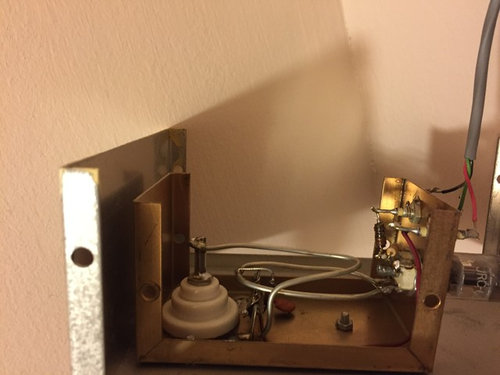
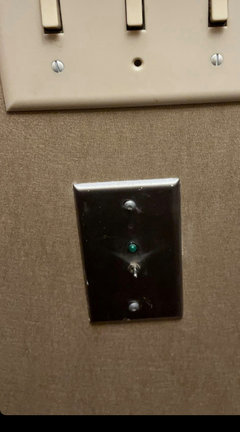
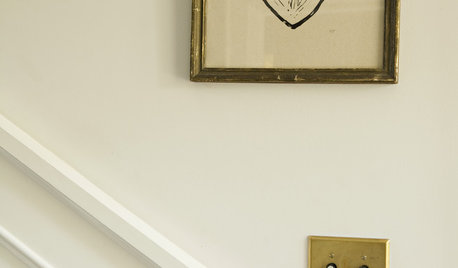
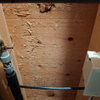
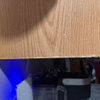
I am very intrigued about this strange switch on the wall of our old house that looks to me like a self-destruct button (if it is, it doesn't work, my husband tested it by flipping the switch, while I squealed!). I have attached pictures of the switch/light with a key hole as it appears in the hallway, as well as the device that the switch connects to inside the closet of the master bedroom. Can anyone shed any light as to what it might be? The house was built in 1964, if that helps. Thanks, all!


Comments (63)

  • 8 years ago

    Fascinating! I love a mystery like this. :)

    That doesn't look quite like an antenna to me. It's oddly thick, and the ceramic insulator it passes through looks like it's designed to handle quite a bit of voltage. And wow, look at the size of the conductor that connects to it.

    I also see a loop of that same wire with what looks like a small choke and a ceramic disc capacitor. Could that be a tank circuit? The loop some kind of ground plane? I'm no electronics expert, just a hobbyist, but the size of the wire might suggest very high frequency operation, maybe in the microwave region, where skin effect is significant.

    The connectors for the 3-conductor wire feeding (?) it look like high or medium voltage pass-throughs. However, the external wiring itself seems pretty tame. It appears that the red and green wires go to the pass-throughs, and maybe the black goes to the box itself. Hard to be sure from this angle, though. And I can't see much of the internal wiring.

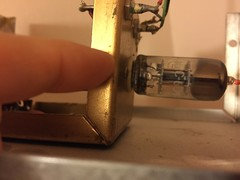
    I also can't get a good look at the glass (?) component that seems to be plugged into the outside of the box-inside-the-box. Only part is visible in the photo, but it looks round and resembles a miniature 7-pin vacuum tube. Maybe you could post a closer photo of it, and/or tell me what's inscribed on it. I can only see JRC-6 something. JRC could be Japan Radio Corp, which was indeed a tube manufacturer.

    Apologies, I'm doing a lot of shooting in the dark here.

    Absent any further information, a wild, irresponsible guess would be that this is a homemade Cottrell Precipitator or outright ozone generator. Ozone has been used to eliminate odors, so that might make sense in a 1960s electronics geek's closet.

    Still, why put the switch for it in the hallway? Why a toggle AND a keyswitch? Is that a lockout? For what purpose? I would love to see the wiring on the back of that switch plate.

    The mystery deepens!

  • 8 years ago

    Ceramic insulators, conductors, high voltage pass-throughs, mysterious switches. The surname of the people you purchased your house from wouldn't have been Frankenstein by any chance would it?

  • 8 years ago

    No mention of the vacumn tube in the lowest picture, right side?

  • 8 years ago

    That's what I asked about. It looks like a 7-pin or 9-pin miniature tube. JRC (Japan Radio Corp) might be the brand.

    But a tube would need a power supply -- something for the heater (filament), and B+ for the plate circuit. I don't see any power transformer.

    The type (?) starts with a 6, which would suggest a 6.3v heater with a separate cathode. Taking a wild guess, suppose there's a 6.3v filament transformer behind the wall plate. I really can't wait to see what's there!

    The next character in the type number might be an O or a C. I've never run into any tubes with 60v heaters and I don't know of any 6O types, so it almost has to be a C. A 6C4 was a 7-pin miniature VHF triode. A 6CG7 was a 9-pin miniature dual triode. but the tube socket doesn't look like it has that many lugs.

    So again some wild speculation. In the cable from the wall plate, black might be ground, green 6.3vac for the heater, red 120vac. The builder didn't bother to rectify the 120vac because he didn't care about the huge ripple. The triode conducts only one way.

    Or maybe there's a solid state rectifier behind the wall plate too. You'd think he'd put that in the builder's box, though, especially since in the mid-60s selenium rectifiers were still common, and they produced a lot of waste heat.

    The components near the "antenna" (?) look to be a small choke and a ceramic disc cap -- a tank (resonant) circuit. The wire loop might be a ground plane, and/or the spacing between the loop and the antenna wire above it might be a tuning method.

    To me the thickness of the wire suggests this gadget is oscillating at pretty high frequencies.

    Could it be a VHF-band television jamming device??? Turn that bad boy on when it's time for the kids to do their homework!

    But I'm not an EE, just a hobbyist, so this is all guesswork.


  • 8 years ago

    This Old House installed a switch like this last year on the second floor of a house.

    It was to power a motor that lowered and raised the chandelier in the 2-story foyer when it needed cleaning. First-world solution.

  • 8 years ago

    OK, here is a close-up of the vacuum tube, which reads "JRC 6099." It also says "RCA" with a radio wave symbol, so that's another clue. There are definitely wires going into the box in the closet that could be an electric power supply.

  • 8 years ago
    last modified: 8 years ago

    Dual Triode Frequency converter - mini-pins.

    Who would build a vacuum tube device to jam VHF TV or have anything to do with WiFi or something else that is less than 30 years of age.

    I built my first TV in 1967 - it was a color set at that. No transistors, one thermistor. 295 Sq Inch tube. ~$500 including cabinet IIRC.

  • 8 years ago
    last modified: 8 years ago

    Could it be a homemade radio receiver?:

  • 8 years ago

    Texan, thanks for posting that tube closeup! Good call, an RCA JRC 6099 is the military equivalent of the civilian 6J6. That's a common-cathode twin triode, 7-pin miniature tube, usable up to 600mHz.

    According to the 6J6 spec sheet, the plate dissipation can be up to 1.5
    watts per plate in the RF range, so as much as 3 watts if they're paralleled or run in push-pull.
    Nominal plate voltage is 150v, max 300v, so quite usable with a rectified 120vac line.

    FWIW, VHF television used 54-88mHz for channels 2-6, with a donut hole at 72-76mHz for other services. Channels 7-13 used 174-216mHz. In between television channels 6 and 7 is FM radio (88-108mHz) and several other services. AM radio uses 540-1700 kHz.

    It's hard to see most of the tube connections, but it looks like the wire loop is tied to both plates with the tuned resonant circuit on its center tap -- push-pull output. The green input wire does look like it's powering the heater (filament) with the other heater pin tied to ground (black input).

    I may be totally off base here, but even as little as I know, I don't think it's a receiver. I still think it's a transmitter. I can't tell the frequency, but I'd guess from the wiring that it's in the VHF band or higher. From the tube used, the power is probably somewhere between a few tens of mW (milliwatts) and a couple of Watts. At 100mW or less, it would be FCC legal without a license.

    As for what it might be broadcasting, It's almost certainly either silence (unmodulated carrier) or AM garbage. That's why I still think it might be a jamming device. Maybe the original owner thought his house was bugged!

    Texan, if you're as curious about this as I am, I suggest that you scout out a local amateur radio club. Maybe one of its members would be intrigued enough by this mystery to pop over and have a look. If you do, please post back with his or her thoughts.

    As you can tell, this really has me curious.

    SaltDawg, the house is from 1964. I'd guess that this gadget was probably built and installed about that time, or maybe in the early 1970s. The 6J6 probably couldn't oscillate or amplify at a high enough frequency to bother wifi, recent cordless phones, mobile phones, or anything similar. It might affect old (49mHz) cordless phones and wireless remote ceiling fans, though.


  • PRO
    8 years ago

    I'm curious too.

  • PRO
    8 years ago

    I was out, and then the electronics experts sucked me right back in!

  • 8 years ago

    As I suggested, it is older than WiFi and VHF TV.

  • 8 years ago

    You could invite the local ham radio club over for a look. They can bring some receivers and they'd have a wonderful time even if the device is kaput. What is the rough geographic location? Any military or broadcasting facilities nearby that the owners may have been concerned about?

  • 8 years ago

    We are in Highland Park, IL. There is a National Guard base in Fort Sheridan to the north, but nothing particularly interesting that I know of.

  • 8 years ago

    Please be sure to share with us what it is, once you reach a conclusion!

  • 8 years ago

    Does a magnet stick to the long metal rod?

  • 8 years ago

    I just tried a kitchen magnet and it appears that the rod is not magnetized.

  • PRO
    8 years ago

    there's also a pretty active forum on reddit called what is this thing if you can't get a definitive answer elsewhere.

  • 8 years ago

    Thanks! Yeah, it sounds like I should head to Reddit and Metafilter, as well.

  • 8 years ago

    Maybe someone wanted to block out TV signals because TV is the devil. ;)

  • 8 years ago
  • PRO
    8 years ago

    wow, the amateur radio thread really took a turn, didn't it? Say hi to Jimmy Hoffa for us!

  • 8 years ago

    I mean, I love that they have cooked up conspiracy theories - I certainly prefer to believe there is some super juicy explanation. However, I also agree that the true story is much more likely to be boring.

  • 8 years ago

    I found the guts of it under the house!: https://www.flickr.com/gp/155482395@N06/12Kh6T

  • 8 years ago

    Possibly a way to broadcast a front door security camera to several TVs in the house onto can unused channel.

  • 8 years ago

    In the 1950s 0r 1960s? Where did they get the camera? lol

  • 8 years ago
    last modified: 8 years ago

    That cable with the red black and green is most definitely NOT from the 50s or 60s.

    https://en.wikipedia.org/wiki/Closed-circuit_television


  • 8 years ago

    Now this is getting REALLY interesting! The extra gear in the crawl space adds a whole new dimension -- IF it's related to the transmitter. Too bad the big black box is so heavily caked with white paint. It looks like it says Mullard at the top. That would be the brand name. Mullard was an English company known for their high quality vacuum tubes. IIRC they also manufactured communication gear. The connectors are F type coaxial. My guess -- a VHF band receiving amplifier. But it might be totally unrelated to the closet mystery, just part of a MATV (master antenna television system).

    The PC board is almost certainly a commercial product. It's obviously a low voltage device; the large electrolytic cap at the top is marked for 50 volts. So I'm pretty sure this isn't the power supply for the transmitter in the closet. It has DOOR and INPUT terminals, OUTPUT terminals, and an ELECTRONIC CHIME terminal. Maybe it's part of a front door intercom system

    I showed the pictures of the closet box to a EE friend of mine, and he said:

    "It looks like classic 1960's ham gear construction. I'd guess it is a low-power transmitter, 144 MHz or higher, that got switched on when something [some event] happened. Maybe part of an alarm system, or just an "Honey, I'm home" beacon for a spouse who had the matching radio receiver.

    "I can't tell, but it's also conceivable that it could have been a transceiver. There were ways to wire a single tube as a transmitter, or regenerative receiver. An article in QST May 1962 shows a one-tube UHF transceiver. It used a telephone handset for its microphone and earpiece."

    Again, though, I don't see any path for an audio or video signal to get to or from that closet box. The red-green-black cable looks like straight power, not signal.

    The Reddit threads are adding further interesting speculation. I'm
    skeptical about the "FBI/CIA safe house" idea though, because with their government budgets,
    they'd use a commercial product. That transmitter just about shouts "homebrewed."
    I have the same objection to the monitored alarm idea. ADT doesn't build stuff like this. Also, if it's an alarm, you should see door and window switches, or some indication that they once existed.

    But let's suppose for a moment that there is, or was, an alarm system. Let's also suppose that the homeowner
    was indeed a ham (amateur radio operator). Riffing on what my EE friend said, let's say the homeowner wanted to know
    whether something was in some particular state before he arrived home --
    whether a
    door was open or closed, perhaps, or whether something had triggered his
    burglar
    alarm.

    Many hams had/have rigs in their vehicles. So, he could fire
    up his receiver while driving down his street. If he heard a carrier
    on a specific frequency, maybe with 60Hz hum modulating it from an unfiltered power supply, he'd know
    that the door was open or closed, or someone unauthorized had entered, or whatever condition he was monitoring. He might then decide to
    do something different -- such as call the police, or go somewhere else.

    I also wonder if this might be part of a scheme to trip up a spouse suspected of infidelity! But then you wouldn't expect it to be controlled from a keyswitch in the hall -- if indeed it is.

    Jamming a ham or CBer next door? Possible, I guess But then, why hide it in the master bedroom closet? (I do think that might be a hiding place, though putting it in the attic just above would have been even better.)

    If it really is a jammer, I'm going to stick with what I suggested earlier -- either it was meant to thwart wireless bug transmitters, or to keep the kids from watching television when they were supposed to be doing their homework.I'd still like to see what's on the back of, and behind, that keyswitch panel in the hallway. If you're nervous about removing it from the wall to take pictures, you could always open the house's electrical panel main breaker to be totally safe.

    But if you remove it carefully, holding it by the edges and keeping your hands off any wiring on the back, you should be fine. Wear thick rubber gloves if you want.

    Someone suggested testing it with a non-contact electrical detector before digging into it. That's an excellent idea. Hold the tester up to the switch plate. If it stays silent and dark, the panel has no power. Open breakers until it does, if you like.

    You can buy those detectors at home center stores' electrical departments, and they're handy to have around anyway. Some are sensitive enough that they can trace electrical cables in the walls.

    I still think your best bet for solving this mystery is to get a local ham operator involved. Most love challenges like this. I can tell you that if I were local, I'd be there minutes after you said "come on over." :)


  • 8 years ago

    Fred, I'm curious as to why you think that red-green-black cable isn't from the 1960s. It probably wouldn't be any older than the house, which was built in 1964.

    I was tinkering with electronics in the mid-1960s, and I remember working with multi-conductor cable not unlike this. Heck, I recall red-black-yellow-green telephone cable from that era that resembled this stuff, except that the conductors were solid, not stranded.

    What are you seeing that I'm missing?

  • 8 years ago
    last modified: 8 years ago

    It's the switch for the whole house shield to keep the aliens off your roof...

    How do folks not know this?

  • 8 years ago

    Could it be part of a Civil Defense siren ? The sirens were also used for volunteer fire departments and tornado warning. It would explain the lockout switch, would not be a good thing for kids to play with.

  • 8 years ago
    last modified: 8 years ago

    The type of thermoplastic and outer sheathing plastic do not appear to be from that era. As an electrician, I can usually tell from a distance. ;)

    But, you can probably find some printing on the sheathing and find out for sure.

    Or see how many layers of paint are on the cable compared to the walls.

  • 8 years ago

    Very interesting! Could someone that was 'important' have owned the house? Can you look up your county tax assesdor to zee who owned the house before you?? Tube delivery if someone 'important' by employee? Chicago gangster? Cold war spy? Elevator? Crazy person who thought everyone and everything was going after him/her? Any older neighbors who may know history of house? Google former owner's name... See what you can find out? Drug house alert system? Illegal activities? Google your address. Reflector for Martians landing on your roof? Alarm system- triggers loud outside bell/horn?? As in 'panic button'? Can't wait for the answer! Put pics on You Tube asking what it is???

  • 8 years ago

    Fred: "The type of thermoplastic and outer sheathing plastic do not appear to be from that era."

    Any thoughts as to what era you think it might date from? To me, it doesn't look very different from cable I still have in my junkbox that dates from the early 1970s, but my eyes may not be as finely tuned as yours are. They're probably also older and dimmer. :)

    Relatively modern cable would be a strange anomaly connecting to a homemade tube circuit, wouldn't it? I don't know many people who still build circuits with vacuum tubes. I did in the mid-60s, though.

    For sure, this is a fascinating puzzle.

  • 8 years ago

    Almost gave up on this thread till I saw the 6J6 tube and then found a pretty good analysis by DavidR that kept me reading.

    There are some great online communities (forums) where antique radio and ham radio guys and gals hang out. You might post a couple pics of the upstairs gadget and the downstairs circuit board with a link to this thread.

    www.videokarma.org (sounds like a TV forum but it's actually the sister site of an audio forum (audiokarma.org) where all the old radio and TV topics are discussed. Lots of tube gurus there and ham operators.

    Antique Radio Forum is another with a lot of traffic from gray haired old tube guys.

    Basically someone needs to figure out what all these parts do - which is easier said than done. For the antenna gadget, making a schematic would not be all that difficult, even from here with enough pics. That circuit board, not so much.

  • 6 years ago

    Is it to call in the nurse?

  • 6 years ago

    I don't think you'd want something that requires inserting and turning a key in the event of a medical emergency. Just a thought.


    That circuit board under the house looks 1960s-70s. Very possible it's from the same time that the closet unit was built.


    A schematic would immediately tell a lot of electronics guys what it does. And not that hard to draw out, at least in crude form, even by a non-electronics person.

  • 6 years ago

    loongtalltexan


    Your two year old post came up amid current chat threads on Houzz and now I'm curious.


    Did you figure out what it was? Did you have any problem removing it?

  • 6 years ago

    Appears OP hasn't been around since Dec. 2018 so we may never know.

  • 6 years ago

    I'm sorry to say that I never did figure out what it was! It doesn't make a fun party trick to show folks, though, especially engineers who visit the house. :)


  • 6 years ago
    last modified: 6 years ago

    You just left it?

    Wow. My curiosity (and paranoia) wouldn't have let me leave it in. I'd have taken it all out and tried to figure out what it was.

  • 5 years ago

    I have a very similar thing next to my front door on the OUTSIDE of my 1977 house that has a key instead of a toggle; mine is an Ademco alarm device (or so it states on the back of the plate).

    . I'm guessing you could turn the key and arm the thing as you left and the red light let people know it was armed.

  • 5 years ago
    last modified: 5 years ago

    We found 2 of these in our new house (built in 74) one on the main floor near the back entrance and another in the main bedroom. Have no idea what they are for- asked the previous owners and they have no idea either.


  • 5 years ago

    Does the green light change color when you toggle the switch?


  • 5 years ago

    I think it's an alarm system.

  • 5 years ago
    last modified: 5 years ago

    @loongtalltexan I know this thread is several years old, but I just wanted to offer one observation that no one else seems to have mentioned. The device you found underneath your house with the the "Door" and "chime" labels on it looks to be a Nutone 470 central amplifier for their old commu-ni-com or direct-a-com intercom system. Here is a link to a photo of one: http://northsideforyourhome.squarespace.com/nutone-intercom-photo-gallery/nutone-model-470-amplifier/

    Are/were there any old intercom speakers on the walls anywhere in your house? I don't think this would have been related to the device in the closet (unless it was some DIY-tinkering) but just an observation. If they had an intercom, maybe they had a security system too.

  • 5 years ago

    The longer rectangular box that is mostly painted over is a super-old Winegard TV distribution amplifier (as someone suggested above). Here is almost the exact same one, I'm pretty sure: https://www.ebay.com/itm/Winegard-DA-8150-82-Channel-Distribution-Amplifier/193941261031?hash=item2d27cccae7:g:SZEAAOSwxjZgRUNJ


    The other box that is completely painted, with the two connections at the top and power coming out of the bottom, I think is one of these: https://www.ebay.com/itm/303839191777?mkevt=1&mkcid=1&mkrid=711-53200-19255-0&campid=5338722076&toolid=10001 a pre-amp TV signal booster, effectively similar to the longer box.


    But, those boxes utilize coax cable-TV-style cable, and the intercom amplifier uses thinner, twisted pair wires that are orange red and black. The cable going into the antenna device in the closet appears to have a larger, heavier gauge wire with green, black, and red conductors....I would try to trace that specific cable as far as you can and see where it goes first. Were there any other kind of junction boxes underneath the house?


    The intercom amp appears to have a line coming into the DOOR input, one line going to the regular input and one line going to the output terminals, which would suggest that they likely just had one door speaker, and one inside speaker to communicate with the front door. If you had multiple intercom speakers throughout the house, typically you would have multiple wires going to those terminals, but I do believe those particular nutone systems could be "daisy-chained" as well, with one room station wired to the next, in a line, etc...so it is possible there could have been more.


    I am absolutely fascinated by what this thing in your closet could be! If it is, in fact, somehow wired into one or both of those two TV distribution amps, maybe it was some kind of project idea from Popular Electronics that utilized making your own antenna and using those amps to power it somehow, but I just can't imagine why you'd have it in a closet, it is so intriguing. The key-switch on the wall looks very common to many old alarm systems of the time, but typically you'd have other security system components around, like sensors on your doors/windows, and a siren mounted somewhere outside your house...It is also entirely possible that the TV distribution amp boxes underneath the house were not related to that antenna thing, but it seems like it would be too much of a coincidence, especially since someone wrote "closet" down there on the joist. This three-year-old mystery is so damn interesting! haha


  • 5 years ago

    If you still have not figured out what it is/was, consider posting a question on : https://old.reddit.com/r/whatisthisthing/

  • last month

    Well the glass tube is a Dual triode vacuum tube. The letters "JRC" followed by a set of numbers is an acronym meaning "Joint Army-Navy/Government. The 6099 are simply reference numbers. The equivalent of a standard civilian 6J6 dual triode tube, this particular one was specifically made for Uncle Sam. It was used by the USAF to receive and transmit High-Frequency, VHF (VERY HIGH)-UHF (ULTRA HIGH) FREQUENCY RADIO SIGNALS.. I'm not 100% sure but off hand with what I see it's someone's attempt at a diy Radio signal jammer. That particular tube osilates at around 600mhz. Would probably render mobile devices useless, anything that relies on a radio signal to communicate back and forth. Again this is mostly guessing, my opinion would be remove it making sure it couldn't be used anymore, it would also interrupt any emergency services radio signals as well. Hope this helped...