Software
Houzz Logo Print
stacy_miller94

Island Outlet to code?

8 years ago
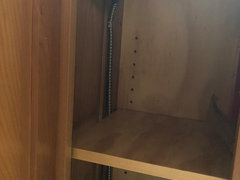
My contractor installed this outlet today and it does not appear to be to code. Any input would be greatly appreciated!

Comments (20)

  • 8 years ago
    last modified: 8 years ago

    The wire has to be run in an armored protective sleeve aka BX. That is subject to damage as shown.

  • PRO
    8 years ago

    Your "contractor" is a hack. Tell him I said so, please.

  • 8 years ago

    Eek!!!

  • 8 years ago
    Yay! I’m just happy as a non pro I knew that the wire needed to be in some kind of protective sleeve to prevent it from being sliced or pinched!

    Sorry you guy was wrong :/
  • 8 years ago

    That's probably the furthest thing from a workmanlike installation that I've seen today. :(

    I agree that the NM cable here is exposed to potential damage and needs physical protection. A piece of thinwall conduit with a proper fitting at the bottom end would do just fine.

    Even if the cable didn't need physical protection, it isn't secured within 12 inches of the box. That's a code violation.

    Also, I would never pinch it between the cabinet side and a shelf that way.

    I'd fire that guy. If he's that careless about wiring, where else is he cutting corners?

  • 8 years ago

    My professionally installed island outlet looks similar, so I should do something about protecting the wire. Actually, it's a little more professional (hole in shelf and wire dressed to the corner, but still the same issue). Would it be acceptable to put an emt sleeve over it inside the cabinet? It may be difficult to access the point in the floor of the cabinet to change to BX.

  • 8 years ago

    I'm not at my house now, but when I get there, I'll send a photo of its situation. Sorry, Stacy, for hijacking your post!

  • 8 years ago

    Ron, you're the pro, and I'm sure your suggestion to dress it to the back would be an acceptable choice, as long as the cable were properly secured and supported (which it isn't now).

    In addition to cookware that might have sharp edges, I don't much like seeing that shelf bearing on the cable when it's going to move a bit every time the cabinet is used.

    So I'd still protect it, at least to preempt the potential inspector's flag. But maybe I'm too cautious. I also use AC to feed garbage disposals, which I've seldom seen the pros around here do in recent construction. (Why is it that they'll use AC to feed an electric water heater or gas furnace, but not under the sink where people store stuff daily?)

    All that aside, it's not what I'd call a workmanlike installation.

  • 8 years ago

    I know BX is an obsolete term, but what's AC (other than Alternating Current!)?

  • 8 years ago

    I know BX is an obsolete term, but what's AC

    Armoured Cable

  • 8 years ago
    last modified: 8 years ago

    The inside of my cabinets is not a protected light use zone. Heavy cast iron, grill pans, drawers in and out. All risky to wire. But especially unsecured wire.

  • 8 years ago
    I immediately thought this didn’t look right.
    To code or not, it looks bad. Does anyone have a picture of what it should look like? I have been searching for one and cannot find one.
  • 8 years ago

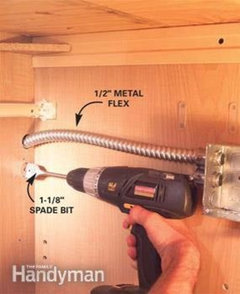
    I'm no pro... but This is one option: I searched "electrical under cabinet conduit" I'm not sure what BX Sophie is talking about. On the second photo you can see how it's mechanically fastened to the back of the cabinet.


  • 8 years ago

    Not sure why photos didn't post.


  • 8 years ago
    last modified: 8 years ago

    The cable used would be a function of local codes. Some require armored cable, some do not.

    BX is more or less a trade name for armored cable (AC). Metallic cable (MC) is different, but might also be used. Ron can confirm or deny that the difference between AC and MC is the grounding conductor (AC it's bare, MC it is insulated green). Well, actually there are a few other things but in this size it is the ground that would be different.

  • 8 years ago
    last modified: 8 years ago

    Metal conduit is rated to provide physical protection, so it is used in garages and other applications where cable could be damaged. The other alternative is Schedule 80 PVC. However, despite its metal cladding, AC cable is usually not considered sufficient physical protection. From the standpoint of providing any required protection, AC cable you buy at the big box store is usually treated the same as NM cable (often referred to as Romex).

    If I was doing it in my house I would prefer the AC cable; however, NM cable may be code compliant if its routed properly and secured properly (the wiring in the 1st picture has about the worst routing possible, and is not secured properly).

    Bruce

  • 8 years ago

    Here’s what mine look like

  • 8 years ago

    NM cable in cabinets is common.

    Some localities may not allow it.

    Some electricians may prefer using AC.

    The lack of securing the cable MAY be the only thing technically wrong with the OP's situation (if the shelf isn't actually pinching the cable).

    I agree that it is kind of sloppy, but add a fastener and it may be to code in the OP's area.


Sponsored
The Creative Kitchen Company
Average rating: 5 out of 5 stars52 Reviews
Columbus Area Kitchen Remodeling and Refacing Professional