Software
Houzz Logo Print
dvargo71

best grow lights

What is the best option? How close is it to natural sunlight?

Comments (13)

  • 7 years ago

    Depends upon what you want to do. If you just want to start some seeds to move out in the garden, then a mix of warm and cool fluorescent tubes will be fine. If, however, you want to grow tomatoes indoors until they fruit, that's another matter.

    tj

  • 7 years ago
    last modified: 7 years ago

    The best option is BRIGHT light. Most grow lights are about the intensity of a cloudy day, even close up. Don't be fooled. Light that is adequate for reading is nowhere near as bright as what plants need. The color is less important.

  • 7 years ago
    last modified: 7 years ago

    I have two sets of these

    https://www.amazon.com/gp/aw/d/B06XGBKDKZ?psc=1&ref=yo_pop_mb_pd_title

    And a couple of these fluorescents
    https://www.amazon.com/gp/aw/d/B00T0CPI6A?psc=1&ref=yo_pop_mb_pd_title

    I’ve had good luck with both of them. I prefer the LEDs over the traditional fluorescent bulbs- just because they are plastic and won’t shatter if I accidentally drop them or whatever. I use them for starting seeds as well as growing microgreens and houseplants


  • 7 years ago
    last modified: 7 years ago

    Just for fun, one can work out what kind of artificial lighting you'd need to get the brightness of sunlight. If you took 100W incandescent bulbs, which are a few inches across, or put 22W LEDs (100W equivalent) a few inches apart, in order to get the brightness of sunlight, you'd need your plant to be close enough to them that the bulbs, looking up at them, filled half the sky. So for a plant a foot or two under the array of bulbs, that would require about fifty bulbs. That's a lot of watts, and not much room for plants underneath them! So what everyone does is to grow plants indoors under MUCH less than natural sunlight, and ideally leave them on for a long time every day. As a result, they'll grow, but don't expect much fruiting.

    Jamie, those URLs you posted are links to your Amazon account, so if I click on them, I can't see what you bought unless I can log you in. If you press "Share" you'll get a more generalized link to the product that others can use.

  • PRO
    7 years ago

    LED, hands down, no comparison. Please read why below.


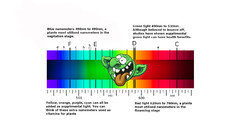
    Brightness/lumens or WATT's have nothing to do with what your plant requires. These are just the measurements used by folks either just starting out or do not need to study beyond this. Plants use light for photosynthesis, each color pigment/spectrum of light, is absorbed by the plant and causes different reactions.


    Blue spectrum is focused on root and stem growth while red is focused on the leaves and flowers. There are many shades of each color, these shades are broken down and classified as nano-meters. Each plant requires a certain amount of nano-meters across the spectrum. LED's are the best lights to use for indoor plants because you can very precisely pick which nano-meters are used, instead of wasting all this energy on nano-meters/colors of light, your plant wont even use.


    You can click here If you would like a full guide on what light you should buy for you plant.

  • PRO
    7 years ago
    last modified: 7 years ago

    Sir, i understand you must be from the bronze age but science is all about finding the most precise answer, and LED is all about precision. This is so we are not irresponsibly using power, not only on wasted energy but also getting rid of the excess heat non LED and fluorescent give out. 90% of the energy Incandescent create is heat, compared to the 20% of LED.

    Maybe at first LED was too expensive to consider but now it can be almost as cheap to start out and definitely more environmentally friendly. You can also consider the fact that LED creates around 50 - 60 lumens per watt and the only other light to come close to that is an HPS(high pressured soduim,) which again, gives off an incredible amount of heat. Using LED with the right spectrum, you will need to consume a fraction of the power.


    I will also correct you on the fact no grow light or hydroponic company will expect a customer to pick each individual LED. We have already designed our lights with the spectrum tested for maximum efficiency. Most of them will have 2 growth stages - Vegging which is mostly blue with red and other colors mixed in, and flowering which will have mostly red with some blue and other colors mixed in.

    Sorry Sir, but your analog living in a digital world.

  • 7 years ago
    last modified: 7 years ago

    Sir, you're talking to someone who actually knows quite a lot about spectral coverage and illumination, and if I may say, you aren't going to attract customers by being insulting. You seem to be living in a world that people won't like. You are here on this forum selling a product. You're new here, but we actually frown on that.

    No one is talking seriously about incandescents. You'd be crazy to use them, nowadays.

    The world I'm living in is where I have a finite amount of money to spend on my illumination equipment. I would love to have a big, bright, LED setup. But I can't afford it. I can afford fluorescents, and I can afford the minimal electricity that I spend on them. People who can't afford big, bright LED setups shouldn't be told that they aren't doing it right.

    Actually, I use the heat from my fluorescents. I have my seedling setup in a converted garage, where the temperature is 40-60F this time of year. Suitably covered, the fluorescents do a wonderful job keeping my seedlings bright and warm. LEDs would not do that.

  • PRO
    7 years ago

    First off, i was not selling any product, nor could of anyone of mistaken what i said for that. Second, you came in first and completely roasted my post without any actual facts, just opinions, and now your going back on some of the things you have mentioned. I see you even changed some of it. I thought this was a fun, heated debate. Now i really know what this was.

  • 7 years ago

    You may get some useful information from this episode of the Joe Gardener Podcast:

    https://joegardener.com/podcast/gardening-indoors-light-science/


  • 7 years ago
    last modified: 7 years ago

    My goal has always been to grow seedlings to plant outside, not grow anything to maturity in the house or to have large flowering/fruiting plants to sell. Or to grow weed.

    20+ years ago when I first started growing seedlings indoors, the advice that was given in a reputable book was to mix both warm and cool fluorescent light tubes. So this is what I did and had always had fantastic results. My first system was jimmy-rigged, and I wasn't about to buy new equipment for a new set-up when I moved, I just jimmy-rigged the same fixtures/tubes when I set up shop in the place I moved to. Now I have one of big the fancy-dancy light carts that came with its own tubes -- they're labelled "wide spectrum". I'm not well versed enough to argue the finer points of all this, but can attest that they work just fine, just like my old DIY set-ups did.

    So yea, don't over-think it, and you don't need to spend a lot of money to get good results.

    What is quite important, though, as mentioned by another poster, is the brightness of the light -- this means getting the light source as close to the plants as possible and adjusting upwards as the plants grow.

  • 7 years ago

    Thanks. I use 4' florescent bulbs 1/2 hot and 1/2 cold. It works great. I would LOVE to grow some stuff inside permanently like herbs but have never been able too. I installed some round skylights with metal tubes that are designed to bring in natural light. They did not seem to help much.

  • 7 years ago

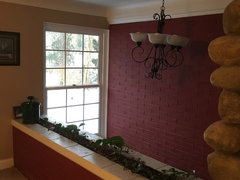
    This window faces East and I have some large trees so I get very little natural light. I would love to grow herbs in here. It does not happen though