Software
Houzz Logo Print
kali_deere

Overwhelmed, first time veggie garden

7 years ago

Hi all!
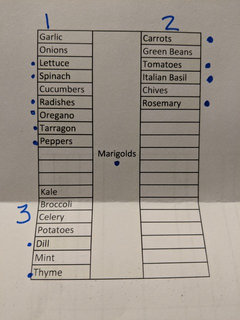
This spring I am planning my first (real) veggie garden. I did herbs last year and did ok and learned some lessons. This year we are expanding the main garden and I want some areas for veggies and herbs. I know some veggies grow best with certain companions, so I tried to make "groupings" of what I thought would work based on my limited research. After a certain point I just got overwhelmed and decided to ask for help haha.
As far as plants that shouldn't be near one another, how far away do they need to be? Do you think these groupings will work? I plan to have marigolds just scattered everywhere in between too.

Comments (25)

  • 7 years ago

    These are the basic groups I have in mind, this isn't how they'd look in the garden just the groups they'd be in. Things with dots next to the are "must haves" everything else would be nice to have. Please let me know your suggestions :)

  • 7 years ago

    You can safely ignore most recommendations for 'companion plantings'. That is really a gardening myth that has little basis in reality.

    There is really no rule for how far apart dfferent plants should be. You just want to space so that they have adequate root room and the ability to grow to size without crowding that can limit flowering/production and create increased disease and insect issues.

    If anything, you want to group plants by their sun and watering requirements. Most Mediterranean herbs want full sun and quite dry conditions. I would keep rosemary, thyme and oregano well away from the more thirsty veg.

  • 7 years ago
    last modified: 7 years ago

    Also, some of your plants are cool weather crops and it's doubtful that they will make it through the heat of the summer: lettuce, broccoli, radishes, and spinach.

    Garlic is usually planted in the fall and it can be planted after you start to clean your garden of plant debris. It's similar to planting tulips and many other spring flowering bulbs.

    Some of your herbs are perennial so they would need to be in a permanent place.

  • 7 years ago

    What is the size of your garden? Most newbe try to pack to much into to small of an area and they have problems. Also if you want to continue and garden you will need to document what and where you plant so you can rotate your plantings to avoid problems in the future

  • 7 years ago
    Cindy - thanks for pointing that out! I think I got over excited and didn't bother to look at planting and harvesting times haha

    joe- oh that's a good point. the extension will be approximately 20'x15', but won't be all vegetable space, there will be some shrubs, a couple perennials and (mostly) roses, and some annual flowers scattered about. you're probably right this is likely too much for that amount of space considering it's not dedicated to only veggies
  • 7 years ago
    Make it as easy as possible to water.

    When you expand your garden you exPand your chores and it makes it easy to slack even if you think you're doing well.

    Drip irrigation is something to definitely look into. If you want to really guarantee it, get the drip hoses on a timer.
  • 7 years ago
    last modified: 7 years ago

    What exactly was overwhelming? Watering? Weeding? Pruning? Harvesting? Or just planning? If the latter, let's make it simple. Very true about "companion planting". Largely a myth. Plants don't make friends. Some plants tend to deter insects that like other plants, but I've always been skeptical about that. Bugs stay off of one plant, and they go hop over onto the other. So don't waste a lot of time on that.

    Think about tall plants that might shade shorter plants, and think about which plants need regular access. Think about climate. Not sure where you are, but green bean season isn't really lettuce season.

    Oh, you must be in New England?

  • 7 years ago
    clumsy grdnr - yes watering can be a huge pain. For the gardens right on the front of the house I am putting in soaker hoses. The big garden I am adding veggies to is far away from the spigot though (sometimes I can cheat and spray using the "Jet" setting aiming down my hill from my porch lol

    daninthedirt -yes it's mostly planning that's overwhelming me. I tend to be slightly meticulous and very anxious just on a normal day, the problem with that is I'm someone who needs to physically see my garden laid out and paper planning overwhelms me sometimes because I can visualize the same way (thank goodness for computer programs in 3D). I'm in 6a Massachusetts so pretty cold and a short growing season
  • 7 years ago

    Soaker hoses are great especially if your garden is far from the spigot. You can hook them up, set them to run on a timer and that way you’re not wasting water, spraying over surfaces you don’t intend to.

  • 7 years ago

    My advice is to SLOW DOWN! It's very difficult to go from 0 to full garden in one year!

    We started with 2 4x8 raised beds, lined with hardware cloth for gophers. We made the mistake of growing perennial herbs in a small 3x3 bed almost 20 years ago! I think some of those are still taking over the garden area!

    Start with a small bed (4x8) or 2. Decide what you really like (tomatoes, green beans, peppers etc)

    Research! If you want asparagus, know that it's going to be probably 3 years before you can get more than a few servings, then, watch out! That 4x8 will be FULL! AND it will be an asparagus ONLY bed!

    Check out the neighbors' gardens and what works for them! My Garden area at the time was a nice mediterranean zone 9, but we were a full 5' below the town that was "our zone" and therefore had much harder freezes than people nearby.

    It looks to me that you have way too much going on! You have summer and winter veges happening!

    I really think you need to slow down and take things more slowly, or you might get overwhelmed (You're already overwhelmed in your origional post!)

    Have fun! Nancy


  • 7 years ago

    Nancyjane, there aren’t winter veg in MA outside of greenhouses because there is snow. We can only grow during the warm season in New England, and though there are veg that can be started earlier in spring, and a few don’t do well for a few weeks midsummer such as peas, it can all be grown together in New England, especially if one chooses varieties selected for our region. Kali is in central MA, about 60 miles south of me.

    I realize that irrigation is needed for most folks and that drip irrigation has advantages over sprinklers, but if Kali’s part of MA is at all similar to mine, it really is overkill. I think I have needed to water my full sun veg garden 5 times in 4 seasons because we get sufficient regular rain most years. Why spend the money and time laying out drip irrigation and timers if one will only need to water rarely? That is why I recommended sprinklers; less expensive and easy for a beginning gardener.

  • 7 years ago
    I started my first veggie garden last year. It was a whole new learning curve. Just pick out a couple of things you want to grow to make it easier for you. I planted a few tomato plants - cherry, beefsteak & lemon boy. Those 3 took a large amount of space. I planted 2 pepper plants, cucumber, celery & carrots. I also planted a few herbs. Well because I had all new soil, a good growing season & regular watering. Everythi
  • 7 years ago
    I hit post by accident, before I finished my comment. Well everything grew too well and some things got crowded out. So now I know that I need to space things out much more. My garden beds are raised beds that my husband built me. I have a smaller yard and our veg area is small as well, so I will always be limited for space.
  • 7 years ago

    HalloBlondie, you can go in and edit your post after hitting submit....you do not need to start a new one should you post by accident or if you want to add to or change what you wrote :-) The editing feature stays in effect for quite a long time.....several days at least.

  • 7 years ago

    Have you read Square Foot Gardening? It's a great book to help you get started and included information about spacing. Many libraries have it, and you can read a lot of the basics at their website. For planting times, check with your local Master Gardener organization. http://massmastergardeners.org/

  • 7 years ago

    Like others have said, most of the stuff to do with companion planting is just folklore. Just be aware of things like root space requirements and moisture requirements instead.

    If you match up shallow- and deep-rooted crops, you really make the best use of space (e.g., dill won’t use much of the top foot of soil and radishes won’t penetrate much below half a foot, so you can plant those two closer to each other because they’re not going to be competing).

    As recommended already, oregano, tarragon, thyme and rosemary should be kept separated from the plants needing constant moisture.

    If you’re only putting marigolds in there as a trap crop, just research first. I don’t know enough about it and never used them so I’m not going to say they absolutely don’t work, but just do a bit of googling on it I reckon.

    Good luck and have fun!

  • 7 years ago

    It might help if you post a picture of the area you are gardening in. Typically areas that grow annual herbs and veggies are not used for shrubs or perennials. The soil needs can vary and you'll want to be able to rototill the veggie area at some point I'm sure. I think it's quite a challenging task to architect a space where there are shrubs and perennials the work in harmony with a working vegetable/herb space. The soils needs of some of your crops are quite different as well. You can also grow some things in containers. I think the first year you are gardening, even for an experienced gardener at a new house, is sort of an "experiment." You should try several things with the expectation that none will work or you will be disappointed. Some of the easier things that I've grown in central MA include tomatoes, squashes, lettuce and cucumbers. Carrots can be tricky around here because of the soil. Most of us have rocky, clay soil and carrots aren't thrilled with that. Nor, in my experience, are peppers. Last few years I've done peppers, carrots and onions in pots with a nice light soil either from a potting soil bag or from my composted manure pile and they've done well in both.

    Anyways, there is a lot to learn. If I were you, I'd designate a space for any perennial herbs (oregano, thyme, tarragon (sort of)), and plant any perennials you are desperate for in that area, like along an edge. Try your annual flowers, herbs and veggies in another area. Honestly, it's going to take a few years to figure out what grows well where you are and what you need to do, or what varieties to get, that grow best.

  • 7 years ago

    I used to ride by bike around town and whenever I spotted a veggie garden with someone tending it I would talk to them to see what I could learn.Especially the older gardeners!! Another thing that can be problematic is procrastinating the weeding!! Weeds only become a problem when YOU let them get established. . Keep a hoe handy so every time you go to your plot you can hoe the weeds while they are small. I bought the Rodale book on organic gardening when I was very young and it can answer most of your questions. Lot's of good advice above but reading some books can provide a wealth of knowledge. Ebay sells the encyclopedia of Organic gardening very cheap.

  • 7 years ago

    All - thanks for the suggestions and advice I really appreciate it. I'm taking everybody's advice and starting small. Going to grow the herbs (the dry weather ones in a separate space), and some easier leafy green like lettuce and spinach. Only others I'm going to try is tomatoes, and throwing in the wildcard of peppers because my husband loves them so much lol. I think I'll leave my garden extension as a perennial bed, and maybe try the veggies/herbs in large containers (I've got a ton of large containers) - that way I can see how things perform in my environment without dedicating a permanent place for them. If all goes well, perhaps I can add some raised beds in other places.

  • 7 years ago

    I still refer to Crockett's Victory Garden which is a month by month guide based on a Boston tv gardening show back in the early 80s. Your library might have it but I frequently see used copies for sale.

    I love growing peppers. Carmen is an Italian type good for salads and cooking and ripens to red sooner than bell types but I also grow bell types which we love in any color.

    Depending on how much you use, a large pot of basil might be enough. Here in NH I have to plan spinach in April or it bolts. Pay attention to good seed catalog descriptions (I like Johnny's) because some lettuce does better in cooler weather and other varieties are a little better in summer. The hardier types can take some cool weather in the fall. Figure succession planting possibilities. Lettuce can be a filler in. As mentioned earlier, garlic is planted in the fall and gives you garlic scapes in early July then is harvested maybe late July so you can follow garlic with something else. I find garlic one of the best things to grow since it can store in our semi heated garage (55 degrees) most of the winter. But plant some of your harvest for the following year to build your harvest. Potatoes take a lot of room and you will probably be plagued with Colorado potato beetles. I still love growing potatoes but with limited space perhaps grow fingerlings or an early season type you can enjoy and don't bother trying to grow enough for storage.

    I have hardest time growing good carrots. Make sure they get enough water for germination. Then remember to thin. I've never tried celery. I highly recommend green beans because they taste so much better than the ordinary grocery store kind. I like a French filet type but Fortex pole beans are both tasty and prolific.

    I like inter planting things sometimes just for pretty. This was in September so violas had gotten leggy, leeks are in the back so slightly out of picture, there was thyme on the right edge.

  • 7 years ago

    I second the suggestion of Crocket’s Victoey Garden as a good resource with the caveat that you should ignore everything he says about pesticides. But his scheduling and general advice on planting is a great resource, especially for New England gardeners.

  • 7 years ago
    last modified: 7 years ago

    Crockett seems to like Safari, but that's really a pretty benign pesticide, toxicologically and environmentally. Um, except maybe for bees. Not good for bees.

  • 7 years ago

    i think you’ve hit on a good plan. Some years I plant veggies, some years not much. In the off years I fill up the empty space with cosmos, zinnias and the like. (I think I enjoy them almost as much) I do have herbs near the patio. They provide a lot of benefit for just a little space and effort. Those and a couple of cherry tomato plants can make summer for me!

  • 7 years ago

    Kali, hit up your extension office for what is best to plant at what time of year! Whether to plant by seed or by starts.

    I'm in sunny CA (very cold right now!), but getting close to planting time! :)