Software
Houzz Logo Print
thepinklady08

Old Electrical Faceplate

7 years ago

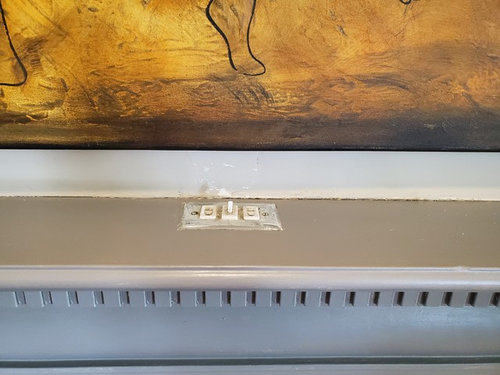
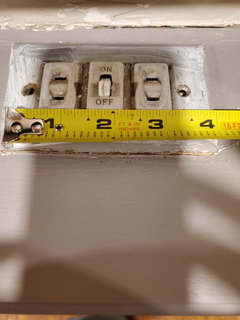
Hi Everyone, I am sprucing up my home and have run across an issue. I have an electrical faceplate located on my fireplace mantle that needs to be replaced (see pics). This faceplate is odd and I am sure pretty old. It has (2) two prong outlets and between the two outlets there is a light switch that turns the power on and off. Has anyone seen anything like this before? Does anyone know where I can find a replacement faceplate?

Comments (30)

  • 7 years ago

    There are modern receptacles (the electrical part) and associated faceplates that have one three prong outlet and a switch. There might also be some with a two prong, but the are much less common. https://www.homedepot.com/p/Leviton-15-Amp-Tamper-Resistant-Combination-Switch-and-Outlet-White-R62-T5225-0WS/202035011

    Bruce

  • 7 years ago

    Hi Bruce, thank you for your response. Just so I am clear, you are saying thay I can change out the receptacle (from 2 (two) outlets and instead one three prong iutlet and a lightswitch)? Is this difficult to do, I have no electrical experience?

    Also, is it possible to just change the faceplate?

  • 7 years ago

    https://www.gordonelectricsupply.com/index~text~5602726~path~product~part~5602726~ds~dept~process~search?gclid=EAIaIQobChMIgdqglfH94gIVivhkCh1uxw1ZEAQYJiABEgLjF_D_BwE

    You could change out your outlets and toggle switch to this configuration and use one of these faceplates IF the placements line up where everything is now. I definitely would use an electrician. If this is too much for you, maybe think about doing a wood faceplate. I would look into what that entails, if the faceplate needs to be backed with plastic or metal. I do not know the codes. You would be surprised how helpful industry is in helping solve problems that are due to archaic features.

  • 7 years ago

    Agree you need an electrician given your self-described lack of electrical experience. For one thing, I doubt very much that the box behind that faceplate has a ground wire; if there is no way to ground the box, then you can't install a modern, 3-prong outlet to replace what is there.

  • 7 years ago

    Thank you everyone! I honestly had not thought of re-painting and re-using the faceplate although I should have! So I trued to remove it to re-paint it and it is completely stuck. it looks like ot has never been removed and there are several layers of paint above it. Any ideas as to what I can ise to remove the paint layers to get it to come up? Or should I just default to calling an electrician?

  • 7 years ago

    Remove the screws. Take a single edge razor blade and cut behind the plate on all sides (you might have to go around more than once). That should cut through the old paint which is the glue holding it on.

    I thought that might be a problem when I saw your photo. It always amazes me that people don't take a few seconds to remove electrical plates when painting. It saves time and avoid problems down the road.

  • 7 years ago

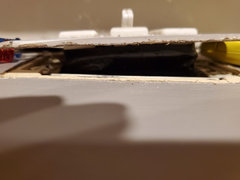
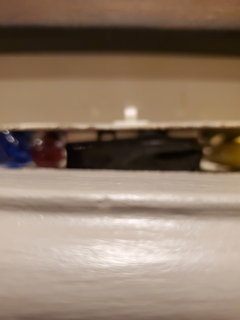
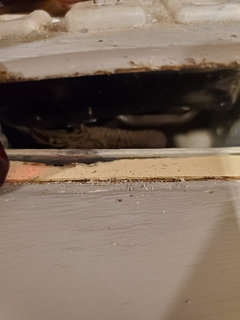
    @ kudzu9. ok, I was able to detach it following your directions. the faceplate, however, appears to be attached by some black tape. the three receptacles (two outlets and toggle switch all Ppear to be wrapped in onle large rectangle of black tape.under the black tape there appears to be some kind of rope wiring. I cannot detach the face plate. any ideas?

  • 7 years ago

    The black tape could be electrical tape which is sometimes wrapped around like that to prevent the terminal screws from coming into contact with the sides of the box, which I assume is metal...correct? The "rope" is just really old-style insulation for the wires.

    Normally, when you remove the two screws, the face plate comes off and then you see two other screws that hold the electrical components in place. The fact that everything came loose when you pulled the face plate make me think that the switch and the receptacles are integrated into the faceplate and you may not be able to separate the faceplate from the rest of the components. I didn't anticipate this, but it may be an old design that is not seen much anymore. I am hoping that you have thrown the breaker for this circuit, because you don't want to be fooling around with this anymore with live wires that can be pulled out of the box when you pull on the faceplate.

    If you give me an exact measurement of the distance between the centers of the two screw holes, I can tell you more.

  • 7 years ago

    @kudzu9 Approximately 3.5 inches

  • 7 years ago

    You're not measuring correctly. It looks like the center-to center distance is about 3", not 3.5 inches. Regardless, it looks like the screws do not have the standard spacing for a faceplate, which is about 3-3/4". That tells me that the faceplate is integral with the devices so you may not be able to separate it. Bottomline: you need to get an electrician involved.

  • 7 years ago

    @Kudzu9 thank you for your time and expertise. I will call an electrician.

  • 7 years ago

    Sorry there wasn't an easy solution. I'd be interested if you posted again after the electrician comes.

  • 7 years ago

    Will do!

  • 7 years ago

    Once the electrician takes it out you will probably find that there are metal clips holding the switch and outlets to the plate. You can probably dismantle it and clean it up.

    Or if there is a viable ground just have the electrician replace it with something more modern.

    Just curious - what do you use this for? And why does it need to be replaced?


  • 7 years ago

    Cloth-wrapped wires scare me. That most likely means you have knob-and-tube wiring, no ground wiring, and what you are looking at is an old loom that is about to fall apart as soon as you disturb the wires. All of that is a house fire waiting to happen. Well, that, and an electrocution hazards.


    In an ideal world you'd rewire your house to get rid of the old wiring that is by now past its useful lifespan. This won't be cheap. But at least afterwards it should be easier to find insurance companies willing to underwrite a homeowner's policy.

  • 7 years ago

    M-

    Plenty of people have knob and tube wiring, and are still alive and their houses haven't burned down. But I agree that the idea of modernizing is a good one. Here is some info for the OP so she can assess the situation better: https://www.nachi.org/knob-and-tube.htm

  • 7 years ago

    It's not the K&T per se that scares me. It's the brittle old loom insulation that has me freaked. I've literally seen it fall apart the moment you touched it. And that's what causes fire. You now essentially have bare copper wires in all your outlets and switch boxes

  • 7 years ago

    M-

    I agree that's a possibility, but I'm simply trying to alert the OP that this is something to be investigated with an electrician, rather than to panic about in the absence of professional advice about the actual conditions.

  • 7 years ago

    Very true, that

  • 7 years ago

    @dennisgli, I use it for christmas decorations and often times to charge my cellphone while in the room. I am planning on hanging a tv above the fireplace but it does not sound like it would be safe from the feedback I received.

  • 7 years ago

    @kudzu9 and @M, thank yoh so much. And yes, I do recall someone mentioning knob and tube wiring. But I definitely cannot embark on rewiring the whole house now.

  • 7 years ago

    Like M mentioned, that old insulation can become very brittle. I would leave it alone, and have an electrician install a new receptacle or two, fed from a new circuit, to power your TV.

  • 7 years ago
    <?xml version="1.0" encoding="UTF-8"?><md>@W0lly32, ignorance is truly bliss. The cute little outlet that I thought was so adorable and convenient now gets the side eye
  • 7 years ago

    I think the outlet is (mostly) fine. Or just as fine as any of the other electrical equipment in your house. OK, it's missing a ground connection, which isn't great. But it'll probably work fine if left alone. The part that has me worried is whenever anybody opens these things. That's when you run the risk of disturbing the insulation that simply stayed in place from being in this same position for the last five to ten decades.

    The moment you move any of the wires, you don't know what happened. Things could still be just fine. In fact, that's the most likely scenario. Or you could now have bare wires just waiting to touch each other.

    So, as @w0lley32 said, run a new circuit for your TV and have the electrician inspect this old circuit that you are worried about. Then rewire the rest of the house when you get a chance. But if it lasted this long, hopefully it'll last a little longer still.

  • 7 years ago
    last modified: 7 years ago

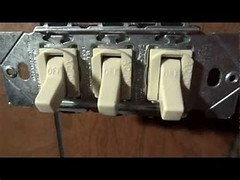
    Is it possible that your switch is something like this? I don't know what they are called but switch and receptacle modules used to be sold so the electrician could make up whatever combination they wanted. I don't know if they are still sold.

  • 7 years ago

    @mtvhike that seems logical, I did not know that you could buy them separately. I have learned so much from all of you. I still will need to call an electrician because all of this is above my paygrade and skillset. Haha! But I am grateful for all of the information and now I even know what knob and tube wiring systems are. :)

  • 7 years ago

    thepinklady-

    Also be aware that the more wires in an electrical box, the bigger the box has to be. I would not be surprised if the electrician will have to replace the existing box if any rewiring is done because new cables will have grounding wires and that means the number of wires in the box will increase. Finally, your wiring may be so old that the box does not satisfy current code requirements even if you don't add more wires. The way the electrical code works is that older wiring does not have to be upgraded to comply with current code until you start changing things.

  • 7 years ago

    What you have there are called Despard devices. Each receptacle and switch is an individual unit. They're back-mounted to a metal strap with 3 standard size holes. The devices are wired, the strap is fastened to the box, and a Despard cover plate is attached.

    Despard devices have never been very common, and I strongly doubt that any are being used for new installations today. I think that most of the Despards I've seen have been in houses built between the end of WWII and maybe the mid-1960s, but they might have been around before and/or after those years.

    Depard replacements are still available. If you want to DIY, a good local electrical jobber (the kind that closes at 5 pm and has vans with electricians' names parked outside) should be able to help you find them. Heck, you can even find Despard devices, straps, and plates on Amazon.

    If you want to have a pro do it, you might consider picking someone who's been doing electrical work since at least the 1970s. :)

    In my admittedly limited experience, loom isn't usually a problem with K&T. Loom is the woven cambric tubing that was used around the conductors for protection where they might be exposed to abrasion. Typically you'll see it on wires that pass through plaster directly into a ceiling light canopy, or on wires entering a junction box. Loom gets somewhat stiff with age, but I don't recall ever finding any that was badly degraded.

    The big problem with K&T is the type R rubber insulation on the wire itself. The rubber degrades from a combination of age, excessive heat, and air pollution (especially in industrial areas). I've had it flake right off when working on wiring in old houses. So you want to move the wires as little as possible.

    If you do damage old brittle insulation and don't want to or can't replace the wiring, the theoretically correct repair (presented here mostly for entertainment value) would be to wrap the wire with a layer of fusing rubber tape, followed by a layer of cloth friction tape. That would be equivalent to the original insulation, and was the code-approved way to insulate soldered splices in the K&T era.

    Those materials can be a little hard to find now, but not impossible.

    I have rolls of both in my toolbox, but in all honesty I very seldom use them for this. My preference is covering the flaking old insulation with a layer or two of good quality heat shrinkable tubing. I keep black and white around, for identifying grounded and ungrounded conductors. . To shrink it, use a heat gun, not a flame!

    In a pinch you can use vinyl electrical tape, but it gets gummy after a while, and I'll say rude things about you if I ever have to work on it. :)

  • 7 years ago

    I do believe that TV's require a "3 wire" outlet: hot, neutral & ground so the existing outlets can't be used for the TV.

Sponsored
High Point Cabinets
Average rating: 5 out of 5 stars21 Reviews
Columbus' Experienced Custom Cabinet Builder | 4x Best of Houzz Winner