Software
Houzz Logo Print
atee62

Heavily compacted lawn soil after construction project

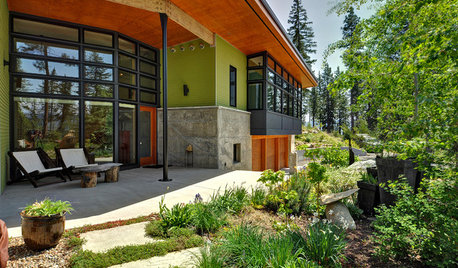
A patio construction project was recently completed on my property and my personal first order of business is to get the lawn ready for reseeding. During the construction they used large, heavy equipment and the lawn got totally trashed and compacted. I can't blame the hardscape firm. They tried their best by laying down plywood but the continuous rains we have had over the last two months didn't help. Then the lawn sprinkler guys came in with their heavy equipment following by several days of more and more rain. More compaction.


The ground is fairly level, but it is now extremely compacted. Once dry it feels like you are walking on concrete. All the grass that was there originally is gone and there is only bare ground now. I want to till it lightly, add some compost material along with additional topsoil, level and then reseed. But I recently read on this forum that lawn soil/ground should not be tilled by machinery. Is this correct?


Can anyone offer their thoughts on the correct process to get the hard, bare ground loose enough for reseeding? Any other advice (soil tests, amendments, etc.) is also appreciated. As an FYI, I had planned on using a national franchise that has a proprietary slit-style seeder to do the actual reseeding. My job is prepping the area for them.


Thanks in advance for your help!

Comments (10)

  • 7 years ago

    I'm the instigator of the no-till approach for lawn care. You have a different situation than everyone else you have read about. You have mechanical compaction where all the air was driven out of the soil by repeated working of waterlogged soil. Rototilling would be appropriate for you. I would not incorporate compost into it. Instead I would incorporate corn meal, wheat flour, soybean meal, alfalfa meal, or any other ground up grains you can find at your local feed store. Cost for a 50 pound bag should be in the $10 to $20 range. These materials, which happen to ingredients in organic fertilizer, will completely disappear in a matter of weeks while feeding the soil microbes. The application rate would be on the order of 20-30 or more pounds per 100 square feet of rototilling. Compost almost always has woody components which do not decay quickly and rob the soil of nitrogen for months or years while it slowly rots. Compost should only be used for surface application where the air provides the nitrogen needed for rotting wood.

    When you do the rototill, try to keep the machine from jumping around. If it hits a hard spot in the ground, it will buck up and leave that area untilled. Go back and get the spot. If it bucks up from a root or rock, that can be a problem in the long run. Tilled soil, as you may have already read, can take years to settle back into a fixed structure. If there are "high spots" under the surface, those will not settle as much and will leave a high spot after all the surrounding soil has settled. That can be fixed later down the road (3 years).

    The no-till approach applies to yards which have no mechanical compaction, but have not been properly cared for (watering). If the soil dries out for weeks or months, then the microbial populations shrink and allow the soil to become hard. The good news is the air has not been squeezed out. This situation can be fixed easily with shampoo or another surfactant which is NOT antibacterial.

    Aurora Tee (Zone 6a) thanked dchall_san_antonio
  • 7 years ago

    " Compost almost always has woody components which do not decay quickly and rob the soil of nitrogen for months or years while it slowly rots. Compost should only be used for surface application where the air provides the nitrogen needed for rotting wood."

    I would disagree wth this comment. It is the particle size of compost that makes it ideal for lightening/loosening heavily compacted soil. It is the lack of porosity or voids between the soil particles that creates the compaction and the seed meals will do nothing to alleviate that issue as they are too small and degrade too rapidly. Whatever woody or barky particles that may be present in compost (and you DO want them) do not rob the soil of N to any significant degree as they are already partially decomposed (so far less N tie-up or unavailabilty) and are offset by the other nutrients the compost contains as well as any fertilizing of the new lawn that may be contemplated. Really a nonissue :-)

    Aurora Tee (Zone 6a) thanked gardengal48 (PNW Z8/9)
  • 7 years ago

    My local county extension did advise not to overtill and the hardscape contractor suggested only 2 to 3 inches.


    We are now getting hot here in Michigan and my goal was to reseed as quickly as possible but I may have to wait until the beginning of September (my luck it will stay hot through October since we got such a late start to warmer weather this spring). Rain is predicted on and off for the next 10 days so I may not get a chance to work on it much.


    So I will most likely have two months of getting nutrients into the ground. So would seed meals and compost both be an option?


    I am overwhelmed by all the landscape and lawn work that needs to be done. I wish I could hire someone but our available money has been spent.

  • 7 years ago

    I'm a fan of letting nature take its course with:

    1) A lot of help and

    2) Trying to mimic what nature does just not at nature's speed.


    And I'm going to disagree back again. " Whatever woody or barky particles that may be present in compost (and you DO want them) "

    You don't want them if you're digging it in. If it's compost, it should be fully decayed and particles shouldn't be woody or bark-like. If they're recognizable as woody or bark-like, they're high in carbon and absolutely will suck nitrogen from any source they can get it to decay.

    That's going to be a problem, from very minor to very major, depending on the amount added.

    I've seen that too many times to count. It can be countered--and small amounts added may be unnoticeable--but grasses grown on it won't perform very well until the nitrogen balance catches up.

    Consider. Nature rarely adds wood directly to deep soils. She lets it rot up top and then the worms and beetles and termites drag the rotten bits down under. Often as poo. When things get buried unrotted, they sometimes don't decay...and turn into fossilized wood. Or fossils. It's rare, but that's the start of things.

    However, if it's fully decayed compost, smells like fresh earth, and has no recognizable bits and pieces, it can be dug into the soil--at amounts up to about five percent. With one warning---it is going to decay off to nothing within a maximum period of five years.

    Which means the soil is going to settle. Which means if you got everything nice and flat, it's going to drop into a divot within five years. Maximum. More if it's a nice environment.


    The rules change for adding stuff up top. You want to chop up wood and toss it up there? Go for it. Sawdust? Have at it, I do (I find Equine Pine pellets to be an occasional nice addition). At the air/soil interface, anything goes. The only restrictions are for things that are dug down into the soil.


    Some meals also work wonders at transforming soils. Cracked corn offers highly fibrous structure with modest nitrogen, and a mild anti-fungal boost to boot. It's one of the best combined boosts for feeding, soil, and protection out there.

    Plus I've been maintaining and improving soil structure quite beautifully just on soybean meal as the worms also rather like the stuff, reproduce quite well on it, and themselves do the work.


    Personally, I wouldn't rototill. It's very hard to get a flat surface after doing so without calling a professional to box-blade. I didn't when the back patio and gardens were installed and I had trucks going back and forth. I should have sprayed shampoo (or my own sodium lauryl sulfate concoction) but it was before Andy and I had developed the formula in a late-night creative chemistry session.

    I fed the area heavily and frequently with organic food, as well as the surrounding areas, and within two years the problem had corrected itself--worms and other critters from microbial to very macro had fixed it for me. It's completely indistinguishable from the rest of the lawn.

    One thing you certainly could do is rent or borrow an aerator and aerate the area several times over. Generally, it's done 2 to 3 times, but for compacted earth, I'd do it 5 to 7 times. Really tear it up.


    There's no reason to load food into the soil at that time or before seeding unless you want to feed any weeds that grow and losing nitrogen to the air and water. Without knowing what your soil is like or what it requires, you're blindly dumping resources, which isn't environmentally sound anyway. You could get a test through Logan Labs if you like.


    Then, wait for temperatures to fall off their high. For you, that's like July 7th. :-) (More like August 10th or so, just when you look out and notice in the evenings that summer is just starting to come to an end and the tree leaves are looking a bit tired). Seed at that point. Feed with a good organic feeding (I'd suggest Milorganite or Ringers or soybean meal or really, whatever you can get) then too. Search around for how to start a new lawn patch or ask at that time because everybody else will be as well, and we've gone through it a ton of times as well. :-)

    Aurora Tee (Zone 6a) thanked User
  • 7 years ago

    Morph, I just saw your reply. Thank you for the detailed response. So far I have done absolutely nothing as the temps here are in the 90s. But what would the difference be between heavily aerating it and using a tiller? Wouldn't they basically do the same thing?

  • 7 years ago

    ...what would the difference be between heavily aerating it and using a tiller? Wouldn't they basically do the same thing?

    Not at all. Tilling is uncontrolled meaning that if the tiller finds a nice soft spot, it can dig in 8-10 inches down. In other places it will hit a root or a rock and jump out of the ground only tilling an inch or two. The difference in tilling depths is the main issue with tilling. The fluffy soil on top settles down to match the profile of the untilled soil underneath. That leaves the surface increasingly bumpy as the soil settles over the next 3 years. Aerating will only dig a plug at the most as long as the aerator plugger.

    Aurora Tee (Zone 6a) thanked dchall_san_antonio
  • 7 years ago
    last modified: 7 years ago

    Last year I rejuvenated and reseeded my lawn. Kind of a shame I didn't wait until this year to do so, but we had bentgrass that was taking over. So after it was killed off, I used an electric de-thatching/ scarifier from made by Sun Joe. It was not fun work. I hired a national franchise to do the slit-seeding and after a soil test we added some amendments during and after reseeding.

    But instead of using the tiller I purchased for this project, should I be using the scarifier to break the compacted soil up a bit? I really don't believe I am physically strong enough to use a rented gas-powered aerator. And if I hire a firm I don't think I can ask them to go over the area more than 2 passes. Luckily the majority of the lawn is doing well so I only have an area of about 50 x 15 feet that is heavily compacted.

  • 7 years ago

    What he said. Tillers will cause you headaches for years to come.

    Scarification is fine if you want, and smaller aerators are easy to use (big ones are certainly not easy or light!). Whatever works for you is best.

    Pro tip: When I seeded? I did nothing. Zip. Nada. Seeds are perfectly capable of penetrating the soil all by themselves. I tossed them down, topdressed with a bit of peat moss, and watered.


    Aurora Tee (Zone 6a) thanked User
  • 7 years ago
    last modified: 7 years ago

    I have reread all of your replies but to be honest I am still feeling a little overwhelmed. I have decided not to rototill and aerate as advised instead. Unfortunately, as I suspected, I don't have the strength to use the rented gas one from Home Depot (the guy was nice enough to start it up outside the store and let me try -- it controlled me and bounced too much). So I found someone willing to come out and do aerate this week for the first time and again before I have it slit seeded four weeks from now. I am hoping to sweet talk him into making several passes over the compacted areas, particularly the first time.

    While the idea of meals, wood chips, etc. sounds interesting, I want to keep this simple for now and use amendments that I can find easily. The compost I was going to purchase was either the type in bags from a reputable nursery or have it delivered from a landscape supply house along with some screened topsoil. My thought was to do the first aeration, let the plugs disintegrate, then add the new topsoil/compost, level with a landscape rake and finally, aerate and slit-seed (again hired out). Is this a doomed or crazy plan? Instead of compost from the landscape supply house, should I used peat moss with the topsoil?

    My other problem besides compaction is that there are TONS of small rocks and some not so smaller ones the size of golf balls. Should I try to get the larger ones out? If so, how?

    Thanks again!


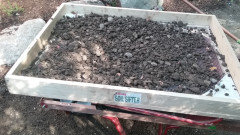
    ETA: I guess I should clarify what I mean by lots of rocks. This is what I pulled up after raking with an action hoe to a depth of about an half inch on a spot of about 2 feet by 2 feet and then sifted. I am finding this amount pretty much everywhere. I think it might be a bigger problem that I realize.