Software
Houzz Logo Print
brent_meyers15

Tap Water Problems - Advice Needed

7 years ago
Hello,


I've been lurking around on these forums for a while now and have learned a ton. I've bought the materials for the 5-1-1 and gritty mix and can't wait to get my plants in the new soil for the next repot. Al, I've read through a ton of your posts and I really appreciate the scientific approach to gardening brought down to the layman's level.


So regarding my current issue. I really like ferns and I've been trying unsuccesfully to grown different types of mosses around my ferns. The moss survives, but it never ¨takes¨ by attaching itself to the substrate and beginning to grow. It just sort of hangs on but the tips slowly brown until the point that the moss dies. I'm sure it is not a moisture problem as I've been very dilligent in keeping the moss wet (at one point I was heavily misting them twice a day). We also have a fairly humid client and don't have heating or ac so the air inside stays fairly moist.


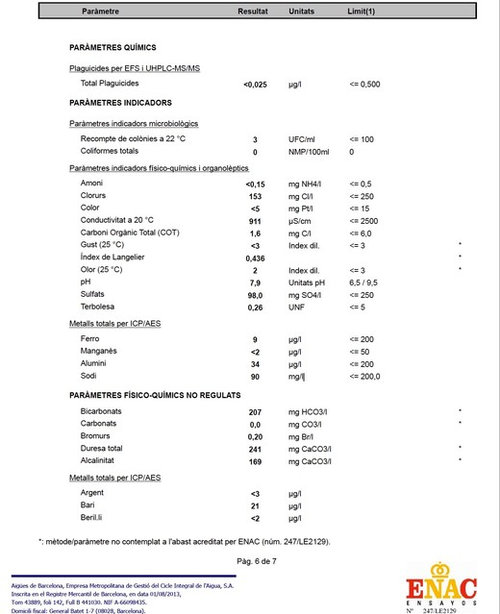
I've slowly come to the conclusion that my tap water is the culprit for the mosses woes. I finally got all of the chemical information from our tap water supplier today, so I'm wondering if someone more knowledgeable than I could sift through these numbers and tell me what is killing the moss.. Once we have that determined, I'd love to hear possible solutions. On a related note, the water seems to be very hard and full of calcium and calcium carbonate and these calcium deposits have already started building up considerable scale on my terra cotta pots (mainly around the rims). Is that going to be an issue? I am fairly careful to flush my containers with 20-30% extra water (percentage based off volume of the container), which should be flushing the excess salts out of the soil, but it doesn't seem to prevent buildup on the pot itself.


Without further ado, I'm attaching two screenshots of my tap water's chemical makeup. In case you are wondering, the language if Catalan. The column titled ¨resultat¨ means result, and the ¨limit¨ column is the legal limit established for every line item. Most of the chemical names should be farely straightforward and the element abbreviations are next to the mg/l measurements.


It seems like there is no column summing Total Dissolved Solids. Without being sure exactly how to calculate TDS (I summed all of the metals, bicarbonates, chlorine, and sulfates) I arrived at a figure around 930 mg/l or ppm.


To my untrained eye, the biggest problem seems to be the 153 mg/l of Chlorine (same as ppm I believe) and the 90 mg/l of Sodium. However, I know very little about what proportions of these elements are dangerous to plants, especially moss. The biggest problem could be the 200 mg/l of dissolved bicarbonates, for all I know.


Thanks in advance to anyone who helps shed light on all of this!


Peace,

Brent

Comments (7)

  • 7 years ago
    last modified: 7 years ago

    To my also untrained eye, it seems that everything's within normal limits. The pH of 7.9, while really good for humans, may be a bit too alkaline for mosses' and ferns' liking. I hope you'll get some expert opinions soon.

  • 7 years ago

    UPDATE: I originally said 153 mg/l of Chlorine but I believe ¨Clorurs¨ is better translated as Chloride. Everything I've read says that tapwater normally does not have more than 5 mg/l of chlorine/chloramine.


    I looked at a different page of the report and it seems that the the ¨total residual Chlorine¨ is at a concentration of 0.84 mg Cl2/liter. I guess if they are adding straight up Chlorine to the water (Cl2) it should gas off if I let my water sit for a while?


    Green vibes, thank you for weighing in. Actually my ferns seem to be growing decently, the main issue seems to be with the mosses.

  • 7 years ago

    Hey greenvibes thanks for the response.


    Yes there are definitely a lot of salts/limescale accumulating along the sides of my terra cotta pots after watering for just a few months. Besides investing in a R/O system and ensuring that I'm flushing the pots each time I water, is there anything else I can do to combat salt accumulation in the soil/sides of pots?


    Thanks for the link about letting chlorine evaporate. Even though I do believe I'm dealing with Cl2 as opposed to chloramine I don't think its worth the time/effort to aerate the water and let the chlorine evaportate when the concentration is only 0.84 mg/l.


    Can anyone who knows more about mosses weigh in as to what might be going wrong?


  • 7 years ago
    last modified: 7 years ago

    Just keeping the conversation alive, in hopes that someone who has successfully been growing moss indoors will chime in.

    Brent, you mention growing mosses around your ferns. What substrate are you using? The moss that’s growing wild behind (northside) my house is attached to rocks and concrete; the one I see in forests is growing on tree bark. Perhaps it’s best to (re)consider the substrate and the water.

    What I would do is remove the plants (ferns and moss) from the pots and scrub those pots really well with a brush, using full strength vinegar to remove the mineral buildup. Then, I’d re-pot using fresh substrate, and water with rainwater or distilled water only. If using distilled water, I’d also add vinegar just enough (a few drops to a liter?) to lower the pH to about 6 (use pH test strips to measure). Other than this or installing a R/O, not sure what else you could be doing. There are ways other than R/O of softening hard water, but they aren’t beneficial to you or your plants, because they exchange Ca++ and Mg++ for Na+ (they add sodium to your water).

    Also, you might want to ask for advice on this forum as well: https://www.houzz.com/discussions/moss-ferns-and-cryptogams

  • 7 years ago

    I've been using straight up potting soil (with a little of the original soil from the forest) in my pots with ferns. I did make an effort to level out the soil as much as possible as I've heard that facilitates moss spreading and growth. On other ocassions I've tried to grow moss on rocks or bark (indoors) but I've always been met with the same gradual browning culminating in death.. Typically I try to grow the moss on the same medium I see it growing on in the forest.


    After a little more reading over on the moss forum, I think it is pretty clear that mosses can't tolerate hard water. They need rainwater or R/O water to thrive, just as you say. The idea about adding a little bit of vinegar to distilled water sounds clever - I'm guessing we are trying to mimic the PH of rainwater.


    It also seems that most people over on the moss forum who grow moss indoors opt for a fine layer of substrate, stearing clear of the thick layer of well draining soil we use for vascular plants The rationale is essentially to keep something akin to a PWT in the media, which we normally try to avoid. However, I don't want to give up on the goal of growing moss in the same container with my ferns, just how they occur together in nature.


    On a side note, I've tried to read up about how bonsai growers grow moss as there are quite a lot of articles on the internet on this subject. Strangely most of these articles don't mention havving to use rainwater/distilled/RO water. I imagine most Bonsai growers are just using tapwater on their trees yet if you are to believe the pictures, many still seem to grow moss succesfully. Maybe the missing piece (this just ocurred to me) is that most bonsai growers have their trees outside where they are exposed to natural rainwater which purges the salts that accumulate in the moss through regular watering. Thats the best explanation I have at least.

  • 7 years ago

    Brent, that’s right: the reason I suggested adding a few drops of vinegar to distilled water is that the pH of non-acid rain is about 5-6; but that's just me theorizing that such action would be beneficial, because I've never actually grown moss.


    You mentioned some bonsai growers using tap water on their moss, with no ill-effects; my guess is they don't have that level of hard water in their tap.


    Also, I imagine there are different types of mosses, some that do better than others indoors?


    I’d be interested too in hearing others' opinion on this. However, you seem to be very well read on the subject, so I think you’ll succeed.