Software
Houzz Logo Print
destiny_c

Electrical Boxes - Does this look right?

6 years ago
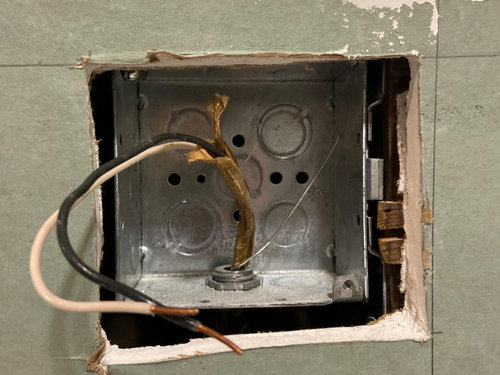
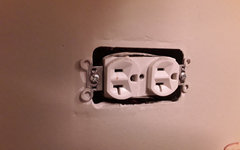
With the pandemic, my GC let me know he did not know when he would be returning to finish his job. He only charged me for installing these electrical boxes and adjusting my plumbing. I had a neighbor who is a retired union electrician come by to look at our progress and he asked why the GC installed 4x4 boxes for single outlets. Hubby and I didn’t know how to respond thinking it was standard. So until my neighbor comes back to help us install the outlets, I thought I’d ask you all and see if this looks right. We cut the drywall around the 4x4 but now not sure what to do if we’re only using single outlets.


Comments (33)

  • 6 years ago

    Thank you for responding! We thought that about the box as well. Unfortunately , I’m responsible for the poor drywall cut out. When he left, he left the walls open and with no working kitchen, hubby and I were forced to put up the drywall and make the cuts. They are indeed not done properly, so we’ll need to readjust.


    Is there a box extender you recommend that we can use? I’m so desperate to have my kitchen finished. Especially with young children.

  • 6 years ago

    Box extenders are inexpensive and are available at any Home Depot, Lowe’s, or hardware store for $1-$2. They are typically easy to install, but the box being not parallel to the face of the sheetrock is a problem, and should be corrected.

    Lynn thanked kudzu9
  • 6 years ago

    I don't see the issue with the box. The licensed union electricians I know would have used that same setup. Unless there is a limited space, the 4 inch box is standard here and purchased by the carton. The box appears to be at the correct depth but I can't see for sure. There are hooks at the front of the bracket which are used to line it up with the front of the stud.

    The problem I see is he did not put the mud ring on the box prior to putting up the drywall. The mud ring is purchased at the correct depth for the wall covering, normally 1/2 inch for new drywall or 3/4 if matching up to lathe and plaster. Then the drywall is cut only as needed for the mudring opening.

    Regional practices may vary. For example, our area requires metal boxes and conduit and standard outlets are set horizontally.

    Lynn thanked Lyndee Lee
  • 6 years ago

    Thank you!


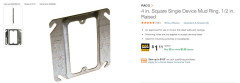
    I was doing some research and came across this. Would this work?


  • 6 years ago
    last modified: 6 years ago

    I was doing some research and came across this. Would this work?

    No. As Lyndee Lee says, you need a mud ring and then redo the drywall.

    You don't have to redo all of the drywall, just fix the areas around the boxes and take your time mudding and sanding. It will be well worth your trouble to fix that now rather than try alternate solutions.

    If you are bad at drywall (which I certainly am) Use the mud ring to cut the outlet hole into a small piece of drywall. Then attach the mud ring onto the box and position the small drywall piece appropriately, and use that as the template to cut in your patch. You can get a good looking job with much better cutouts that way.

    Good luck.

    Lynn thanked bry911
  • 6 years ago

    Thank you so much for that info! I’ll head over to Lowes tomorrow.

  • 6 years ago

    Maybe it's the way the photo is taken but where is the bare ground wire?

    Lynn thanked User
  • 6 years ago

    I agree with what was said above. A box extender and some decent finish drywall work can solve this. It's a good thing your contractor bailed, his work is shoddy and unsafe.

    Lynn thanked Ron Natalie
  • 6 years ago
    last modified: 6 years ago

    It's a good thing your contractor bailed, his work is shoddy and unsafe.

    I don't see anything wrong with the contractor's work. The box was installed to use a mud ring which is common with good electrical work in older houses being remodeled. It gives you adequate room in the electrical box without depth, which is often required in remodels. I would personally take it as a sign of an electrician doing things the right way.

    The drywall is not done very well, but the OP did the drywall and not the contractor. In the OP's defense, drywall is a tough skill to acquire. In my opinion, the only way to become good at drywall is to spend the appropriate amount of time being bad at drywall.

    Lynn thanked bry911
  • PRO
    6 years ago

    You should have put plaster rings on before you sheetrocked.

    Lynn thanked Creative Design Cabinetry
  • 6 years ago
    last modified: 6 years ago

    where is the bare ground wire?

    Look to the right. It's cut too short as it's supposed to be wrapped around a grounding screw and then on to the receptacle. A wire can be added. Also, there seems to be just one screw holding the box to a stud; should be another one. (I was about to get a flashlight to check. But it won't help from here.)

    Hack job all around as noted in the first response. Not even the right box for a standard duplex or GFI receptacle!

    Lynn thanked worthy
  • 6 years ago

    Worthy, I'm so used to seeing bare copper wire coming out of the jacket that I didn't see that wire. Is it a heavy enough gauge?

    Lynn thanked User
  • 6 years ago

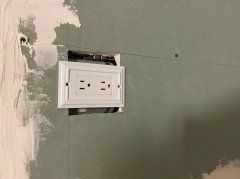
    @worthy, lol, a flashlight would de be ideal. Our neighbor came by and him and hubby removed the drywall to make some adjustments to the boxes. I have no idea how to maneuver electrical and definitely understand why it’s something a professional should do.


    Just a note, the contractor removed all of the lathe and plaster so the boxes are only screwed into the studs on one side of the electrical boxes.


    This is me as of yesterday, not knowing how to go about it. 🤷🏻‍♀️

  • 6 years ago

    A plaster ring should have been installed during the rough-in. The sheetrock is then cut out to expose only the extended end of the plaster ring. That is the only thing I see wrong, electrically speaking. Unfortunately, you didn't know this before you installed the sheetrock. A 4x4 box provides more room for making joints on the wiring. The 4x4 box is not necessary for an end-of-run like the one you have pictured but the end-of-run is not usually known when installing the boxes so it's common practice to just install a 4x4 box at all locations. Plaster rings are available for different thicknesses of finished wall materials. bry911 posted a picture of one above. (Licensed Master Electrician >40 years)

    Good Luck.

    Lynn thanked stevesbackyard
  • 6 years ago

    Thank you @stevesbackyard! I will update the thread with pictures today with what the boxes look like.

  • 6 years ago

    Depending on where this is in your house, you might want to install two duplex receptacles to give you a "4-plex". Much nicer if you have more than two devices to plug in.

  • 6 years ago
    last modified: 6 years ago

    ^^^^^^^^^^^^^^^^^

    Good idea. (Unless this is a kitchen.)

    I'm so used to seeing bare copper wire coming out of the jacket that I didn't see that wire. Is it a heavy enough gauge?

    It appears to be the ground wire, which is part of the Romex cable, so it's fine.


    (BTW, a professional would as a safety matter twist a wire connector on at least the black conductor in case the box was inadvertently powered.)

  • 6 years ago

    A mudring doesn't correct the fact that the box is set too far behind the surface (and that is illegal and unsafe). If the box had just been flush with the back of the drywall, that may have been true, but the box is set way back. Second, most mudrings (and this is what they are designed to do) are to reduce the opening of the box (typically turning a two gang box into a single) in cases where you need the larger box for box fill use. It's not designed to compensate for slipshod installation of the boxes and the drywall. That box place meant is unsafe.


    Further, as someone else pointed out, I've got my doubts about the ground wire. That doesn't look like a proper NM ground wire, and even if it is, it is illegally too short.


    I'm not even going to address how crappy the drywall is. Slathering compound all around those gaps isn't a great solution, It will eventually crumble as compound isn't designed as structural, you're supposed to use it to join (with the use of tape) two adjacent pieces. The marking just indicate what a goofball the drywaller was. They cut the hole way oversize and the box screws are still covered by the top. I also have my doubts about what it's attached to. It seems like the stud is set way back from the drywall and they shoved some lathe or something in there to shim it out (probably because the framing is about as imprecise as everything else on this job).


    Lynn thanked Ron Natalie
  • 6 years ago

    @Ron Natalie, unfortunately the drywall was my work, which was admittedly not done to professional standards. I did seam both top and bottom with mesh tape and slapped the compound over. My thought was sanding it down and going forward with the backsplash when the cabinets were installed.

  • 6 years ago

    A mudring doesn't correct the fact that the box is set too far behind the surface (and that is illegal and unsafe). If the box had just been flush with the back of the drywall, that may have been true, but the box is set way back.

    Why is it illegal and unsafe?

    314.20 In Wall or Ceiling. In walls or ceilings with a surface of concrete, tile, gypsum, plaster, or other noncombustible material, boxes employing a flush-type cover or faceplate shall be installed so that the front edge of the box, plaster ring, extension ring, or listed extender will not be set back of the finished surface more than 6 mm (1⁄4 in.).

    ---

    Boxes added to plaster and lathe walls are often set behind the lathe because of the likelihood that they get removed in the future. Now maybe there is no lathe left anywhere and it is a really bad job, but I assumed that the box was set to the front of the stud and the drywall was built over lathe somehow. I could be wrong.

    Lynn thanked bry911
  • 6 years ago

    Give the discoloration on that cable jacket, I’m guessing that’s an old, existing cable that got stuffed into a new box, and now it’s too short to comply with code. The solution is to either run a new cable, or reposition the box a few inches so there is adequate length for proper connection.

    Lynn thanked kudzu9
  • 6 years ago

    Not old cables. This was all new per the gc’s requirement. He removed all old outlets and wires/cables and ran everything new to the electrical box right below in basement.

  • 6 years ago
    last modified: 6 years ago

    Why is it illegal and unsafe?

    the concern is that in case of sparking from a short, flammable materials will be exposed, creating a fire hazard.

    I've actually seen the charred wood from exactly that in diy renos. (Not to mention the diy electrical boxes cobbled together from wood scraps!)

    Lynn thanked worthy
  • 6 years ago
    last modified: 6 years ago

    @worthy, people have actually made electrical boxes with scraps of wood???? I cannot wrap my head around that and would see the house going down in flames quickly.

  • 6 years ago

    The ground wire is fine. That’s not a NM cable (romex), it is what is commonly called a BX cable (spiral armored). The ground wire need only be connected to the box, then the receptacle needs a wire to connect it to the box. Don’t worry about arcs or sparks escaping from the box and starting a fire; the plaster ring covers tight to the box to prevent this. That is one of the primary purposes of small electrical box covers and plaster rings are listed for the purpose.

    Lynn thanked stevesbackyard
  • 6 years ago
    last modified: 6 years ago

    That's not NM or BX, it's type AC cable evidenced by the thin sliver bonding strip that runs up diagonally from the box fitting. The bonding strip doesn't need to enter the box nor is it attached to box or device(s). Typically it's just folded back along the cable and captured by the box connector with the excess trimmed. What I'm not seeing is the red anti-short bushing but maybe it's the camera angle.

    I actually prefer 4" boxes and mudrings because they give you room for future expansion with a minimum of fuss. There isn't much of a cost difference between those and a single gang box.

    I'm sure Ron will correct me but my understanding is the the junction box sits flush with the front of the stud. The mudring then fills in thickness of the drywall.

    And, yes, the mudring should have been installed before the drywall. Either measure carefully and cut the drywall or use a rotary tool to make the cut (some experience required).

    Lynn thanked johnc777
  • 6 years ago

    JohnC is absolutely right.


  • 6 years ago

    You are mostly correct. There is no BX cable in the code book that’s just what the trade commonly calls the variations of spiral armored cables. Somewhat correct about the ground wire too but, if required to be connected, it must be connected to a dedicated ground screw, not a box or cover screw. Since the ground wire is aluminum, I’m sure the cable is listed to carry the ground without termination at all, provided the connector is listed for the purpose. I was trying to keep it simple for the homeowner and err on the safest side. BTW - the Sheetrock is installed on furring strips, that’s why the box is so far back. Destiny, finding a plaster deep enough wont be easy, if you can find one at all. Your local electrical supply can help.

    Lynn thanked stevesbackyard
  • 6 years ago

    My local Home Depot stocks 3/4 mudrings. They might be more common here as a large portion of our housing stock has plaster walls. In an area with mostly newer housing, you might need to order what you need.

  • 6 years ago

    Mud rings come in many depths. 1/2", 5/8", 3/4" and 1". You need the correct size for the box set back. And yes they are installed before drywall. Even if you put a double plug or plug and switch or USB set up you need a ring. That type of box is not made to fasten a receptacle to without adding a ring.

  • 6 years ago

    I added an adjustable mud ring and the oulets and cover fit perfectly with the drywall. Luckily only one drywall cutout was a bit too large so I’ll have to rectify that.


  • 6 years ago

    Looks like the right people chimed in to help you =). Johnc mentioned it at the end but I’ll mention it too...a rotozip does wonders for cutting openings for electrical boxes, cans etc for the future.