Software
Houzz Logo Print
scorpiononx

Fiddle Leaf Fig Mealybugs Damage

6 years ago

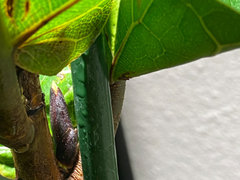
Hello, I’m new to plants and need help with the FLF that I just got from a local nursery less than a week ago. A couple of days a go I noticed that it had some Mealybugs on it near the new growth area. As I was treating it I noticed that there was damage on the stem where the new growths are. Stem was covered under the brown bits where Mealybugs were. Assuming the Mealybugs were eating it? The new growths are growing(for now). What should I do? Will the plant able to heal itself from Mealybugs damage?

Comments (7)

  • 6 years ago

    I don't think mealy bugs do that kind of damage. looks like mechanical damage maybe?

  • 6 years ago

    I found it like that under the brown sheath after peeling it off to treat Mealybugs. Should I tape/glue it? The leaves are still growing I’m afraid it’s gonna get too heavy for the weak stem to handle and eventually break off.

  • 6 years ago

    Hm... what you propose is not a solution, it will not strengthen that stem. Actually putting a splint on a stem will weaken it. If i thought this would always be a weak point, I would remove it now so that the stem doesn't "fail" after the plant had already spent energy to build a new branch there. But, it might not be as big of an issue as you expect, the plant will callous over this "injury" and I think it might be fine with time.

    I realise I said a whole lot of nothing there. how someone more experienced will have a better feel of how the plant will react to this damage.

    Elena

  • 6 years ago

    Sorry but you've had it for less than a week?

    I wouldn't do anything except return it to the Seller & ask for a refund. Why even try to fix it? Just get a new, uninfected plant, even if you need to take a magnifying glass to inspect the underside of the leaves.

  • 6 years ago

    Thank you everyone for your help.


    @tapla (mid-Michigan, USDA z5b-6a) I hope that the plant is strong enough to hold up the new leaves. It would be nice to see the healing process and see the plant grow.

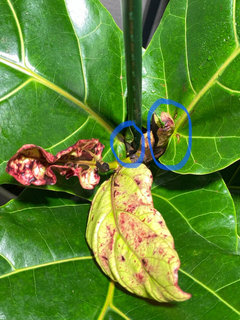
    I am very that they plant gives out three more new growths since then! (See pics)


    However, I think the older two leaves might have edema? The leaves have a lot of these awful red dots and some of the new growth as well. I might help to tell you about my watering schedule. I water when the first few inches of the soil is dry using a chopstick method, making sure no dirt is sticking to it. I also use the the 6-2-4 fertilizer. I water till the water runs out of the drip tray and let the plant sits there for about 15-20 mins to soak up the water then dump the excess water out. I also have a full spectrum grow light on for about 16-18 hours a day because it sits near the north facing balcony. Lastly, I have the humidity at around 45°-60° all day. Any suggestions on how I can improve and combat edema? I realized that those red dots won’t go away and I am okay with that. Thank you!

  • 6 years ago

    I hope that the plant is strong enough to hold up the new leaves. It would be nice to see the healing process and see the plant grow. It's full strength will return as the wound is repaired by the formation of callus tissue, just as you see in the images I provided just above. Also, as the weight of foliage on the new branch increases, it compresses the new wood forming in the inside of the branch's curve, which increases the strength in that area.

    However, I think the older two leaves might have edema? The leaves have a lot of these awful red dots and some of the new growth as well. Be careful who you listen to. There is a popular website that claims status as a resource for reliable information about FLFs, but I have found their information to be questionable at best. I mention that because they promulgate the idea maroon spots on new foliage are evidence of oedema. They are not. They are an expression of the pigment anthocyanin, which is a very common occurance in the emerging leaves of many Ficus species. Not only that, the products they sell ("special" fertilizer, soil, and root rot treatment) are offered at rapacious prices, even though they are watered down versions of other products readily available for a fraction of the price. Another member recently offered a link to their site, which was a disappointment. I wrestled with pointing out the reason for my disappointment, but decided against mentioning it.

    I really didn't see any evidence of oedema in the images provided so far, but I did see some necrotic areas that are probably related to over-watering, but could be old mechanical injuries (the equivalent of a bruise in humans).

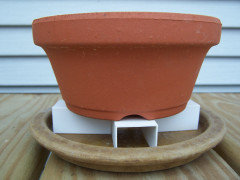
    It might help to tell you about my watering schedule. I water when the first few inches of the soil is dry using a chopstick method, making sure no dirt is sticking to it. You're probably over-watering. Continue to use the 'tell', but water when the soil is almost dry at the bottom of the pot. I also use the the 6-2-4 fertilizer. Would you please provide a link to what you're using. The NPK ratio (3:2:1) is great, but surprisingly, most fertilizers lack several nutrients essential to normal growth. I water till the water runs out of the drip tray and let the plant sits there for about 15-20 mins to soak up the water then dump the excess water out. Try to avoid any practice that allows the effluent (waste water that exits the drain) a pathway back into the pot. We flush the soil when we water to rid the soil of accumulating salts and fix the imbalance of the nutrients lingering in the soil that occurs over time. It's best to water over the sink and return the plant to its collection saucer after the pot has stopped draining; or, set the pot up on blocking so the bottom of the pot is above the highest level reached by the effluent.

    I also have a full spectrum grow light on for about 16-18 hours a day because it sits near the north facing balcony. That's good. I run my lights 16/8. Lastly, I have the humidity at around 45°-60° all day. That's quite a wide range. The plant would prefer humidity on the higher end of the range, but that might not be possible in the winter. I can't go above 60% in the winter w/o risking mold problems. Any suggestions on how I can improve and combat edema? I realized that those red dots won’t go away and I am okay with that. The red dots should go away as the leaves mature, and the best way to combat oedema is by using a highly aerated medium that makes it difficult to over-water, one that holds little or no perched water. I wrote something about oedema I'll copy/paste to the end of my post.

    I know you're a new FLF owner, but, do think it would be beneficial to look over An Overview of Good Growing Practices? There is also a thread I posted about Long Term Care of Ficus in Containers.

    Oedema

    Oedema is a physiological disorder that can affect all plants. It occurs when the plant takes up more water than it can rid itself of via the process of transpiration. The word itself means 'swelling', which is usually the first symptom, and comes in the form of pale blisters or water-filled bumps on foliage. Under a variety of circumstances/cultural conditions, a plant's internal water pressure (turgidity) can become so high that some leaf cells rupture and leak their contents into inter-cellular spaces in leaf tissue, creating wet or weepy areas. Symptoms vary by plant, but as the malady progresses, areas of the leaf turn yellow, brown, brown with reddish overtones or even black, with older damage appearing as corky/ scaly/ ridged patches, or wart/gall-like bumpy growth. Symptoms are seen more frequently in plants that are fleshy, are usually more pronounced on the underside of leaves, and older/lower leaves are more likely to be affected than younger/upper leaves.

    Oedema is most common in houseplants during the winter/early spring months, is driven primarily by excessive water retention in the soil, and can be intensified via several additional cultural influences. Cool temperatures, high humidity levels, low light conditions, or partial defoliation can individually or collectively act to intensify the problem, as can anything else that slows transpiration. Nutritional deficiencies of Ca and Mg are also known contributors to the malady.

    Some things that can help you prevent oedema:

    * Increase light levels and temperature

    * Monitor water needs carefully – avoid over-watering. I'd heartily recommend a soil with drainage so sharp (fast) that when you to water to beyond the saturation point you needn't worry about prolonged periods of soil saturation wrecking root health/function. Your soil choice should be a key that unlocks the solutions to many potential problems.

    * Avoid misting or getting water on foliage. It slows transpiration and increases turgidity.

    * Water as soon as you get up in the AM. When stomata close in preparation for the dark cycle, turgidity builds. If you water early in the day, it gives the plant an opportunity to remove (for its own needs) some of the excess water in the soil.

    * Put a fan in the room or otherwise increase air flow/circulation. Avoid over-crowding your plants.

    Al

Sponsored
Bella Casa LLC
Average rating: 5 out of 5 stars17 Reviews
The Leading Interior Design Studio in Franklin County