Software
Houzz Logo Print
highcolddesert

Uncured cement in my garden soil -- Help!

6 years ago

When my house was being built, the contractor allowed the workers to mix cement directly on empty land in the area in front of the house. It got covered and mixed with other soil.

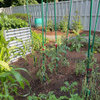
A year later when I started making vegetable garden beds, I just pulled stones out and mixed compost right into the existing ground. That was last summer. Things didn't grow great, but I got a late start and the summer was unusually cool. Asparagus seems to be doing fine (which might indicate salt or alkaline), and thankfully the peas are currently doing well. Most other stuff is not doing so hot.

But in spring, a lot of white mineral deposits appeared around the edges of the beds. I am in the desert and the beds are slightly sunken for the purpose of watering, which is the traditional growing method here.

Can anyone steer me to sites explaining what happens when inadequately cured cement is mixed into soil? Do you think I can use sulfur to reduce the pH? Will huge amounts of compost eventually solve the problem?

I am in a country where I can't just buy topsoil. I might be able to bring a few truckloads of desert soil that is known to work well as garden and field soil, but if possible I'd like to rectify what I've got. Even if I bring in loads of new soil, where do I dump the old soil? (Maybe I'll use it to make a dedicated large bed for the asparagus, but there are problems of topography and space)

Comments (18)

  • 6 years ago

    Is there a place you can send a soil sample to in order to get it tested? You really need to know what you have before attempting a cure.

    tj

  • 6 years ago

    Ugh, good advice, I know, but I'm not sure where I can get a soil test. I think there are no regular labs available to the public to get soil tests at will, but maybe I can find a friend of a friend in such a lab. I'll try to ask arund


  • 6 years ago
    last modified: 6 years ago

    Concur; A soil test would tell you more precisely what you are dealing with. The major components of cement are calcium silicates and gypsum. It is alkaline. Many desert soils are already alkaline so you you probably have a high pH. Sulphur may help but the process is slow. Many vegetables are tolerant of High pH as you have noted.

    HighColdDesert thanked farmerdill
  • 6 years ago

    As soon as moisture hit it, it cured. It probably leached out some highly alkaline leachate too. I agree, check the pH and see what you have. It is probably not too far off or nothing would grow at all. But it may need adjustment if some of your crops did not do well.

  • 6 years ago

    Sulfur is slow, and if the pH is very high (especially if it's higher than the native soil in your area), you might consider using slightly acidic water on it. Say pH 5-6, using vinegar. You could probably look up a dilution ratio for that, but it's probably something in the range of a teaspoon per gallon of water. But check the soil pH first.

  • 6 years ago

    @ZachS. z5 Platteville, Colorado

    Great, that is very encouraging, thanks! On the plus side, generations ago the ancestors of the person who sold us this land did make fields here. One the minus side, they evidently abandoned those fields, for what reason I know not, and by the time we built here, it had reverted to desert exactly like the surrounding land which had never been farmed.

    Yes, I can get truckloads of dry cow dung, and have done so. It's hard to keep it damp enough to compost, but I hope soon I'll build bins for it and cover it with scrap plastic, and that will help. Otherwise, I did mix in a fair bit of cow dung that I had tried to water and break down, but maybe it wasn't well composted before it went into the soil. Can that also cause minerals to appear?

    @toxcrusadr I always thought that concrete needs to be cured by watering daily for at least 12 days. Maybe in some sense cement cures as soon as water hits it, but the junk in my soil that I call uncured cement is chunks of blue-grey cement and aggregate that often crumble in my hand when I try to pull them out to remove them. I believe that fully cured concrete might not be a serious problem for gardening; it becomes like a slightly alkaline stone. This stuff though, I suspect, is dissolving into the surrounding soil. Though I don't know for sure.

  • 6 years ago

    Yes, manure can be very high in salts depending on the source. A lot of the manure we get out here in the west comes from feed lots where animals are pooping and peeing in the same spot for days, or weeks on end and the salt content can be as high as 10%. These salts typically get leached out during the time it takes for the manure to compost however, but if the manure was not composted they didn't have time to "drain away" so to speak.


    I feel you on the whole dryness thing. It's hard to keep anything moist here when it hasn't rained a drop in 4 weeks and the wind blows at a constant 15-20 mph (on a "slightly breezy" day). But I'd rather deal with that than humidity.

  • 6 years ago

    This wont address your soil problem, but may be some useful information for your future gardening endeavors.: waffle garden


    Waffle gardening is an ancient agricultural technique from the American Southwest. I use a similar method in my own garden where I dig a shallow basin around the base of each plant to collect water from either rain or my hose. In dry climates, hydrophobic (water repellent) soils are common and by collecting the water near the root zone, it not only allows water to be collected and reduces runoff, but allows it to slowly percolate deeper into the soil.


  • 6 years ago

    Yeah, I guess all gardens here might be what you call waffle gardens, though we don't use that term in my country or region. All garden beds are recessed in the ground or surrounded by a small raised line of soil, and we water by flooding the bed and letting it soak in.

  • 6 years ago

    I tried pouring a tiny bit of vinegar on the garden soil today, and it sizzled like crazy, foamed up, then soaked down, leaving a scum of foam on top. Sheesh, it must be really really alkaline! Ugh...

  • 6 years ago

    If it's leachable alkali, it will eventually wash away with watering. If it's the soil itself - i.e. a lot of limestone - you can try to change it but it will generally go back to where it was. Compost is about the only thing that will mitigate the effects. You can grow in high limestone soil, if there is enough organic matter for the plants to get what they need despite the pH.

    HighColdDesert thanked toxcrusadr
  • 6 years ago

    Thanks. I've been watering very deeply a couple of times this week since I started this thread and have been freaking out about it, and I'm scheming out how to get a lot more manure and make compost bins so the manure is better composted for next year.

  • 6 years ago

    Now I finally tested vinegar on other spots of soil nearby and they don't fizz, so I think the problem with my garden soil is mainly the cement left behind after construction; the workers mixed cement directly on the ground.

    So does anyone here know, or can you steer me to a soil science website, if I can rectify this with sulfur? Or should would that react and make a new problem? Should I just bite the bullet and have my topsoil removed and bring in new?

  • PRO
    6 years ago

    Greetings! High Cold Desert frequently extension services and/or counties have soil testing that is free to residents. If not there must be labs that will do it for you at a minimal investment if you send in samples. Typically you get a report that is very detailed about NPK present or needed as well as PH and trace elements. Ultimately compost will improve any soil but there may be other issues to solve to get nice crops next summer. Good luck!

  • 6 years ago

    Sulfur is slow because it relies on microbes to convert it to sulfuric acid before it can react with the base. You might want to do something more direct, such as aluminum sulfate. Depending on what you want to grow, there may be a risk of having too much soluble aluminum, so watch out for that.

  • 6 years ago

    You mentioned getting a lot of manure. If I was you I'd compost it right on this spot. For one thing, the leachate (what there is of it, in a dry climate) will be slightly acidic and will help neutralize some of it, plus a compost pile always enriches the soil below it. You can't go wrong. A lot of folks do this as a slow passive way to start a new bed in poor soil. I've done it myself, and just till it all in the next spring, or dig a hole in it and plant through it.


    As for water for the compost, I lived in Albuquerque for years and still have family there. I'd suggest a chicken wire or pallet bin lined with plastic with just a few holes. Or, a bin like the Home Composter or Earth Machine which are plastic with few holes. Save wastewater. I dry weather, even here in MO, I have a bucket in the kitchen for dish rinse water, produce washing water, etc. It gets thrown on the lawn or garden. If this is not too inconvenient for you, it would be great water for the compost. And it makes you feel good. During the epic 2012 drought I was plugging the tub drain during showers and scooping out 10-15 gallons of water for the gardens.

  • 6 years ago

    Those are great ideas, and do-able. I'm going to do them!

    My greywater all goes out to a little canal to some ornamentals and trees, but it's a good idea to intentionally save some dirty kitchen water to put on the compost heap too. The greywater canal already gets more than enough