Software
Houzz Logo Print
rouge21_gw

Any experience with "Orange Rocket" barberry?

6 years ago
last modified: 6 years ago

karin_mt's oldie but goodie now revisited thread titled Worthy shrubs to use in a mixed bed coupled with GardenHo's When the joy is gone.... has again got me reevaluating the plants in our garden.

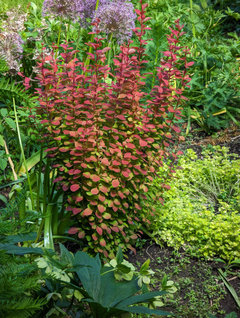
I was at a friend's earlier this season and I was very impressed by a couple of specimens of what she told me was "Orange Rocket" Barberry.

https://www.gardenia.net/plant/berberis-thunbergii-orange-rocket-japanese-barberry

The colour was spectacular and I like the narrow profile (and of course being a barberry they are for sure drought tolerant). I asked where she got them and she wasn't very forthcoming...something about these barberries being "banned" in Ontario?? (Are certain barberry more invasive than others?)

Just posting to see what others say re their real world experience with this shrub.

Comments (35)

  • 6 years ago

    Excellent post Skip909. Thank you.


    And yet in my locale I dont recall seeing barberries in the "wild".

  • 6 years ago
    last modified: 6 years ago

    The feral barberries that I see in northern Virginia forests have green foliage. The thorns and general shape of the shrub scream barberry so they are noticeable.

    rouge21_gw (CDN Z5b/6a) thanked cecily 7A
  • 6 years ago

    These are sterile. No danger of spread.

    rouge21_gw (CDN Z5b/6a) thanked Sara Malone Zone 9b
  • 6 years ago

    Thank you Sara.


    I wonder why I am having a hard time sourcing this barberry here in Ontario Canada.

  • 6 years ago

    Many examples I see here are having a problem maintaining a columnar shape. If you do an image search you can find plenty of photos showing the same issue. There are also web sites that talk about it fruiting, but I don't know how solid their information is. That is if they are really using information known to apply to 'Orange Rocket' specifically or if they are misapplying canned remarks about Berberis thunbergii in general.

    Unfortunately the patent description says nothing about any fruiting of this cultivar one way or the other:

    patft.uspto.gov/netacgi/nph-Parser?Sect1=PTO1&Sect2=HITOFF&d=PALL&p=1&u=%2Fnetahtml%2FPTO%2Fsrchnum.htm&r=1&f=G&l=50&s1=PP18411.PN.&OS=PN/PP18411&RS=PN/PP18411

  • 6 years ago

    Yes, not as columnar as advertised but definitely grows taller than wide :-) I find the coloring very appealing however, and have used it a lot in design work.

    Not all J. barberries produce fruit or seeds in significant numbers. APHIS has done an analysis on various popular cultivars - some are copious seed producers and others produce very few, if any. There are also a few sterile cultivars of J. barberry on the market but Orange Rocket is not one of them. And more continue to be developed. However, sterile or not, one is unlikely to find these plants available in Canada....read this for an explanation why.

    rouge21_gw (CDN Z5b/6a) thanked gardengal48 (PNW Z8/9)
  • 6 years ago
    last modified: 6 years ago

    The two I saw earlier in June on my friends property were desirably narrow.

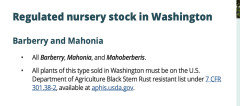
    Anyways I heard back from my nursery contact and as you linked 'gg', he said it is not available here because it is a secondary host for wheat rust.

  • 6 years ago

    Which is exactly what that link pointed out.

    rouge21_gw (CDN Z5b/6a) thanked gardengal48 (PNW Z8/9)
  • 6 years ago

    ('gg', if you read my post I did give you credit ;))

  • 6 years ago

    What is interesting is that my state - Washington - is one of the top five wheat producing states in the country. And yet Japanese barberries are not restricted in their sales here at all!! And neither are they considered invasive or even freely seeding here. Perhaps it is also a climate related issue with respect to the rust as it is with the self-seeding.........

    rouge21_gw (CDN Z5b/6a) thanked gardengal48 (PNW Z8/9)
  • 6 years ago

    And yet Japanese barberries are not restricted in their sales here at all!!


    Canada is more risk averse? ;)


    (My friend who has several specimens had said she got it from another gardener. It would make sense that somehow he brought it across the border surreptitiously.)

  • 6 years ago

    Very interesting. Thank you. A friend persuaded me to pull out a well grown older crimson pygmy. I still miss it. There is no adequate substitute. physocarpus doesn't even come close

    rouge21_gw (CDN Z5b/6a) thanked Marie Tulin
  • 6 years ago

    IDK about being more risk adverse :-) Since agriculture is a primary industry here, one would think that factors that would adversely impact this industry - like wheat rust, for instance - would be very closely monitored and controlled if they came into play at all. The negative impact on agriculture does account for a large majority of our noxious weed/invasive species listing.......but no mention or notation on barberries at all.

    rouge21_gw (CDN Z5b/6a) thanked gardengal48 (PNW Z8/9)
  • 6 years ago

    Without knowing anything else it seems to me that USDA doesn't believe that barberries have anything to do with the transmission of "wheat rust" whereas Agriculture and Agri-Food Canada does(did) and so it seems that Canada is (still) erring on the side of caution.

  • 6 years ago

    There is a USDA-APHIS process for getting barberry approved for sales.


    rouge21_gw (CDN Z5b/6a) thanked pennlake
  • 6 years ago

    This was very educational. I have read over and over again about how invasive barberries are, yet even though I frequently hike in wooded or Prairie areas, I have never seen one growing wild. Perhaps zone 5 is too cold for them to reseed.

    rouge21_gw (CDN Z5b/6a) thanked Nancy R Chicagoland 5
  • 6 years ago

    The varieties with heaviest seed set have been banned in Minnesota so there must be some evidence it can reseed in zones 3-4.

    rouge21_gw (CDN Z5b/6a) thanked pennlake
  • 6 years ago

    Also in the PNW and have many varieties including Orange Rocket over the last 40 years I have never had any seedlings. The longer I garden, the more I recognize a plant’s response to even small variations to climate and site. And of course, this is all changing before our very eyes with climate change.

    Thanks for initiating the thread, Rouge. It is an interesting one.

    rouge21_gw (CDN Z5b/6a) thanked cercis47
  • 6 years ago

    Never seen any seedlings from any of my Berberis cultivars over 20+ years, even in areas where I overhead water. And many have berries.

    rouge21_gw (CDN Z5b/6a) thanked Sara Malone Zone 9b
  • 6 years ago

    Barberry seeds with unfortunate enthusiasm here, and unfortunately, the farmer next door uses management practices that encourage its growth.

    rouge21_gw (CDN Z5b/6a) thanked NHBabs z4b-5a NH
  • 2 years ago

    UPDATE June 2024


    My friend propagated her OR and gave me it a few years back. Every year since the rabbits would eat it down in the winter. But now it seems to be holding it's own.


    M

  • 2 years ago

    That looks very nice, Rouge! I used to have a red one and a golden one. Before they were banned, I guess. I don’t think it has been mentioned here that there are now barberry cultivars that can be sold in Ontario. As I understand it, they do not spread the wheat rust. I saw them here and there the last few years, also at Terra. They had a dwarf form, supposed to stay small all over, not columnar.

    rouge21_gw (CDN Z5b/6a) thanked gdinieontarioz5
  • 2 years ago

    Berberis thunbergii is invasive and growing it will allow birds to spread the seeds everywhere. I really hope you reconsider growing it rouge!

    rouge21_gw (CDN Z5b/6a) thanked Jay 6a Chicago
  • 2 years ago
    last modified: 2 years ago

    Hey Jay, it appears that this particular variety is "well behaved"?

    And I quote from this site:

    https://plantpreview.blogspot.com/2012/08/sterile-barberry-is-non-invasive.html

    Orange Rocket Barberry PP18411 lacks flowers and has never been observed to set seed. It is not invasive.


  • 2 years ago

    They said the same thing about buckthorn and callary pear. Why chance it? It's a slap in the face to the hundreds of people I know who are restoring degraded ecosystems. It's troubling that you would even consider growing it. Is the selfish need for visually spectacular cultivars worth adding more plants that no wildlife can use?


    rouge21_gw (CDN Z5b/6a) thanked Jay 6a Chicago
  • 2 years ago

    Jay, I do agree it is not native but from what I am reading, that unlike many other barberries, it does not have a viable seed set and therefore it cannot be invasive. If someone can show me otherwise ie that *OR* produces viable seeds then I will remove it.

  • 2 years ago

    One of my neighbors has an old green barberry and it has reseeded in my yard a few times but that is over a 20 year period. I'm not a big barberry fan because of the thorniness. I don't even see the birds using it. I don't doubt that some places it has invaded woodlands, I just wonder if there are certain special circumstances?

    I have another neighbor who has bittersweet in his yard and that is reseeding on my property all the time and it is a nuisance. That same neighbor has Poison Ivy climbing the trunks of 4 spruce trees. And we do get that in the yard too.

    But interestingly, the plant that has caused us a whole lot of work, is a native vine Virginia Creeper. It appeared in my garden on it's own and I thought, 'oh, a nice native!' So I let it go. In 5 years time it covered a 60 x 10ft bed and a 6ft stockade fence all along that bed and we've been pulling it all out last year and we still have a long way to go. It is not easy and has to be dug out and is intertwined with all the other plants in the bed which I am afraid I may have to ditch because I don't have the energy to unwrap them all.


    rouge21_gw (CDN Z5b/6a) thanked prairiemoon2 z6b MA
  • 2 years ago

    Lol, the special conditions that lead to Berberis thunbergii invading fragile ecosystems are the people planting it in their yards! Prairiemoon is your neighbor's bittersweet the native C. scandens or the invasive C. orbiculatus? I dont consider Virginia creeper overly agressive. Just last night, some prophet of doom was accusing Virginia Creeper of killing trees. Ive never seen it strangling a tree, but I often see it climbing up already dead trees. Those vines arent covering any branches and they didn't strangle the trees. A misconseption. Basically, Virginia Creeper vines eminate from a rather small, shallow root system. They can completely cover the ground and cause people to assume it's rhzomatous, like Goutweed, but it's rather easy to control imo. One always has to check for any further growth after removing them, but prophets of doom enjoy scaring people. They are always on hand when someone needs to ID an umbellifer. They can't wait to pour out their sinister descriptions of Poison Hemlock and the evil Cow Parsnip.Why, just looking at them from a distance can cause severe blistering of ones eyeballs, and make sure you keep your mouth closed when passing Conium maculatum, so the leaves don't jump into your mouth Lol. There would be more dark prophesies if Oenanthe grew here too. Poison Hemlock is as dangerous as the electrical outlets in your house. Your dog and kids don't stick their tongues and silverware into the electrical outlets do they? They would also avoid poisonous plants if you told them too.

  • 2 years ago
    last modified: 2 years ago

    While I very much understand and support the concern regarding invasive plant species, we would all do well to remember that issue is very much locationally determined. A plant that may display invasive tendencies in one area of the country (or even closer - regionally) may well be perfectly well behaved elsewhere. Putting forth blanket dismissals of these plants is not productive nor is dismissing the development of sterile cultivars that significantly reduce or even eliminate the invasive threat. Horticulturists are intent on developing sterile or noninvasive cultivars of a variety popular garden plants that have proved problematic - like butterfly bush, nandina and Japanese barberry.

    It is also important to realize that we all have our own gardening styles. Some prefer to go all native, others are collectors, some focus on specific plant types (like conifers) while others just plant what pleases them. No way is more valuable or important than another and it is highly presumptuous to demean or criticize anyone for not gardening according to your personal beliefs!

    I never met a barberry I didn't like so it's great they are not considered invasive anywhere on the west coast. I particularly like Japanese barberries for their extremely useful diversity of sizes, shapes and colors. I use them frequently in my designs and grow several myself.

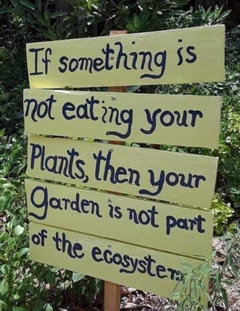
    btw, that signage is so bogus. LOTS of plants do not get eaten by whatever and are still contributors to the ecology, if by nothing more than carbon sequestration.

  • 2 years ago
    last modified: 2 years ago

    Jay, did you read my post? You don’t consider Virginia Creeper overly aggressive? I think you have missed the point of my post.

    My point was, that in my garden, Virginia Creeper created more work and caused more disruption than a number of other non native plants that I’ve been warned against time and time again. More so than any other plant in my garden.

    Having to clear an entire 60x10ft bed of it, is a huge job in my world. And not the kind of garden work I enjoy doing. Imagine how I would feel toward a person who might have recommended that vine to me as a garden worthy plant. I am surprised that you don't have some sympathy for me ending up with that job. I think my experience is important to share with other gardeners so they understand what can happen in their own garden with the plant.

    And one of my pet peeves are Native enthusiasts who elevate the acquisition of natives to a personal quest and try to bully other gardeners into growing natives exclusively. I have enjoyed all of your photos of natives you grow. I grow a lot of natives. But your post is pretty negative toward other gardeners who have questioned the use of one native or another. From my viewpoint, it’s not all or nothing. Natives aren’t always the answer in every situation. You do realize that right?

    rouge21_gw (CDN Z5b/6a) thanked prairiemoon2 z6b MA
  • 2 years ago

    The National Gardening Assoc database says Orange Rocket fruits & naturalizes. The RHS database also says it fruits.

    rouge21_gw (CDN Z5b/6a) thanked cecily 7A
  • 2 years ago
    last modified: 2 years ago

    Oh....and one other point, I think I need to make, Jay points to 'fragile ecosystems' being invaded.....what do you think my garden is? It's it's own ecosystem, that I have been developing and encouraging for 30 years! And is it any more fragile than another? And a 1/4 acre suburban property has it's own challenges just like a huge forest, and Virginia Creeper is not the plant for that ecosystem.

    rouge21_gw (CDN Z5b/6a) thanked prairiemoon2 z6b MA
  • 2 years ago
    last modified: 2 years ago

    And here is a very interesting article on 'Worry Free' Barberries, but, why they may never be available for sale in Canada.....

    Why Worry Free Barberries may never be available in Canada

    rouge21_gw (CDN Z5b/6a) thanked prairiemoon2 z6b MA
  • 2 years ago

    I am late to this discussion. My scepticism runs deep about any plant being sterile. L’il Kim hibiscus and allium Millenium are both touted as sterile. In its 7th year in my garden L’le Kim is seeding. Millenium is too. My point is that their reproductive behavior is not consistent with the advertising.