Software
Houzz Logo Print
anholod

Brick walkway: Gaps in soldier course edging

5 years ago
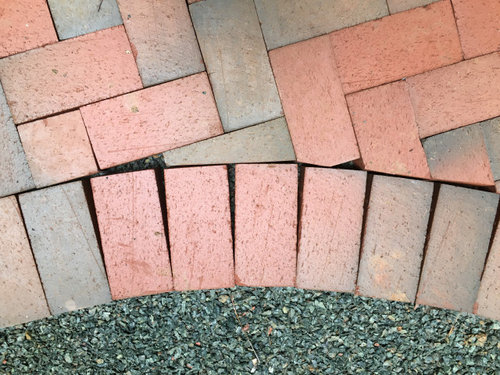
I've got a hardscaping job in progress, and I'm disappointed with the masonry work. The job included replacing the old, rotting wooden front steps from the front of the house, burying downspouts, regrading, and putting in a brick walkway. The contractor is disorganized and somehow didn't register that my specs called for a curved soldier course, even though I discussed that with them at the estimate stage and it is written on the blueprint. That added a lot of time to the job, and instead of cutting the bricks so that they were flush with a less than 1/8th inch gap, they've plunked them down whole around the end of the path. This was supposed to be a 4-5 day job and they've been here for 6 days already and need to come back tomorrow. (There were complications related to the deck work that I paid extra for... a rotten rim joist.) I talked to them about the gaps on the brickwork today, and they just said, it would look weird if you cut the bricks. I take that as code for, "We don't have the time/budget/skills to give you a soldier course that is flush." They've already concreted the edge of the path and they'll put the polymeric sand in tomorrow. Advice about negotiating with the contractor or is this a lost cause? For the record, I did check references and look at photos of their past work. Due to the complexity and scale of the job, few contractors were interested, and this one had the most reasonable price. Stone masons here are making a killing building outdoor kitchens for other, wealthier clients.


Comments (15)

  • 5 years ago

    Not a pro, but to me that looks like crap. I would insist on fixing it. Let them know you have lots of photos and expect it fixed. Is it all like that, or just one spot?

  • 5 years ago

    I can see the did cut the field ones, but left a hole in two areas.

    The walkways that I've looked at did not seem to have their bricks cut, but the curve was not as tight. But maybe with a few cut they can get a tighter joint.

    Patios · More Info


  • 5 years ago

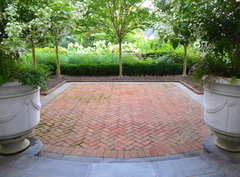
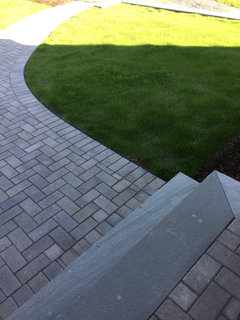
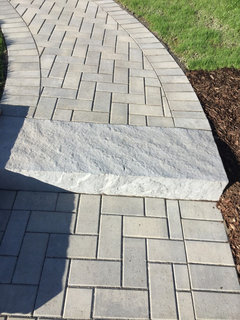
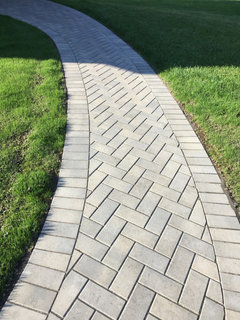
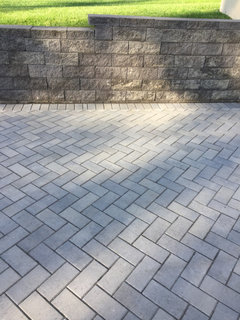
    I attached some pictures of my paved areas. The curved areas show very little gapping.

  • 5 years ago
    last modified: 5 years ago

    I see you have chosen the cheap brick pavers from the big box store, not the ones that interlock (they have little nubs on the sides). It is critical that there is a bed of sand (or 1/8 chipped stone if available in your area) to lay the pavers on so you don't get the lippage that I see. Also, a concrete haunch used for perimeter edging is not the best method. A perimeter soldier course is not typically cut as pie slices; the radius of the curve is addressed during design. A mason is not the person to call for non-mortared flatwork, a landscaper with paver experience should be the proper contractor.

    As far as polymeric sand, there is a specific method to laying and watering, which I assume this contractor won't know. There also needs a minimum of 1/8" gap between bricks.

  • 5 years ago

    3onthetree, we intentionally chose the straight edge brick from a local supplier that manufactures in-state, because we did not like the look of the bricks that interlock... they result in bigger gaps and more visible sand. This was done by a landscape contractor who does a lot of hardscaping, albeit more often with concrete pavers. We had a design drawn by a landscape architect (a neighbor/friend), so I'm not sure what you mean by "radius is addressed during design." The design showed the curve and specified a max 1/8th inch gap. The landscaper didn't do it to spec. Maybe the plan needed more detail, maybe I needed a bigger budget, or maybe I just needed a different contractor? We also spoke with stone companies that specialize in outdoor stone structures, i.e. house facades, kitchens, patios, driveways, walkways, etc. Most of them quoted double or were not interested in the job, unfortunately. Some of them didn't want to work with brick.

  • PRO
    5 years ago

    It’s not what you pictured but it looks ‘normal’ to my eye. As prn says it will blend once it has the sand.

    Lorina Street thanked HALLETT & Co.
  • PRO
    5 years ago

    I would fill in gaps with concrete/cement.

    Lorina Street thanked Celery. Visualization, Rendering images
  • PRO
    5 years ago

    Clay paver bricks generally test at 11-13k psi compressive strength so I wouldn't agree that they're a wrong or "cheap" alternative to concrete pavers. I prefer sand cast for this application vs wire cut but that's a personal preference. On the curve, I think it's too open of a radius to justify cutting the bricks for tighter gaps. I actually think it would look odd. Once the joint sand is in place it'll look like any normal brick walk.

    Lorina Street thanked Revolutionary Gardens
  • 5 years ago

    Maybe to explain in more detail and further expand on the "cheap" moniker. It is perfectly fine to buy clay pavers (which I've seen for $0.89ea) which are typically locally produced for sale in any region. However, because they are not interlocking, they do not maintain a consistent gap and therefore need to have more care taken in placement. Polymeric sand should have minimum 3mm (1/8") gap to perform its function, and sometimes max 1" (verify with specific manufacturer). There would also not be issues with lippage if there was a sand bed. When installing non-interlocking pavers sometimes you get bouts where you require installation similar to stone, when you have to adjust lippage with a mallet and gaps with a putty knife. Note that clay bricks do chip easier, and spall very easily in freeze/thaw climates. You already have a start as I see a few chipped bricks just in this little picture. A concrete haunch is inferior to a plastic/metal edging. Here the installer would have benefited from a plastic edge to set a more uniform curve. For the soldier, the larger the radius, the smaller the gaps between soldier bricks.

    Yes the contractor did a poor installation by not understanding the materials chosen. However it seems they do not understand how to install a patio in general.

  • 5 years ago
    last modified: 5 years ago

    Hi again! 3onthetree, wanted to report back that the landscapers cut tiny brick triangles to fill those gaps on the herringbone on the last day of the job. I don't know why, but the plan written by my landscape architect said a MAX gap of 1/8 inch. I don't see lippage. They installed the brick over a 5 inch crusher run base, with a layer of small gravel on top, saying that a sand base would not be advised because of my drainage issues... it wouldn't hold up. They used the plat compactor and then put in the polymeric sand, and I think they compacted again (I was in the back of the house so I'm not entirely sure). The landscapers did try to talk me out of using clay brick when we set up the job, but the concrete holland bricks they offered didn't have colors I liked. They were basically gray or tan, and I didn't want to have to deal with the sealing. All of the contractors I spoke with only offered one brand of clay brick, which is made 1.5 hours from here. I assumed they offered it because it was "local", but I'm clearly no expert on landscaping supplies. Anyhow, they gave us what I asked for. I did get an answer to my question about cutting the soldiers (thank you to all who replied), and I'm less concerned about that now that the sand is in. Others were right that it wouldn't look so odd with the sand. Also, the contractor said he'd come back to add more polymeric sand over the next couple of weeks. I do think we got about what we paid for.

  • 5 years ago

    Thanks for the update.

  • 5 years ago

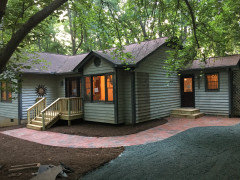
    Here's the finished job!


  • 5 years ago

    Looks great❣️I like the curved path.

    Lorina Street thanked kculbers
  • 4 years ago

    Very, very sweet. Which brick name is that one? It looks excellent with the green house!