Software
Houzz Logo Print
webuser_528228756

How to Insulate Wall Cavities formed by 2x4s?

4 years ago
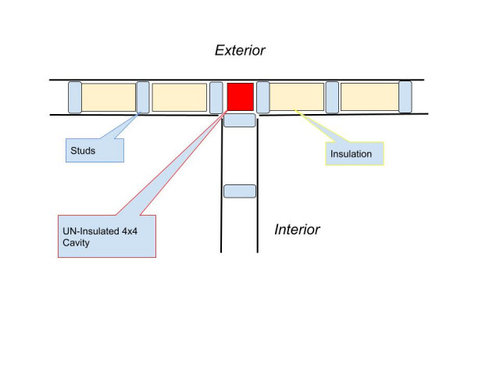
Building a house in central TX. I have a number of spots where, on an outside wall there is an intersecting or adjoining wall whereby the studs form a 4" x 4" enclosed cavity at the exterior wall. There are modest gaps where you can see or stick a knife or thin screw driver thru.


But by no means can you push any insulation batting in that 4" x 4" cavity.


They are squirting some canned foam spray on the seams (and sloppily w/ air gaps I might add) to attempt to close up the cavity. But that leaves an uninsulated air pocket in the cavity.


What is best practice or code here? Should that cavity be filled/insulated with something since it's on an exterior wall? Or is it OK to seal up the gaps and leave it as a cavity?


Thanks,


Comments (11)

  • 4 years ago
    last modified: 4 years ago

    The best practice is to use ladder blocking or other advanced framing techniques that eliminate all those unreachable voids in exterior walls in the first place.


    You could drill holes and pump in expanding foam, but the results will be hard to control.

  • 4 years ago

    Part A: Is there code or best practice that these cavities should be insulated?


    If so -


    Part B: Is there a code I can leverage to force the issue to be addressed.


    Part C: Actual solution - I can't justify re-building the walls - I too was thinking some small holes to allow spray strays to fill the cavities. But first I need to win the battle of getting them to agree they need to be filled with some sort of insulation.

  • 4 years ago

    Would blown-in cellulose insulation be an option?

  • 4 years ago
    last modified: 4 years ago

    Blind corners, interior-partition-to-exterior-wall connections and headers over doors and windows can be insulated as they are built. But when they're not, the un-insulated space should ideally be accounted for in thermal calculations.

    Unless you are having this house custom-built to your specs, including plans with those details, I'd venture you're at the mercy of the builder and the local building inspector. Last year, Texas adopted IRC 2012 and the International Building Code as the municipal statutory codes statewide.

  • 4 years ago

    If you're in central Texas and the IRC applies, your climate zone is either 2 or 3. If you're in zone 2, the insulation requirement is R13 which can be met with fiberglass insulation. If you're in zone 3, the minimum requirement is R20 or R13 cavity + R5 continuous sheathing.

    In either case, the inspector should require all cavities in the exterior 2x4 walls to be insulated to R13.


  • 4 years ago

    what should have happened is insulation installed after framing but before sheathing. Usually this is done in an insulation prep trip at the same time as behind prefab tubs before they are installed and overhangs. If house is sided/stuccoed already holes can be drilled and open cell spray foam blown in but that would be expensive.

  • 4 years ago

    Exterior foam sheathing is a Best Practice that should be a requirement at this point. If you are building with a tract builder, good luck with anything Best Practice, as it might add $1 to the builder’s costs. And unless he can upcharge you $3 it will not happen.

  • PRO
    4 years ago

    Insulating any cavity where interior and exterior walls meet is a best practice that's, well, not typically practiced. Unless you're building a really, really tiny house, the amount of heat transfer at those intersections will be pretty small compared with the home's overall heat transfer. I don't know what the Texas residential code allows, but the International Residential Code (IRC) allows an overall heat transfer approach (UA method) to demonstrate compliance with code requirements. I believe Worthy refers to that in his post above. With the UA approach, your builder wouldn't need to insulate those cavities to comply with code, provided there are offsets elsewhere. I wouldn't push the issue.


    In my opinion, the more important consideration at the intersection of interior and exterior walls is air leakage which can be addressed by drilling some holes and using spray foam insulation to fill the cavity from the interior side. Since the volume is enclosed, I recommend a low pressure expanding foam and drilling a series of holes. If you buy a kit, I suspect you'll find other places to use spray foam as construction progresses.

  • 4 years ago
    last modified: 4 years ago

    Are you concerned about meeting the building code or the additinoal cost of heating and cooling?

    Unless the framers did something unusual, the cavity is probably 2" wide instead of 4" and if you insulate the first stud bay of the interior wall, the heat loss/gain path is somewhat insulated.

    Its not good practice to omit the insulation but there are other more critical parts of the building envelope that you should be thinking about like the windows and the roof/attic.

  • 4 years ago

    As others have stated - don't stress about it. I doubt there is any code argument that can be realistically made - you are in TX and not CA - and even in CA these things probably happen all the time (although presumably the term California corners came from CA).

    I am in NC and no one stresses about these things except on a high performance house when advanced framing is used. I would say that only the high end custom houses worry about this and then you aren't using 2x4 construction. I live in a high-end tear-down neighborhood, built with AF myself, and what I see is that perhaps 20% of builds in this high end custom market use advanced framing.


  • PRO
    4 years ago

    Drill a hole(s) and spray foam in?


    The instruction seems straightforward enough to not need explanation, but if it does, filling voids after framing for the purpose of air sealing is done all the time using spray foam insulation. If you drill a hole in the bottom portion of the stud of the interior wall where it intersects the exterior wall you can inject spray foam. I recommend a couple of holes so you can work your way to the top of the cavity.