Software
Houzz Logo Print
jaxo_gw

How long before heat pump dryers become mainstream?

3 years ago

I am moving appliances away from natural gas to electric. I have already replaced the gas range with induction and will be getting solar panels in a few years.

When the HVAC eventually needs replacing in the next few years, I plan to switch to a heat pump.

Then, when/if I change my gas water heater to electric, I will be able to permanently shut off the gas and terminate that utility account.

I have a washer dryer set with a gas dryer that I want to switch to an ultra-efficient heat pump style when it comes time to replace it. However, the selection for heat pump dryers serns very limited. Probably fewer choices than I had for induction ranges.

How much longer before heat-pump dryers become common or even default for all-electric dryers?

Comments (37)

  • 3 years ago
    last modified: 3 years ago

    Heat pump dryers are different than condensing all in ones though.

    They are separate dryers that should be able to made with the same capacity as any other dryer.

  • 3 years ago
    last modified: 3 years ago

    There are some large capacity heat pump dryers now.

    https://www.lg.com/us/dryers/lg-DLHX4072W-electric-dryer

    The main issue I see is the slower drying times that take longer than the wash cycles. So, if you let your laundry pile up and need to do back to back loads, it will be an issue waiting for the dryer to finish the previous load before you can start another wash load.

    If you have a large laundry room, you could put in two dryers to solve this just like some people have two dishwashers in their kitchens.

  • 3 years ago

    They will never be popular. The technology doesn't support their use.

  • 3 years ago
    last modified: 3 years ago

    We have one because we needed ventless electric dryer, and there were very few options, and only one locally available with larger capacity because: yes, it needs to fit a full sized quilt, as we have an old dog that sleeps on the bed; my guinea pigs have fleece bedding that goes in the washer and dryer, which makes for a large load; and we wanted a dryer with similar capacity to our existing washer. We have a Whirlpool, and it works nicely, though I would say it takes longer than a vented electric dryer. We just use the sensor setting and wait for it to be done; if it is taking a really long time, the lint filter needs to be recleaned (we clean it before each run). I have no idea about efficiency; that wasn't a factor in selecting our dryer (only criteria were: ventless, electric, available near us, and size).

    To answer the question:

    There's going to need to be a lot more larger capacity ventless dryers before they become more popular in the US; most are about 4 cubic feet. Price will have to come down, as well; I think they're about double to triple cost currently.

  • 3 years ago

    Please note the above-refeerenced LG dryer is discontinued.

  • 3 years ago

    Since the LG is discontinued, this new GE all in one looks good.

    It solves some of the issues of the older all in one systems, has a heat pump for drying and has large capacity. Can do a complete wash and dry in about 2 hours.

    https://www.geappliances.com/appliance/GE-Profile-4-8-cu-ft-Capacity-UltraFast-Combo-with-Ventless-Heat-Pump-Technology-Washer-Dryer-PFQ97HSPVDS


  • 3 years ago
    last modified: 3 years ago

    Whirlpool has 2 ifferent models.

    lower priced model


    higher priced model

  • 3 years ago
    last modified: 3 years ago

    "Assuming that the heat is taken from outside air, then for conventional hot air drying here in New England during winter one would have to have a heat pump that could extract heat from air between 30F and -20F and release it at dryer air temperatures -- more than 100F."

    They dryer isn't outside ... it takes inside air; basement don't generally get below 45° even when it's cold, and I don't think anyone keeps their living spaces colder than that. No one is keeping their dryer far away from their washer, so it's going to be in an environment where the pipes won't freeze.

  • 3 years ago
    last modified: 3 years ago

    The big issue with those is that it may hold 4.8 cu ft, but if you want things to ever get dry, you can only fill to half capacity at most.

  • 3 years ago

    Since it has a heat pump instead of relying solely on condensation drying, maybe the GE can dry a full load well. I’ll need to see some real world reviews.

    Still might be worth it even if you can’t stuff it full. 2 hours start to finish isn’t much longer than using a front loader washer and dryer separately and you have the convenience of not having to transfer clothes between units.

  • 3 years ago

    This is the one we have ...

    https://www.whirlpool.com/laundry/dryers/electric/p.7.4-cu.ft-front-load-heat-pump-dryer-with-intiutitive-touch-controls,-advanced-moisture-sensing.whd560chw.html


    If you're trying to convince people to get one, that's probably going to be the most palatable, since it's the only one with a larger capacity that I know of.

  • 3 years ago

    You are not understanding fabric care, or heat transference technology, if you think you can just ”stuff it full.“ That is a recipe for a big damp ball of wrinkles that are fully set.

  • 3 years ago

    "you have the convenience of not having to transfer clothes between units."


    This assumes you only ever do all dryer loads or all non-dryer loads. My loads are usually mixed unless it's bedding, towels, or guinea pig bedding. Mixed loads would still require taking the load out to sort out the non-dryer clothes and putting back the dryer items.

  • 3 years ago
    last modified: 3 years ago

    It’s expensive at $2900 before even adding a pedestal.

    I suppose I could get a complete traditional Speed Queen set that would last twice as long for the same price range, but no heat pump dryer from Speed Queen.

  • 3 years ago
    last modified: 3 years ago

    You'll also find that all-in-one washer/dryer units tend to be inferior at both washing and drying to their single-function counterparts. Jack of all trades ... master of none. They fill a niche, though, since they take up half the space.

  • 3 years ago

    It looks promising.


  • 3 years ago

    @BlueberryBundtcake - 6a/5b MA wrote:

    "They dryer isn't outside ... it takes inside air; basement don't generally get below 45° even when it's cold, and I don't think anyone keeps their living spaces colder than that. No one is keeping their dryer far away from their washer, so it's going to be in an environment where the pipes won't freeze."

    I assumed it was inside but taking heat from the outside air. If it takes heat from the inside air, then the house heating system, directly or indirectly, has to supply the initial level of heat and deal with the cold air exiting the condenser coils. So does the house heat come from a separate heat pump? From electric heating? Oil heating? I have some doubts about the efficiency of this scheme unless every stage of heating is by a heat pump. Note that such a configuration will be equivalent to two heat pumps as I remarked.

    Now, to be fair, my comments assume cold winters. If the OP is in an environment like that of San Diego, a heat pump dryer makes sense, and might not be more expensive to operate than a gas dryer, depending on fuel cost meddling by the state.

  • 3 years ago

    The few videos I've watched from that Yale guy, there are always a few misstatements or errors. Regards to heat pump dryers, he says heat pumps have been around in air conditioners since the 1990s. That's wrong on a technical point and also on the timeframe which goes back much further. There were window units in the 1950s with reverse-cycle heating. I counted four technical errors, one repeated twice.

  • 3 years ago

    Can you get a standard electric dryer in the meantime? While not super efficient, it as least does not run on gas so you cut off that utility. I think there will be a lot more options on the market as large cities have passed bans on gas in new construction and appliances will eventually have to catch up to that market.

  • 3 years ago

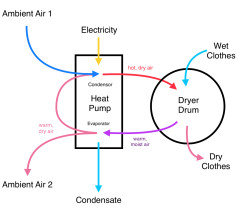
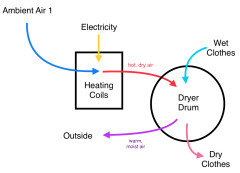
    Ummm ... pretty sure most dryers take in ambient air and then heat it before adding the now-hot air to the drum ... A heat pump dryer just uses heat pump instead of burning gas or electrical resistance.

    Or, if you prefer a (simplified) diagram:


    Ambient Air 1 and Ambient Air 2 are the same environment, but the outlet isn't feeding the inlet ...


    And here's the conventional dryer (simplified) diagram:


  • 3 years ago
    last modified: 3 years ago

    Let's discuss how a heat-pump condensing dryer works.


    At not time is there any exchange between the air that is trapped in the closed loop to dry the clothes and the ambient air. There is no need to pull or add heat or cold from the ambient air.


    I have a Bosch dryer. It has a small fan (like the ones found in desktop computers) that comes on towards the end of the cycle. It pulls air through the cabinet merely to expel excess heat from the inside of the cabinet. This is air from around the drum, control boards, motor etc. NOT the inside of the actual drum (which is, once again, a closed loop). The reason the dryer does that is because, unlike vented dyers or air condensing dryers, it cannot simply cool the clothes without the hot side of the heat pump being active as well. So it just tries to blow ambient air around the drum to eventually cool the drum and thus the clothes. Some dryers have a third radiator that IS outside the closed loop. It has a fan next to it and helps to pull heat from the heat pump to actively remove heat from the refrigerant circuit to cool the clothes down. Those having a Miele HP dryer will know the whirring sound shortly before the cycle ends.


    I have a Bosch dryer in my 65 sq.ft. bathroom. Even if I close the door (not recommend) it never gets above 79F. And it certainly does not get cooler.


    Heat pump dryers, just like induction, are the norm in Germany and I suppose most of Europe. Looking at a German price comparison website, I see
    1,122 heat pump dryers listed versus 237 air condensing and vented dryers. Some brands simply no longer make vented dryers or even "regular" condensing dryers.


    Samsung sell a 7+ cubic foot dryer in Europe and Australia (and possibly elsewhere). Surely there are others but the main demand for oversized dryers seems to come from the US... where there is seemingly little demand for large heat pump dryers, so...


    In Europe, the success of heat pump dryers is mainly a result of energy costs (I pay almost 40 Cents per kWh). I guess if electricity and gas become more expensive in the US more manufacturers will start selling their larger HP dryers there as well due to an increase in demand.

  • 3 years ago

    Thanks @BlueberryBundtcake - 6a/5b MA for the helpful drawings. Passersby may wish to think of the block named "heat pump" as containing both a condenser and an evaporator. This will be like having both halves of a Mitsubishi split cycle air conditioner in one room with the clothes receiving the hot hair from the condenser side, and the condensed water from the evaporator side pumped away.

    Some things to consider: To get condensate ambient air 2 has to be colder than the dew point of the hot drying air after mixing with the clothes. The hot drying air has to be hot enough to evaporate water from wet clothes at a desirable rate. The question is COP (coefficient of performance) when operating between the required hot and required cold temperature differential. (The electrical power as heat is added to the heat transferred to "hot dry air.")

    In an earlier comment, I suggested cold-side ambient air 2 released into the house would have to be re-heated by household heating. However, the second law of thermodynamics insists that the system overall generates heat equal to the electrical power supplied. So ambient air 2 could be warmer than household ambient unless the electrical heat added is contained within the condensate, which would then be warmer than ambient. The heat balance (temperature difference) between ambient air 2 and condensate may be adjustable by the design, with the trades being drying time and COP.

    It would be interesting to know these parameters for an existing design.

  • 3 years ago

    @Kendrah I don’t think getting a standard electric dryer makes sense. i wont be able to turn off the gas utility until I also switch the furnace and water heater to electric. So, I would be buying a new appliance and increasing my utility costs since standard electric dryers use so much power.

    There is also a gas fireplace, but it’s easy to just not use it. Maybe it can be converted to an alcohol burning fireplace or full electric.

  • 3 years ago
    last modified: 3 years ago

    Yes, I simplified to Heat Pump ... there is a compressor in there turning electricity into work, and, as marked, a condensor and an evaporator. I also left out all the blowers, filters, motors, controls, and there's likely a cooler somewhere to prevent the possibility of overheating. None of those things really matter for this kevel of conversation, though.

    Ideally, Ambient 1 and Ambient 2 don't need to exist, and the system works as a closed loop. They are thermodynamically inconsequential. The dryer isn't a fully closed system, though ... it's a clothes dryer. What they may take and give is not going to impact the house ... that's why they don't have to vent outside. It's the primary reason people buy them.

  • 3 years ago

    This was from 11 years ago by Miele, but the process is the same today.


    We have the Miele T1 dryer. It has over 6000 hours on it now. Not a single problem. Most loads are done in an hour or less. Loads of towels are done in around an hour and fifteen minutes.


    https://m.youtube.com/watch?v=IWqNmOLHwt0


  • 3 years ago

    Do any extra large capacity heat pump dryers exist that can be placed on a pedestal and also are designed to drain the water out to your plumbing without needing the gravity assistance you get by stacking it over the washer?

    The ones I have seen require you to manually empty a water tank unless you stack it over your washer. Stacking them would mean no pedestal for the washer and no upper cabinets.

  • 3 years ago
    last modified: 3 years ago

    Yes ... the Whirlpool ... it's not stacked.

    No pedestal required ... ours doesn't have one and no manual emptying.

  • 3 years ago
    last modified: 3 years ago

    I do want pedestals to avoid stooping down on my knees to load and unload. I just don’t want stacking or manual emptying of a water tank.

  • 3 years ago

    Nice description by Miele, @luna123456. Seems COP ≈ 2.

  • PRO
    3 years ago
    last modified: 3 years ago

    The most energy efficient dryer is still solar. Nothing beats the scent of line dried laundry either.

  • 3 years ago

    Energystar.gov allows you to filter out large heat pump dryers. Nothing new there besides the Whirlpool units and the one that's part of the WashTower.

    There is a Samsung DV53BB89**H* listed as a stand-alone unit with a 7.8 cubic feet drum. However, that units seems merely to be listed but not on the market yet. I've only found Reddit posts of people also looking for it.

  • 3 years ago

    You could put a pedestal on it ... but it's not required for gravity purposes. If you look on the Whirlpool website, it shows it either with or without a storage drawer pedestal.

  • 3 years ago

    There's more to heat pump dryer efficiency than heat pump COP. Conditioned air isn't discharged out of the house because heat pump dryers are ventless. The cost of reconditioning the makeup air includes removing humidity in some climates/seasons. The 5th post in this thread contains a calculation I did for that:


    https://www.houzz.com/discussions/4737310/is-it-time-to-go-ventless 

  • 3 years ago

    I'm in an all-electric house, with (air source) heat pump HVAC and electric appliances - I kinda wish I'd shopped for a heat pump dryer, since an electric dryer is such a beast with respect to energy usage, but I didn't really think about it at the time since I have a dryer vent. I would guess that it will be 3-5 years before the demand grows and more models become available. There's an increasing need for less space and I think that will be matched with an increased demand for no (external) venting.

    Unless you'll be storing your solar energy with your own battery (bank), you may want to consider an automatic generator that will start up in case of a power failure.

  • 3 years ago

    I found another video on the GE washer/dryer that addreses some of the things mentioned in the comments here.