Software
Houzz Logo Print
twoschnauzers

VentaHood Premium Power Lung (V-Line) Under Cabinet

2 years ago
last modified: 2 years ago

I need a 30 inch under cabinet hood for a 30inch Wolf induction cooktop. The V-Line would fit nicely in my space and meet the requirements of allowing between 21-24 inches (23) between cooktop and hood. My hesitation is it doesnt seem that powerful. The specs say it is 250 CFM or 375 equivalent CFM. Does anyone have this hood installed and are you happy with the performance? Does it capture well?

Comments (19)

  • 2 years ago

    Capture is a matter of overlapping cooking plumes that expand as they rise. Containment is a matter of not letting what is captured back into the room. The former requires a hood that overlaps the cooktop; the latter requires an air speed into the hood that is sufficient for entraining the effluent into the hood flow. Beating this topic to death over the past decade or so has beaten down my motivation to discuss it in depth today. Here are some references to cuddle up with on New Years Day. The first need only be reviewed for about a dozen pages.

    https://www.tagengineering.ca/wp-content/uploads/2015/02/KVSApplDesign_catalog.pdf

    https://bamasotan.us/range-exhaust-hood-faq/

    https://www.houzz.com/discussions/2328297/range-hood-faq-personal-notes-updated-10-31-2007#n=20

    https://www.houzz.com/discussions/5161173/hood-faq#n=101

    https://www.houzz.com/discussions/6099827/exhaust-hood-faq-ii#n=113

    https://www.houzz.com/discussions/6040827/range-hood-noise-project

    https://www.houzz.com/discussions/6417748/hood-depth-question#n=10

    And of course one can search on this forum for hood topics of interest, or use an external search engine with one's search terms plus "site:houzz.com" (without the quotes).


    twoschnauzers thanked kaseki
  • 2 years ago

    Thank you for continuing to share your knowledge in this area Kass; especially in the area of containment. Your post here reminded me of something I wanted to ask your perspective on. Most professional hoods use baffle filters as at least one part of their filtering process. Given that VAH exhaust hoods use the squirrel cage, in lieu of, baffle filters, do you think that the lack of baffles increases the containment volume of their hoods to a degree that would be relevant for overall hood performance? I know that VAH uses this to reconstruct their CFM ratings, but I always go by the standard CFM spec and so that is really not the nature of my question. But I did wonder if the squirrel cage blowers can move air more quickly (thereby preventing effluent escape from under the canopy ) since there is no baffle type filter for the air to pass through before being exhausted.

  • 2 years ago

    Containment volume, or reservoir volume, helps average a rising plume transient across a baffle space, or in the case of VaH, the volume that their blower(s) take(s) air from. The (generally) huge reservoir of a commercial hood allows a lower CFM as a result (but never lower than the average CFM of all plume sources under the hood). I think VaH gain a modest aid from this empty (but ugly) volume, but it will usually only be relevant to transient plumes.

    Commercial hoods (exclusive of perforated ceilings and other exotic schemes) use baffles because they don't degrade flow rate over time, the grease they extract is collected in a more convenient manner, and baffle systems allow large external blowers that can be sized to the particular flow rates desired taking into account commercial MUA systems. Note that commercial hoods don't need the space above the baffles for reservoir, because they already have a lot of volume below the baffles. See @opaone's writings on this.

    What VaH do is measure the flow rate of their blowers when mounted in their hood, and try to estimate what blower would be needed with a baffled hood for the same flow rate (hood hanging in air, no ducts, no MUA restriction). This is the genesis of the 1.5X factor they use, but this is very approximate.

    Unfortunately, it appears to me that the squirrel cage blowers have a more restrictive fan curve such that when additional pressure losses are included in the overall cooktop-to-outside-to-cooktop air path loop, overall flow rate is degraded faster than for centrifugal and axial blowers.

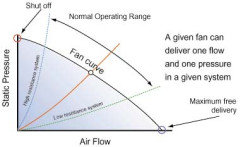
    Consider the generic fan curve of the figure below. Real fan curves will be variations on the curve illustrated, but could be designed to have the property of starting at the same free air point on the right (maximum free delivery) and ending at the same shut-off point on the left, with some curve connecting these points.

    The extreme case would be if a fan curve were a rectangular shape -- flow is constant for all static pressures until cut-off occurs -- one would have an ideal blower for operating below cut-off. I think the squirrel cage blower has something more akin to a straight line or concave curve where increasing static pressure causes a greater flow rate penalty than more typical curves such as in the figure.


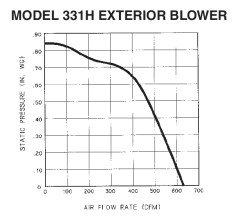
    The Broan/NuTone 331H fan curve (below) shows good performance in its operating region with its convex shape.


    I'm not sure how to interpret "quickly" w.r.t. flow behavior. Plumes are exhausted as a function of the final, in situ, hood flow rate given whatever MUA is available. If there is full containment, then the hood is quick enough. :)

  • 2 years ago
    last modified: 2 years ago

    “meet the requirements of allowing between 21-24 inches (23) between cooktop and hood.”

    Who is requiring that distance? Are you sure? Say exactly where you see that distance requirement and copy the wording here or provide a link. That is lower than exhaust hoods are supposed to be. Most hoods are anywhere from 30” to 36” above the range. Which is the right distance from a visual prospective, it looks right, not closed in. But more important, it won’t look cramped or feel cramped. If you are using a tall pot to make chili, boil corn on the cob, make soup, etc. will you have enough space over it to stir that pot and look down into it? Especially on the back burners?

    @kaseki can you say what your hood distance is over your range? No offence, not asking for a write-up about it, just want to know.

    twoschnauzers thanked webuser_ 786635126
  • 2 years ago

    This is quite helpful, thank you. Yes, I was pondering the trade-offs of any added, hissing or noise that is created due to baffles, although a number of hoods that have baffles can be outfitted with external blowers. On the other hand, VAH offerings do not allow for external blower mounting as the squirrel cages are always internal according to my understanding. So, I’m just totally guessing at this, but maybe those trade-offs between the two designs come out as a wash in the end when it comes to noise as a factor. I will be focussing on a Blue Star professional canopy versus a VAH canopy while assessing both the pros and cons. Should I choose a VAH, I will choose their 900 CFM. (actual CFM and not the 1.5 theoretical that VAH markets). One of the baffle filter hood design, options is a Blue Star professional hood, and their external blowers begin at 1000 CFM‘s. Either of these should be more than enough CFM given that I am planning on an induction range top. Some would suggest that the higher CFM range that I am looking at is an unnecessary, extra cost .

    Part of what I am imagining being useful for the higher CFM is that I can run the exhaust on a lower speed, while getting good air exchange at a lower noise level then I “might “get with a lower CFM blower run at a higher speed.. As much of your writing has revealed in numerous posts, along with others inputs, I’ve only listed a few of the variables in the calculus that goes into specifying the correct CFM, and MUA combinations that allow for proper ventilation. and of course, there is also the practical consideration of how straightforward, (or convoluted),the cleaning process can be, and I know there are lots of varying opinions on what people think about the various designs of hoods, and what makes them easier or more difficult to clean. (this is less of a technical consideration and more subjective I know ). I find it remarkable just how much of my one’s brain power must be invested into hood and ventilation needs. Although many other appliances in one’s kitchen might be considered more technologically complex as compared to a ventilation hood (essentially ductwork, lights, fan, blowers, and switches), choosing the right ventilation set up demands a considerable amount of forethought. I appreciate all of the guidance and mentorship here.
    Happy new year everyone!!

  • 2 years ago

    @webuser_ 786635126: You get write-up whether wanted or not! 34.5 inches above the soapstone; 34.25 above the induction surface. Note that this is a Wolf Pro Island hood. These were the resulting values from putting the soapstone at 36 inches above the floor, and using a 6-inch chimney cover above the 18-inch canopy hood to mount to the existing ceiling. (Actually the chimney is screwed into joists and microlam above the gypsum but is flush with the gypsum.)

    Some modest hoods, particularly when not very deep front to back, are intended for lower mounting to improve capture.

    Baffles hiss, blade tip turbulence makes wide-band noise, fan disk unbalance makes rumble. All fans will do these things to some degree, and the only ways to mitigate noise are distance, silencer, and/or using a large blower operated at lower than maximum speed. For some commercial up-blast units, the fan speed can be adapted to the motor speed by belt sheave ratio. With a roof mounted Wolf/Broan/NuTone blower, and a silencer, my baffle hiss is at about the level of normal conversation. Conversation is possible under the hood at reasonable voice levels.

    The VaH squirrel cage blowers have to be local, because they provide the grease stripping function protecting the duct. (Actually, like baffles, they remove grease particulates from the larger end of the particulate spectrum by centrifugal extraction and impingement collection. Finer particulates are hoped to be blown outdoors.)

    Potential MUA system complexity can outmatch hood system complexity. That is why I argue for avoiding house configurations that make possible back-drafting of combustion appliances.

    twoschnauzers thanked kaseki
  • 2 years ago

    An errant yellow sticky led me to rediscovering the thread linked below. This link provides further discussion related to the series of links I provided earlier up thread:

    https://www.houzz.com/discussions/5745986/commercial-range-hood-install#n=129

    Note that all this commercial hood stuff is intended for perspective; most residences can live with residential hoods if they provide the requisite performance. A few here have adapted commercial elements with good effect, but they started the design process by making the effort to understand the requirements we try to make clear. Some engineering instinct helps, but copy-catting can also be successful.

    Nonetheless, there are many residential related bounds related to cost, space, and aesthetics that limit what what can be done in particular instances. No one should conclude that a smallish, lower-cost hood is necessarily out of the question. What is out of the question is believing that one can splurge on a high-cost high-BTUh quasi-professional range and get away with a low-cost hood system.

    As to the OP's somewhat more constrained requirements, these will somewhat depend on cooking style with the induction cooktop. Hood air velocities into the hood capture area of 60 to 90 ft/min (ft/min equals CFM/sq.ft.) can be recommended based on what is being cooked.

    A 2.5 x 2 ft hood entry area is 5 sq. ft., requiring 450 CFM flow rate at 90 ft/min for searing or woking, and a blower rated in free air in the vicinity of 700 CFM. Smaller hood front-to-back distances will reduce required CFM, but also capture effectiveness. Cooking greasy or odoriferous food on rear hobs can be a mitigation for an undersized wall hood.

    Are you still with us, @twoschnauzers?

    twoschnauzers thanked kaseki
  • 2 years ago

    As a (former) owner of a VAH as well as a hood with remote blower, I'd put in a very emphatic vote for baffled hood with remote blower. Noise from airflow over baffles is nearly non-existent. Noise from the infamous squirrel cages is extremely loud and annoying.


    That's an opinion based on personal experience with both setups (VAH, and ModernAire liner with remote Fantech blower and LD10 silencer). But many years ago, I was motivated enough to actually do some simple sound pressure measurements to prove my point:

    Vent hoods and noise: the real scoop on VAH

    You appear to be concerned with noise levels (your comment about running a higher cfm blower at lower speed to reduce noise). If so, a VAH is the wrong choice.


    And, again, based on experience, cleaning the "squirrel cage" housings is a huge PITA. Has to be done by hand in a large sink. My ModernAire baffles get thrown into the dishwasher, easy peasey. Again, no contest.

  • 2 years ago

    Regarding the distance requirements between bottom of hood and cooktop, I am quoting the VAH specs for this model hood. The Wolf cooktop actually said a minimum of 24 inches was required. I will end up with 23 inches if i go with VAH

  • 2 years ago
    last modified: 2 years ago

    Here is the link with requirements - https://ventahood.com/index.php/products/premium-power-lung/pl-wm-uc?id=361&model=SLH6-K30

    You will notice the drawing to the right shows 21-24”. Please tell me if I’m reading this incorrectly. This is a retrofit application which cannot be altered without extreme remodeling of the kitchen. I have been doing extensive searching for an adequate hood which works in this space. Very few reputable manufacturers make low profile hoods. None seem to have decent depths.

    Another option is this low profile Miele - https://www.mieleusa.com/e/30-inch-built-under-ventilation-hood-da-1280-stainless-steel-10451490-p

  • 2 years ago

    @kaseki - I am definitely still with you and learning! I’ve had 2 previous VAHs in past homes and loved them. No issues with cleaning (husband has the technique down…lol) and they work great.


    I have constraints of width and distance between the 30 inch induction cooktop and what is available to the consumer. im not hooked on VAH. I just want a sensible solution.

  • 2 years ago
    last modified: 2 years ago

    Seeking opinions - after reading some of @kaseki reference links, Modernair was mentioned, so I looked at them online and ame across this model - http://modernaire.com/wp-content/uploads/Spec-PMW1630.pdf

    Would there be any reason I shouldn’t have the chimney portion going up through an empty overhead cabinet? it would connect directly into an existing 7 inch vent pipe going up to the roof…straight shot up. This would require a reducer. Not only does the Modernaire have a 24 inch depth, the canopy is only 4 inches tall and the cfm moter can be increased to 600cfm (the most I would want without having MUA).

    I‘d still be limited to just 25inches between the cooktop and the bottomnof the canopy and this is a downside. Eyesight disturbance of the canopy is NO issue with me since I’m a shorty…4’11”.

  • 2 years ago

    Given all your constraints, then I have no objection to the ModernAire. Does it use baffles or mesh filters?

  • 2 years ago
    last modified: 2 years ago

    Baffles or Mesh are available

  • 2 years ago

    ModernAire is extraordinarily expensive. Given your small setup, I see no benefit to choosing such an high-end custom hood.

  • 2 years ago

    @royhobbs..I certainly dont want to overspend. which would you choose of all mentioned?

  • 2 years ago

    TBH, I am flummoxed by your requirement for the low distance between your cooktop and the hood. Therefore, I do not have a suggestion for you. Is that short distance due to your existing cabinetry?

    A hood that is going to specify to be mounted as low as you want will have low cfms that may not be that helpful to exhaust your cooking effluent. Or I could put it a different way - that a hood manufactured with low cfms is going to require it be mounted that low in order for it to be even moderately effective.

  • 2 years ago

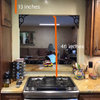
    @royhobbs The requirement for low distance is due to existing cabinetry which cannot be corrected short of ripping out all cabinets and starting with new. I have exactly 29 inches frombthe bottom of the cabinet where the hood must sit to the top of the countertops. The cabinet is empty and ducting runs through it to the ceiling.