
Search results for "Cheaper options" in Home Design Ideas

 Father Nature Landscapes of Birmingham, Inc.
Design ideas for a mid-sized modern partial sun front yard gravel landscaping in Birmingham.

 Crescent Builders, Inc.
New home build - Inverness, CA
Architect: Rob Kelly, Kelly + Abramsom Architecture; Photo: Trevor Henley
Bathroom - eclectic bathroom idea in San Francisco
Bathroom - eclectic bathroom idea in San Francisco

Find the right local pro for your project
 Shelving and Bath Unlimited
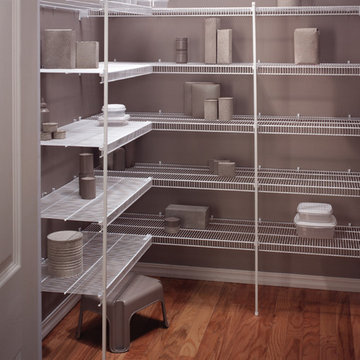
Inspiration for a mid-sized transitional medium tone wood floor kitchen pantry remodel in Chicago

 Natasha Habermann Studio
Boho couch with lots of pillows
Mid-sized beach style open concept ceramic tile and beige floor living room photo in New York with white walls, no fireplace and no tv
Mid-sized beach style open concept ceramic tile and beige floor living room photo in New York with white walls, no fireplace and no tv
 Cabochon Surfaces & Fixtures
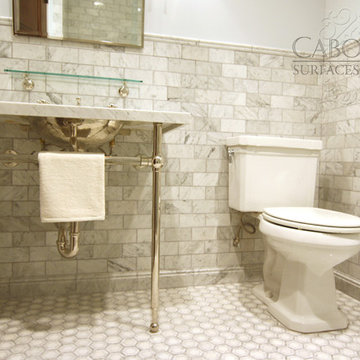
Waterworks Crystal washstand with Hammered Nickel Normandy Sink sits atop the detailed carrara and white hexagon mosaic flooring. Polished carrara marble wainscot adorns the walls. Waterworks sconces, mirror and shelf finish off the vanity area.
Cabochon Surfaces & Fixtures

 Unique Home Solutions Inc.
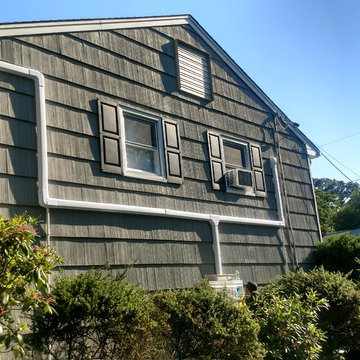
This house was recently renovated. Gray walls is a common colour used by many renovators in the area and appeals to most people as it replaces the common white walls.
If you are planning on putting your property on the market, give us a call at 514-222-5553. We stage vacant and occupied properties.




 Jenni Pearson
Jenni Pearson
Inspiration for a mid-sized transitional master white tile and subway tile marble floor bathroom remodel in Portland with an undermount sink, furniture-like cabinets, gray cabinets, marble countertops, a one-piece toilet and white walls
Inspiration for a mid-sized transitional master white tile and subway tile marble floor bathroom remodel in Portland with an undermount sink, furniture-like cabinets, gray cabinets, marble countertops, a one-piece toilet and white walls

 By Design
This dining room is defined by the dropped ceiling with light cove, large area rug ad wet bar soffit treatment. Stainless wine storage flanks a wet bar that includes an under mount sink, refrigerator drawers and dishwasher so that glassware can be cleaned and stored without leaving the space. Custom walnut dining furniture.

 safe ZOnea
Every year, the same thing happens. The first real snowfall arrives, demand for de-icing materials spikes overnight, and the businesses that waited too long find themselves scrambling for supply at the worst possible moment. Facility managers, property owners, contractors, and municipalities all depend on a steady supply of salt and ice melt to keep their properties safe and operational through winter. The ones who plan ahead sail through. The ones who don't pay more, wait longer, and take on real risk.
Sourcing de-icing materials well is not complicated, but it does require thinking ahead and understanding the options. The choices you make about what to buy, how to buy it, and who to buy it from have a direct effect on your costs, your reliability, and your ability to keep people safe when conditions turn dangerous. This article lays out what matters.
Why Your Choice of Supplier Matters More Than You Think
It is easy to treat de-icing material as a commodity, something you grab whenever you need it without much thought about where it comes from. That works fine until the moment it doesn't, usually in the middle of a storm when everyone needs supply at once and the casual sources have run dry. At that point, the relationships you built before the season become the difference between staying stocked and being stuck.
Reliable supply is the whole game in winter operations. A property that runs out of ice melt during a storm faces safety hazards, liability exposure, and disruption, none of which can wait for a back-ordered shipment. This is why establishing relationships with dependable rock salt suppliers before the season starts is one of the smartest moves a facility manager or contractor can make. It locks in supply, often locks in better pricing, and removes a major source of mid-winter stress.
The lesson here is to treat sourcing as a planning decision rather than a last-minute errand. The businesses that come through winter smoothly are almost always the ones that secured their supply chain early, chose suppliers who could actually deliver when it counted, and never had to gamble on finding material during a shortage. Reliability bought in advance is far cheaper than scarcity paid for in a crisis.
Bagged or Bulk: Matching the Material to the Job
One of the first practical decisions is whether to buy de-icing material in bags or in bulk, and the right answer depends entirely on the operation. Each format has clear advantages, and many operations end up using both for different purposes.
Bagged material offers convenience, control, and easy storage. It is simple to handle, easy to distribute to different locations or crews, straightforward to store without special equipment, and convenient for spot application by hand. It suits smaller properties, businesses without bulk storage, and situations where portion control and tidiness matter. Bulk material, on the other hand, tends to make sense for large operations that go through high volumes, where buying in quantity lowers the per-unit cost and the operation has the equipment and space to store and handle it. The tradeoff is between the convenience and flexibility of bags and the volume economics of bulk.
For many operations, the right approach is a mix: bulk for the high-volume core of the work and bags for flexibility, spot treatment, and locations where bulk handling is impractical. The key is to match the format to how the material will actually be stored, moved, and applied, rather than defaulting to one or the other out of habit. Thinking this through in advance avoids both the waste of over-buying bulk you can't handle and the expense of relying entirely on bags for a large operation.
Rock Salt Is Not Your Only Option
Rock salt, or sodium chloride, is the workhorse of winter de-icing for good reason. It is effective, widely available, and cost-efficient, which makes it the default choice for most operations most of the time. But it has limits, and understanding the alternatives helps you choose the right material for the conditions you actually face.
The most important limitation is temperature. Rock salt becomes less effective as temperatures drop, and in genuinely cold conditions it can struggle to do the job at all. This is where alternatives come in. Calcium chloride, for instance, works at much lower temperatures than rock salt and acts quickly, which makes it valuable when conditions are severe or when fast melting matters. Operations that face hard freezes or need dependable performance in extreme cold often keep calcium chloride for sale on hand for exactly those situations, using it alongside rock salt rather than instead of it.
The practical approach is to understand the conditions your property faces and stock accordingly. For many operations, rock salt handles the bulk of the work while a faster, colder-rated material like calcium chloride covers the extreme days when ordinary salt falls short. Matching the material to the temperature and the urgency of the situation is what separates an operation that stays ahead of winter from one that is constantly reacting to it.
Securing Your Supply Before the Season
Knowing what to buy is only half the equation. The other half is making sure you can actually get it when you need it, which means securing your supply before winter arrives rather than after it has already started. Timing is one of the most underrated factors in winter operations.
The logic is simple. Demand for de-icing materials is highly seasonal and spikes sharply during storms, when everyone needs supply simultaneously. Prices and availability both move against the buyer at exactly those moments. By contrast, planning ahead, estimating your needs and arranging supply before the season, puts you in a far stronger position. Working with established rock salt suppliers ahead of time means your material is accounted for before the rush, often at better pricing and with the confidence that it will be there when the first storm hits.
This kind of planning also lets you think clearly rather than react under pressure. You can estimate your seasonal needs based on your property and past winters, decide on the right mix of materials and formats, and arrange storage in advance. Operations that do this consistently spend less, worry less, and never find themselves making frantic calls during a storm. The effort of planning ahead is modest, and the payoff in reliability and cost savings is substantial.
Storing and Handling What You Buy
Securing supply is not much use if the material degrades before you can use it, which makes proper storage and handling an important and often overlooked part of the equation. De-icing materials are sensitive to moisture, and poor storage can turn a good supply into a clumped, hardened mess that is difficult to apply.
The fundamentals are straightforward. Keep material dry and protected from moisture, since salt and ice melt readily absorb water and can harden if exposed. Store it in a way that suits the format, whether that means a proper bulk storage area or a dry space for stacked bags. Keep it accessible, so crews can get to it quickly when a storm hits and time is short. And handle it with the right equipment for the format and volume, which protects both the material and the people working with it. None of this is complicated, but neglecting it can undermine even a well-planned supply.
Good storage practices protect the investment you made in securing supply early. There is little point in arranging your materials ahead of the season only to have them degrade before use. Treating storage and handling as part of the overall plan, rather than an afterthought, ensures that the material you secured is actually usable when the moment comes. It is the final link in a supply chain built to perform under winter conditions.
Estimating How Much You Actually Need
One question trips up operations of every size: how much de-icing material to buy. Order too little and you risk running short during a storm. Order too much and you tie up money and storage space in material you may not use. Getting the estimate reasonably right is a meaningful part of sourcing well.
Several factors shape the answer. The size and type of the areas you treat, sidewalks, lots, entrances, and drive lanes, set the baseline for how much material each application consumes. The local climate matters too, since colder regions and those with frequent snowfall go through far more material than milder ones. Application frequency depends on how often storms hit and how quickly surfaces need to be cleared, which varies with the kind of property and the expectations of the people who use it. And the type of material plays a role, since different products are applied at different rates.
Past experience is often the best guide. Operations that track what they used in previous winters, adjusted for the size of the property and the severity of the season, can estimate their needs with reasonable confidence. For newer operations without that history, it helps to plan conservatively and to work with a supplier who can replenish stock reliably, so that a low estimate does not turn into a mid-storm shortage.
The goal is not perfect precision but a sound, slightly cautious estimate paired with a dependable supply relationship. That combination lets an operation keep enough material on hand to handle the season without over-committing to volume it cannot store or use. Thinking this through before winter, rather than guessing during it, is one more way that planning ahead pays off when the snow starts to fall.
The Bottom Line
Sourcing de-icing materials well comes down to a few straightforward principles: plan ahead, choose reliable suppliers before the season, match your materials and formats to your actual needs and conditions, and store what you buy properly. The operations that follow these principles move through winter with confidence, while those that improvise pay more and take on needless risk.
Winter is predictable in one respect: it arrives every year, and demand for de-icing material spikes the moment it does. The businesses that prepare for that reality, rather than being surprised by it, are the ones that keep their properties safe, their costs controlled, and their operations running no matter what the season throws at them. A little foresight before the first snowfall pays off through every storm that follows.

 All Marble Tiles
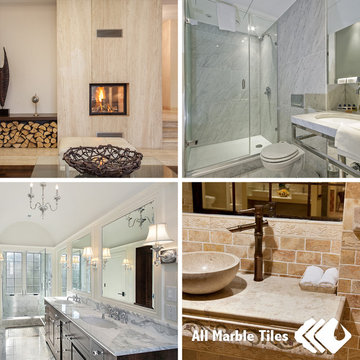
Marble tiles vs. Travertine tiles
It is a daunting task in renovating an existing or building a new home. All the right choices have to be made as you are going to live with your decisions for a while, unless you are a billionaire whom can afford renovations every six months. Most of us can’t. Part of that decision making process, is to decide what type, color and quality tile to use. Do you want to go with marble, porcelain or travertine tiles? What does your budget allow you to spend? There are so many things to decide. A good idea is to try and understand the differences between all the types of tiles.
In this article, the difference between marble and travertine tiles are going to be explained. Many tiles look like marble, but there are distinct differences:
1) Marble tiles:
Known throughout the centuries for its beauty and proper use in the building of homes for the rich or immaculate sculptures of great minds or the ancient gods; marble has a strong historical background and as such is the first choice for most people, that is, if they can afford it.
• Marble is a saltwater rock, usually mined close to the sea. It is a far more durable than travertine.
• Marble tiles come in various colors from mineral deviations in the marble;
• Marble is more suitable for internal use; though it can be used externally as long as its guarded from the forces of nature;
• The finish options with marble is restricted due to its nature to break;
• Marble tiles are more expensive;
2) Travertine tiles:
This tile is often wrongly referred to as “travertine-marble”. Travertine is closely associated with marble, yet there are important differences.
• Both are natural stone, but travertine tiles are limestone and thus sedimentary and marble tiles, while also a type of limestone, is metamorphic, i.e. marble is formed in tremendous heat;
• Travertine is quarried near fresh water rivers and natural dams;
• The color spectrum of Travertine tiles are far less than marble due to its natural colors;
• Travertine tiles are porous and marble denser;
• Travertine tiles are far more suited for outdoor use because of its durability;
• Travertine tiles has more finish options than marble;
• Travertine tiles are cheaper than marble because it’s widely available.
So, in effect, they are both made from natural stone; Travertine tiles just being more widely found than marble. Decide which atmosphere you want to create at which cost; then decide on the proper tile choice. http://AllMarbleTiles.com
Sponsored
Westerville, OH

Custom Home Works
Franklin County's Award-Winning Design, Build and Remodeling Expert

 Interior Archaeology
Photographed by Karol Steczkowski
Alcove shower - mid-sized coastal master white tile and stone tile travertine floor and beige floor alcove shower idea in Los Angeles with an undermount sink, furniture-like cabinets, white cabinets, an undermount tub, beige walls and a hinged shower door
Alcove shower - mid-sized coastal master white tile and stone tile travertine floor and beige floor alcove shower idea in Los Angeles with an undermount sink, furniture-like cabinets, white cabinets, an undermount tub, beige walls and a hinged shower door
 Fines cuisines
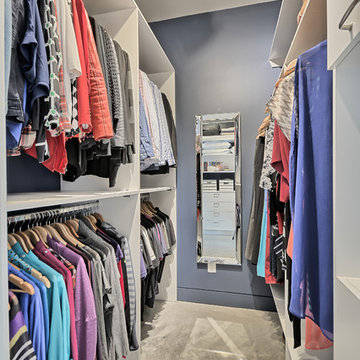
Small elegant gender-neutral concrete floor walk-in closet photo in Montreal with flat-panel cabinets and white cabinets

 EcoRegions
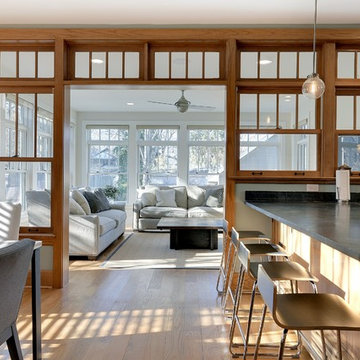
What a striking home! This home in South Baton Rouge was designed by Cockfield-Jackson and the clients wanted a complete landscape design that would accompany the architecture of this A. Hays Town inspired home.
Featured in this design are a substantial entertainment area in the rear, complete with an outdoor kitchen (built by Joffrion Construction) expansive pool with water feature wall, and a bluestone courtyard. Additionally, this home features a quaint side yard complete with brick steps leading to a bluestone courtyard with an antique sugar kettle fountain. The clients also needed options for guests to park. A circular driveway in the front provided a grand entrance, as well as ample parking for plenty of guests.


Sponsored
Columbus, OH

Snider & Metcalf Interior Design, LTD
Leading Interior Designers in Columbus, Ohio & Ponte Vedra, Florida

 Jeannette Architects
Front Entry and Living Room with vaulted ceiling and bi-sliding doors to rear patio with pool and front patio with fire pit. Architect & Photo by Jeff Jeannette / Jeannette Architects
 Hickory Dickory Decks
Picture by Greg Potticary.
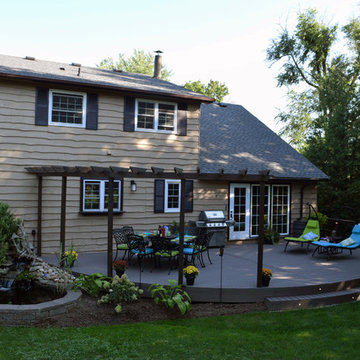
Example of a mid-sized trendy backyard deck design in Toronto
Example of a mid-sized trendy backyard deck design in Toronto
 Creation Builders Inc
Driveway Ready
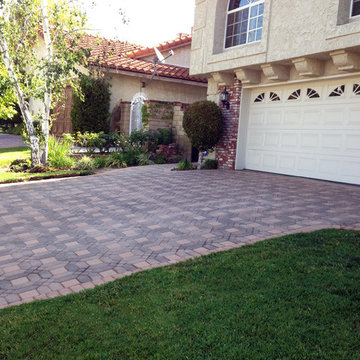
Photo of a mid-sized traditional partial sun front yard concrete paver driveway in Los Angeles.
Photo of a mid-sized traditional partial sun front yard concrete paver driveway in Los Angeles.
11