
Search results for "Observation" in Home Design Ideas
 HK Design Studio
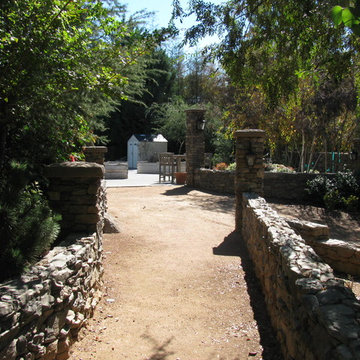
HK Design Studio aims to provide creative, exceptional landscape designs that reflect the clients style and budget. Owner, Heather Koermer, is a licensed landscape architect on who will provide you with a complete and professional set of plans. Our job is to give the client a product that suits their needs, wants, and style.
We strive to create comfortable outdoor rooms that are designed to complement each client’s style. Each project is unique and given the personal attention to detail. A person’s garden should be an extension of their home.
Working in the industry since 1996, Heather started her own firm with the express intent of sharing her passion and knowledge with her clients. She is diligent and works in all phases of the projects from initial meetings, concepts, working drawings through construction observation. Let us share our passion for landscaping while providing you with a complete package to see your dreams fulfilled!
 Jams Landscape
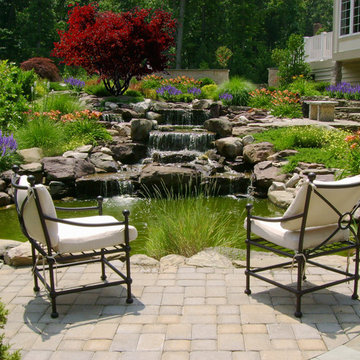
Sitting area at base of waterfalls
Inspiration for a large traditional landscaping in Baltimore.
Inspiration for a large traditional landscaping in Baltimore.
 jARCHITECTS: Jim Rymsza, RA
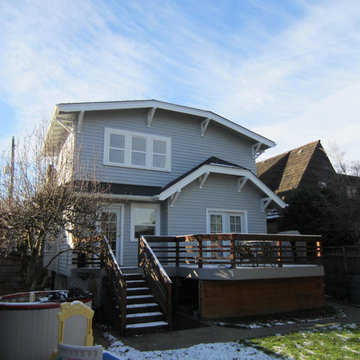
In order to meet budgetary and construction realities, the addition was placed in the rear half of the house. Loads were transferred to exterior walls, scissor trusses provided vaulted spaces and attention to existing detail was observed:
Jim Rymsza, Architect
Find the right local pro for your project
 Envision Web
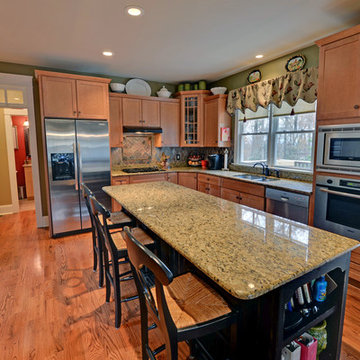
Stuart Wade, Envision Virtual Tours
Envision Virtual Tours and Professional Photographers provide the high quality media neccessary for premium marketing of homes.
Nestled in the foothills of the Northeast Georgia Mountains, there is a lot to offer visitors looking for a small historic town with plenty of charm. Cornelia is one of the stops along the U.S. 441 Heritage Highway. Visitors to downtown can shop, eat and enjoy the historic and scenic attractions. Fenders Diner is a retro and fun dining experience. Overlooking Cornelia is the 54-foot Chenocetah Tower built in the 1930s by the WPA and used until 1971 for fire observation on a seasonal basis. The Tower and its surroundings, including one of the largest stands of Rhododendron minor in the nation and Russell Lake Recreation Area are now part of the Chattahoochee National Forest. The centerpiece of downtown is definitely the Big Red Apple monument, adjacent to the historic Railroad Depot. Elvis fans will love the Loudermilk Boarding House & Everything Elvis Museum.

 safe ZOnea
If you’re active on GardenWeb sharing plant photos, asking for advice, tracking seasonal progress you already understand how much detail goes into gardening. Soil pH, rainfall, emerging leaves, bloom counts, fertilizer schedules it adds up fast. But all that rich information often remains buried in posts, lists or memory. What if you could visualize that data and turn it into clear quick insights? That’s where a graph maker becomes a game-changer for your gardening workflow.
1. Why garden data belongs on a graph
On GardenWeb, you’ll find forums for everything from perennial care, vegetable gardening, patios, herbs, even cooking and craft projects. While plant lovers share observations and ask questions, many track progress manually in spreadsheets or memory. A graph maker flips that around:
Instead of a list of numbers (e.g., “Soil test: pH 6.4 in May, 6.1 in October”), you get a line graph showing the decline over time.
Instead of guessing which plant bloomed most, you see a bar chart comparing counts across plants.
Instead of manually calculating average rainfall effect, you plot scatter points of bloom count vs. rainfall.
By turning your data into visuals, you’re not just recording—you’re analysing, learning and improving. For GardenWeb users this means smarter decisions: Which fertilizer actually improves bloom count? Which shady spot recovers slower? A graph maker gives clarity.
2. What is a graph maker and how to use one
A graph maker is a web tool or software that lets you input raw data (numbers, dates, categories) and output visual charts like line graphs, bar charts, scatter plots, etc. It might allow you to import a spreadsheet, select chart type, customize colours, label axes, and export the image for your blog, forum post or personal log.
Here’s how you could apply it for gardening:
Log blooms per week for each rose plant.
Using the graph maker, choose line graph to track changes over weeks.
Label your y-axis “Number of Blooms”, x-axis “Week of Year”.
Add colour lines for each plant for easy comparison.
Export as PNG and embed it in a GardenWeb forum post: “See bloom trend for my ‘Peace’ vs ‘Knock Out’ roses”.
This isn’t just pretty-to-look-at: it makes the trend obvious, invites discussion (“Hey, your ‘Knock Out’ line dips after week 28—what changed?”) and helps you refine your routine.
3. Use these specific scenarios on GardenWeb
A. Soil pH and plant health tracking
After multiple tests you have pH values over time and bloom results. Upload both datasets into the graph maker, produce a dual-axis line graph: soil pH on one axis, bloom count on the other. Post your findings in the “Soil, Fertility & Nutrients” forum and get feedback.
B. Seasonal pest or disease appearance
Record number of aphids spotted each month and whether you used treatment. A bar chart via the graph maker can show pre- and post-treatment figures. Then ask the “Insect & Disease Control” forum for advice based on your visual data.
C. Yield comparison between varieties
You grow two zucchini varieties. You keep weekly yield in pounds. Use the graph maker for a side-by-side bar chart. Share in the “Vegetable Gardening” forum: “Which was better this year? See the chart”.
D. Rainfall vs growth rate
You log weekly rainfall and growth (in cm) of your tomato plants. Use scatter plot in graph maker. If a pattern emerges, you’re ready to post: “Is my growth plateau due to drought? Chart shows a clear correlation.”
4. Why this elevates your GardenWeb contributions
When you post with a chart made by a graph maker, you’re doing more than asking or showing off. You’re investigating. You’re analysing. You invite the community to give feedback on data, not just anecdotes. That elevates the discussion. Instead of “My plant died, any ideas?” you post “See this graph of pH drop and bloom count—what might be the limiting factor?” High-quality visuals raise your post’s value and garner more thoughtful responses.
Plus, your posts become useful references for others: someone else can say, “Cool graphic, can you share your data sheet?” You build credibility and help the forum become a learning hub—not just a Q&A board.
5. Tips for using a graph maker effectively in the GardenWeb context
Keep it simple: One chart, one insight. Don’t overcrowd.
Label clearly: Titles, axis labels, units (e.g., cm/week, mg/L, °F).
Use readable colours: Avoid faint tones that vanish on mobile.
Annotate when needed: Add notes like “Fertiliser switched week 12” or “Shade cloth added”.
Provide context in your post: Don’t leave the chart alone—write a few sentences explaining what it shows and what you’re seeking.
Embed carefully: Make sure your image displays properly in GardenWeb; check mobile view.
Share raw data: If possible link to your spreadsheet so others can replicate or comment.
Be open to feedback: The chart invites questions; embrace them.
6. Possible pitfalls and how to avoid them
Bad data = bad chart: If your measurements aren’t consistent, your graph will mislead. Use standardized data collection.
Too much complexity: Multi-axis charts, too many variables—confusing. Stick to one or two variables.
Overlooking mobile viewers: Many GardenWeb users browse via phones. Use large fonts and simple visuals.
Ignoring the narrative: Chart alone won’t answer. Explain what it means and what you need.
Outdated charts: If you update your data annually, keep your visuals current or label them clearly as “2024 data”.
7. Final thoughts
On GardenWeb you’ll find a vibrant community of gardeners, DIYers, cooks and design lovers.Using a graph maker for your posts and progress turns your experience from casual hobby-logging into smart data-driven gardening. You’ll not only learn more—your peers will learn more, too.
So next time you log your plant growth, record your yield, test your soil or track pests—don’t just note it. Plot it. Use a graph maker. Share it in the forum. Let your garden tell the story, and let the community help you write the next chapter.
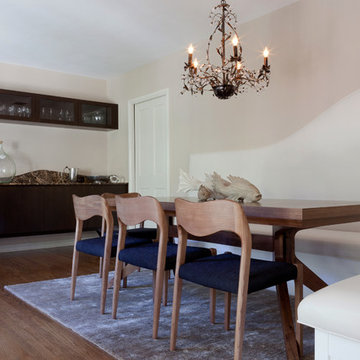
 Stage One Custom Furniture & Construction Inc.
We have been creating custom furniture and cabinetry for Paige Saltzman for approximately 10 years. We enjoy collaborating with her because she brings knowledge and creativity to the project. A artisans, we appreciate the beautiful pieces we have the opportunity to create. She has a fine eye for finishes and materials and for shape, and we have been first-hand observers of the excellent attention she provides her clients. She owns the process every step of the way so that the customer experience is always smooth and positive. She makes our job easy as well, with her clear vision and direction. We have found her to be an exceptional Interior Designer and highly recommend the work of Nanci Paige Design
 Martin Architect, Inc.
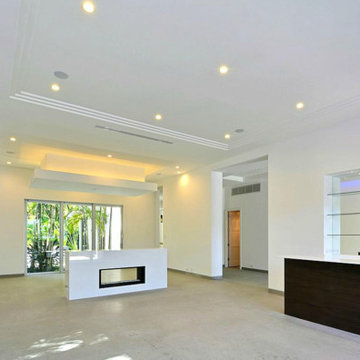
View of Living Room with Dining Room beyond. Ceiling coffer details. View out to Summer Kitchen and bbq / sink / refrigerator area at exterior, classic white Porcelain floor tiles. Bar to right and low fireplace between Dining Room and Living Room.
 Ideo Architects
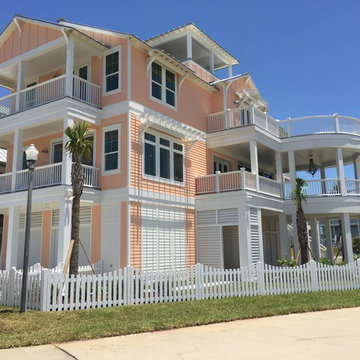
Rear/Left Elevation
Example of a beach style three-story mixed siding exterior home design in Houston
Example of a beach style three-story mixed siding exterior home design in Houston
 HK Design Studio
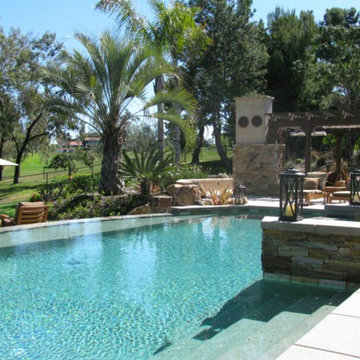
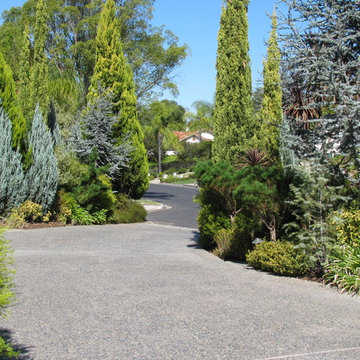
HK Design Studio aims to provide creative, exceptional landscape designs that reflect the clients style and budget. Owner, Heather Koermer, is a licensed landscape architect on who will provide you with a complete and professional set of plans. Our job is to give the client a product that suits their needs, wants, and style.
We strive to create comfortable outdoor rooms that are designed to complement each client’s style. Each project is unique and given the personal attention to detail. A person’s garden should be an extension of their home.
Working in the industry since 1996, Heather started her own firm with the express intent of sharing her passion and knowledge with her clients. She is diligent and works in all phases of the projects from initial meetings, concepts, working drawings through construction observation. Let us share our passion for landscaping while providing you with a complete package to see your dreams fulfilled!

 HK Design Studio
HK Design Studio aims to provide creative, exceptional landscape designs that reflect the clients style and budget. Owner, Heather Koermer, is a licensed landscape architect on who will provide you with a complete and professional set of plans. Our job is to give the client a product that suits their needs, wants, and style.
We strive to create comfortable outdoor rooms that are designed to complement each client’s style. Each project is unique and given the personal attention to detail. A person’s garden should be an extension of their home.
Working in the industry since 1996, Heather started her own firm with the express intent of sharing her passion and knowledge with her clients. She is diligent and works in all phases of the projects from initial meetings, concepts, working drawings through construction observation. Let us share our passion for landscaping while providing you with a complete package to see your dreams fulfilled!
 HMWhite
On the quick view, the landscape for this speculative summer home development could not be more ordinary. Its story all too common. As a product of a farm’s subdivision, it had all the trappings of American residential sprawl – large front lawn exposed to street, few mature trees, clumsy entry sequence with service and front door in direct conflict, and lack of privacy. To fulfill its function as a summer and vacation house destination, the new owner understood the landscape required a transformation.
A delightful and magical surprise was the property’s mature Poplar forest, abutting the new house. By removing and transplanting the Poplars, a sculpted void and solid composition established a garden structure. Introducing scale and a landscape continuum, the relocated tall Poplars erased the house front’s youthful origins. A distinctive landscape personality grew out of the skeletal structure of the Poplar groves. A bold landscape graphic emerged with simplified underplanting strengthens the Poplar’s mono-culture presentation, calming the eye and inviting further sensory observation and reflection.
 Westland Design
Moss Garden: A Living Carpet of Tranquility
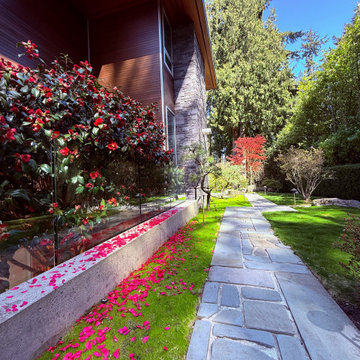
A moss garden is a serene, low-maintenance landscape feature that evokes a profound sense of calm and natural beauty. Composed of vibrant, velvety mosses that thrive in shaded, humid environments, these gardens offer a soft, carpet-like groundcover that replaces traditional lawns or gravel with rich, green texture.
At Westland Design, our moss gardens are thoughtfully integrated into the overall landscape to enhance a feeling of timelessness and stillness. Whether nestled beneath the canopy of trees, edging a stone pathway, or surrounding a tranquil water feature, moss brings subtle movement and color to quiet corners of the garden.
Key qualities of a moss garden include:
Evergreen softness: Moss provides lush, year-round greenery that requires no mowing or fertilizing.
Quiet beauty: It absorbs sound, contributing to a peaceful, contemplative environment.
Natural elegance: Ideal for Japanese-style gardens or woodland settings, moss complements stone, water, and wood elements with organic harmony.
A moss garden is more than a design choice—it’s an invitation to slow down, observe closely, and appreciate nature’s quiet elegance.
 Sandmark Custom Homes, INC.
Gordon Kreplin - Ascencion Photography
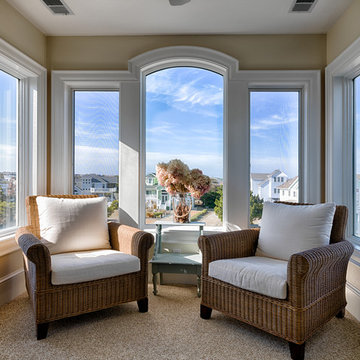
Living room - small open concept carpeted living room idea with beige walls and no fireplace
Living room - small open concept carpeted living room idea with beige walls and no fireplace
 Engineered Steel Solutions LLC
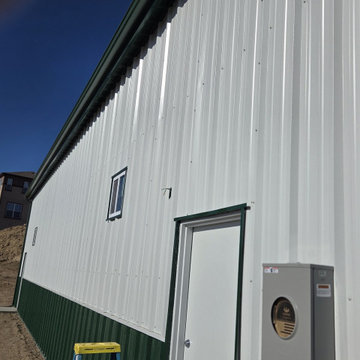
interior mezzanine display for consumer observation to see structure
Example of a classic garage design in Denver
Example of a classic garage design in Denver
 Deck and Patio Company "Outdoor Living Experts"
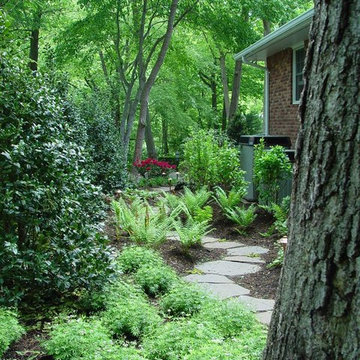
A woodland path can be a very special part of an outdoor retreat. The layout of the project detailed different settings and focal points. In some cases you are sitting next to a pond observing a waterfall; in other cases you’re walking through a woodland path. The result is a wonderful outdoor experience.
www.deckandpatio.com
 Minglewood, LLC
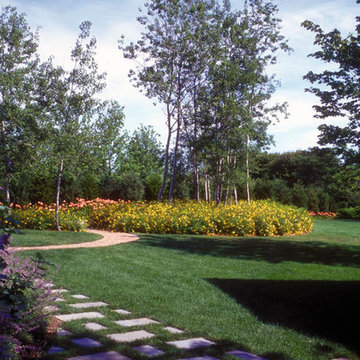
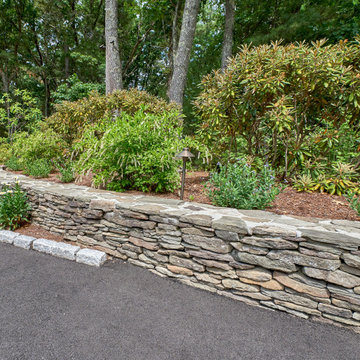
The goal of this project was to craft clean lines, gentle flows, and seasonal texture within an established woodland setting. Challenges arose from dappled light and deer pressure, along with the need for minimal irrigation. These conditions inspired us to create a woodland meadow enriched with understory birches, flowering shrubs, part-shade perennials, and spring bulbs. The inclusion of woodland ephemerals, stepping-stone paths and strategically-placed boulders enhanced the opportunity for quiet contemplation and wildlife observation. The crisp, curved edges of the tightly-jointed walks invite you into the garden while clearly defining maintenance areas. Angela Kearney, Minglewood, LLC
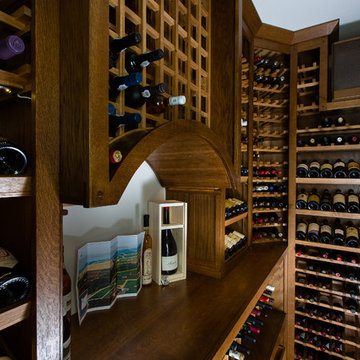
 First Street Builders
Example of a small arts and crafts wine cellar design in Atlanta with storage racks
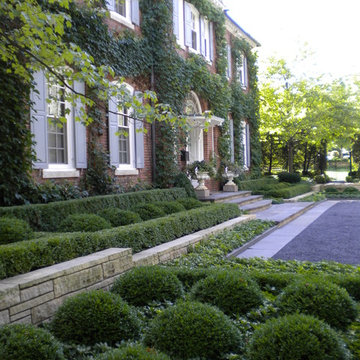
 Scott Byron & Co., Inc.
Careful attention to detail and proportion is observed upon entering the property's driveway, framed by stone walls and layered Boxwood.
This is an example of a large traditional partial sun gravel landscaping in Chicago for summer.
This is an example of a large traditional partial sun gravel landscaping in Chicago for summer.
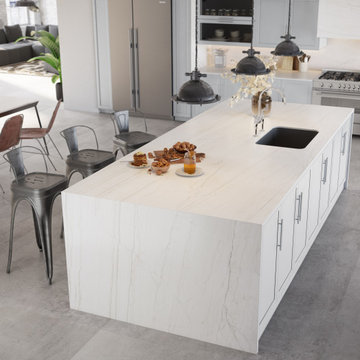
 Cosentino Canada
A collection that unites the poetic and unique beauty of stones harnessed by Dekton® technology, as those dreams where we observe and vaguely feel in control but only the deepest part of our mind truly understands. The collection is named in honor of the lavish inspiration of the two worlds conveyed in marbled colors to captivate our eyes and bring to any space a feeling we understand but cannot explain.
51