Software
Houzz Logo Print
lauren_shumway

Squash Vine Borer Question

11 years ago

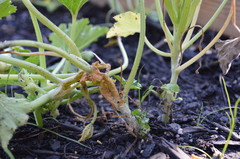
This is my first year growing melons and gourds. I stumbled upon squash vine borers on the web while doing research and decided to check out my plants today. I ended up having two affected plants, my butternut squash which I was able to slice open the base and pull the worm out and then my zucchini had quite a bit of damage and no worm to be found. What are the chances that the worm had its fill and went to a new plant? Or would it still be in the plant somewhere? The base of the zucchini is barely hanging on but the plant is still alive.

Comments (30)

  • 11 years ago

    They don't move on to other plants. Once done eating they drop down to the soil and go into the pupae (cocoon stage). If the plant is "barely hanging on" I would just pull it and plant new seeds. There is plenty of time for another crop rather than waiting in the hopes that one survives. Depending on the amount of damage the survival odds aren't great.

    Dave

  • 11 years ago

    The advice to plant new seeds is spot on. Before planting scratch down in the soil near the stem to find that cocoon, there may be more than one. These are next years SVBs.

    I've not heard about a butternut plants being affected by the SVB (doesn't mean it's not so) - is it a hollow stem variety?

    You don't say where on this glorious planet you are located but our state agriculture entomologist tells me that in CT after July 4th the season for SVB is over and no longer a concern. If you start your seeds now there is time for another crop free of the SVB.


  • 11 years ago

    obtw - either dispose of the affected plant off site or burn it as there may be other worms you have not found.


  • 11 years ago

    <tells me that in CT after July 4th the season for SVB is over and no longer a concern>

    Good point gumby. My date here is July 20th +/- a couple of days. One reason why timed planting is so effective against them. Unfortunately in some of the hotter parts of the country they can have 2 life cycles in the same season.

    Dave


  • 11 years ago

    I had SVB in just about all my cucurbit plants last year, and they all produced anyway. But they looked ok... not barely hanging on (the plant... not the stems. The stems looked terrible!) I did have one or two that started wilting bad they did not recover once that happened. But I sure am glad I didn't just pull up all the plants at the first signs.

    This year I have been scouting, spraying the stems with BT (which may be a waste of time but worth a shot), and ready to inject BT at the first signs of them. I also tilled during frosts, though I am not sure if they could survive a winter like last here.. it was a brutal zone 5.

  • 11 years ago

    This my zucchini so since there's no worm anymore, I'll check the soil around it.

  • 11 years ago

    Oh, and I'm in Charleston, SC so we have a long growing season. I'm guessing these little guys stay active for awhile?

  • 11 years ago

    Can you post a picture of the entire plant? It looks a little spindly... is it in a container? Is it in full sun?

  • 11 years ago
    last modified: 11 years ago

    Long before there was an internet filled with such helpful information, I was traumatized by that evil moth!

    I had no idea what took down every one of my carefully pampered winter squash.

    Only later did I find out it was the SVB and what it looked like. Now, with the pain still so close to the surface lol, I use row covers on my 20' beds.

    Ok, ok, well it's not just the SVB, they are also heirlooms, and you know.... why buy seed?

    Anyway, you can do both prevention and maintenance to help with SVB damage...

    First, row covers work great... but you'll have to hand pollinate. They also protect against squash bugs and a host of other pests.

    Also, as the vines grow, some varieties put out 'air' roots along the vines. If you see those roots, cover them with soil. If the borer gets to the base of the plant, having already-rooted places along the vine will help a lot.

    If the SVB does strike your plants, cover some of the vine along it's length where roots are likely to grow with soil. many squash varieties will root when the vine is covered. This can save even an already-infected vine. It was mentioned about using a razor to get at the worm. If you can find it, a needle can kill it without too much invasive surgery. remember though, there can be more than 1 worm per vine.

    Some people use pantyhose and aluminum foil wrapped around the base of the vines. There are videos on youtube.

    And... as gumby said, there are resistant varieties, and Butternut is usually one of them.

    lauren_shumway thanked rgreen48
  • 11 years ago

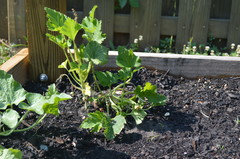
    That's the whole zucchini plant. We planted it about 2 months ago now.

  • 11 years ago

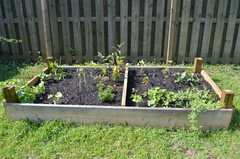
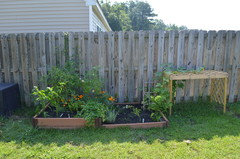
    This is my first year planting in Charleston. I'm a PA girl so this has been challenging for me. I can't just plop something in the ground and expect it to grow anymore. It takes a lot of work down here. Both of these garden beds are in direct sun and everything was planted two months ago. Most things aren't really growing at all. My husband and I think their growth is being stunted by the sun and have thought of maybe putting a trellis over top to provide some shade. What are your thoughts?

  • 11 years ago

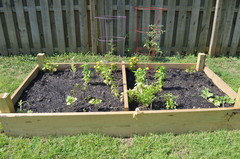
    This bed pre-existed when we bought the house. I planted the veggies about 3 months ago and they seem to be taking off. This bed also gets the most shade in our backyard. Our cucumbers on the right aren't doing too great though, do they need more sun? The leaves are yellow spotted and the cucumbers are shaped wonky.

  • 11 years ago

    That zucchini plant looks light starved to me... I'm sorry I don't know what else to offer... I'm very surprised to hear it is getting full sun. I'm sure someone else with more experience with beds like yours in your climate can chime in. What is the soil in it?

  • 11 years ago

    We have top soil and mixed in a little chicken manure. I have compost that I can add in if I need to. Maybe neither bed is getting enough nutrients? Is there a good organic fertilizer you can buy at Lowe's or Home Depot?

  • 11 years ago

    I am not a soil expert by any means so I will leave it to others, but I know others have posted that topsoil can be extremely low in nutrients, and I would hazard a guess that the soil is your problem.

  • 11 years ago

    Honestly, I would start with a complete & professional soil test from the local Agriculture Dept. Do each bed. They should be able to answer many of your other questions also.

    I have not heard of the sun stunting the growth of veggie plants - unless it is some shade loving variety and most veggies like more sun than not.

    What I'm trying to say is get the soil test done before you install a shade trellis.


    What I would do is to kill all that grass going right up to the beds - I like a 4ft perimeter, plants roots can extend out even farther. The grass is just robbing your plants of water and nutrients.

    To me grass is a perennial weed that invades my vegetable garden and it will invade.

    Would be a good place to try solarizing the soil before next year.

  • 11 years ago

    Apparently the SC Agriculture does not do soil testing. However Google found this
    http://www.clemson.edu/extension/hgic/plants/other/soils/hgic1652.html

    I prefer either state or edu because they should have no interest in selling you things - esp things you don't need - like someone else might want to do.

    lauren_shumway thanked gumby_ct
  • 11 years ago

    Thanks so much gumby! I'll make sure to get the soil tested.

  • 11 years ago

    I think it would be fine to use the compost as getting the soil test results can take some time. Compost is always good, esp. if it is "homemade dirt" ;)

  • 11 years ago

    Oh it is! This is our first year composting and I'm amazed at how easy it is! Everyone should do it.

  • 11 years ago

    Absolutely, composting is the original recycling model.

    Gumby who wishes he was gardening in SC or someplace south of CT anyway, maybe someday soon. We stayed at Charleston AFB last Dec while out on our road trip, then over to Myrtle Beach.

  • 11 years ago

    The only benefit I see so far is three growing seasons. Other than that, I'll take Northeastern dirt any day.

  • 11 years ago

    SC is known for growing some tasty watermelons maybe due to the soil?
    Oh and the looong HOT summers. And shorter winters ;)


  • 11 years ago

    Haha! I miss the snow believe it or not. But we'll see! I planted 2 watermelon and they seem to be doing ok so far. :)

  • 11 years ago

    It's pretty awesome to see how the compost progresses and breaks down. Nothing better than when you turn the compost and see it loaded with worms.

    Although when I turned it yesterday, it was loaded with grubs. I'm talking like some colossal suckers. I looked into it a little and read it could be the June Beetle? Read that the grubs themselves help to breakdown the compost, that they do not eat the roots of plants like other grubs might, but in their winged adult form they can be bad for your plants. Seeing as this compost pile is located at the end of my garden, I have been plucking them out and serving them up to the neighborhood birds. Though I think these giants would intimidate anything smaller than a crow.

    Anyone else have this problem?

  • 11 years ago

    I live in very hot and dry west Texas, zone 8a. Zucchini and summer squash are a few of the things I can plant anywhere in my yard and not get scorched. I plant them in the hottest areas and they thrive. However, I do water thoroughly often, through a drip system every couple of days (drip system not necessary by any means) and I fertilize them with a blood/bonemeal mix that is like a 4.7.7 mix I think every 2 weeks. What works for me, is planting too many, because I always have a few that are kind of struggling for no reason, so I may plant 16, but pull up the weakest looking ones and end up with 5 or 6. I have one now that I left in and for no reason it isn't even half the size of the healthy plants. same soil, same water, same fertilizer.


    For the borers, I know people have stated BT doesn't work, but in my experience it has. I spray it on the bas and stems and never have svb problems. Spinosad has worked also, although I try not to spray it too much because I am not sure how it affects some pollinators. that's my biggest issue, is unpollinated fruits that shrivel up. So, I am having to hand pollinate which is a pain. We usually end up having to get pretty creative with our recipes to cook all the squash, so my approach has been working I guess...

  • 11 years ago

    Chris the grubs are a topic all their own - prob another thread?

    I will add I went to a talk where it was suggested to plant Peonies to attract Tiphia Parasitoids which are a natural enemy of the Japanese beetles.


  • 11 years ago

    Ugh - Japanese beetles.

    I will dig up the compost later and post a picture of one of these mammoths in another thread.

    I'm all about using flowers to draw in the "good guys".

  • 11 years ago

    No, no, no no. Butternut is not immune to SVBs. It's "resistant". As in, it isn't hurt AS MUCH as everything else. I routinely have SVBs in my Butternuts. It is a common garden myth that Butternuts, and Moschata's in general, are left untouched by SVBs. But maybe my Texas SVBs are just bigger than everyone elses?