Software
Houzz Logo Print
norcam50

Radon mitigation system

10 years ago

Couldn't find my old post on this. In the previous discussion I was told that the radon mitigation was supposed to run continuously. Mine was not running. Got in the crawl space beneath basement floor and found a thermostat for the radon system. Turned it up and it came on. This tells me that it was set for a certain temperature and when it got below that it shut off. So, is it supposed to run continuously or not?

Comments (18)

  • 10 years ago

    I have never heard of a thermostat on a radon system. It makes no sense. The perfusion of radon has nothing to do with temperature. The retrofit mitigations all use a continuous running fan.

  • 10 years ago

    I'm at a loss as to what this is. My daughter was told that it was for radon and never having seen a vent pipe coming up from the space beneath the basement floor, I had no reason to disagree. I'm beginning to think it is something to get rid of any buildup of humidity down there. However, there is a paper enclosed in a plastic bag attached to the pipe and I'm sure that it mentions radon. It's been awhile since I read it but will do so again the next time I'm there.

  • 10 years ago

    Which is it? A normal thermostat turns ON when it gets below a certain temp.

    For heating yes, for airconditioning it works the other way.


    They do make a monitor that is adjustable so that a fan can be set to only run when necessary, but I think it is quite expensive.

    I doubt it measures radon levels. I don't know of any electronic way to do that, and radon mitigation isn't usually controlled by level. It perhaps might measure the lack of natural draft on the stack and turn on the fan when needed, but I've never even seen one of those. You have an example you can point at?

    Is your crawl space vented and in a cold climate? It may be set so that it doesn't suck cold air in in the winter and freeze your pipe


    Eh? The radon mitigation system is typically a large PVC pipe that goes from the slab to beyond the roof. It most certainly doesn't have any connection to the interior envelope of the house.

    I've got sincere doubts. I have never seen nor can imagine any reason why a radon mitigation fan would be set up to run other than continually.

  • 10 years ago
    last modified: 10 years ago

    "for airconditioning it works the other way"

    That was just the for instance. It still doesn't answer the question of whether it is turning on or off. If you turn the AC UP it will NOT turn ON.

    "radon mitigation isn't usually controlled by level"

    Actually, the EPA (and therefore various govt backed home loans) have reduced the "acceptable level" several times in the last 40 years. I know this because I have several friends that work at the lab that does the testing.

    HERE YOU GO.

    http://radon.sunnuclear.com/

    OR HERE

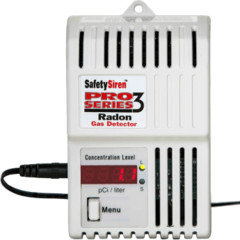
    http://www.sylvane.com/safety-siren-pro-series3-radon.html

    "The radon mitigation system is typically a large PVC pipe that goes from the slab to beyond the roof. "

    Why would there be a SLAB in a CRAWL SPACE ???

    Typical crawl space ventilator;

    http://www.rewci.com/radon-ventilation-fan.html?gclid=Cj0KEQiAv5-zBRCAzfWGu-2jo70BEiQAj_F8oMlsKC4cNjS_BfI6XeeP8TRqrj0k0_R4jfmLwQo7we4aAnHL8P8HAQ

    "I've got sincere doubts. I have never seen nor can imagine any reason why a radon mitigation fan would be set up to run other than continually."

    Where do you think the make-up air is coming from when you suck it all out of the crawl space?? It comes from outside, through the vents in the sides of the house. If you live in Minnesota, you would freeze your water pipes in the winter by leaving it on!! Most crawl space vents have dampers on them that you are supposed to close in the winter.

    Typical crawl space, water pipes and all;

    You need to realize that most radon systems are put in when the house is inspected for resale. The owners selling the property usually only do the minimum to pass an inspection, not an elaborate system. The next owners probably put the thermostat in after their water pipes froze.

  • 10 years ago
    last modified: 10 years ago

    LOL. No the radon fan should not be controlled by a thermostat.

    My guess is it is a rheostat they were trying to control the noise level of the fan by lowering the fan speed. Does the fan get louder the further you turn it up?

  • 10 years ago

    The crawl space is vented by the pipe that runs up from the crawl space. When I got down in the crawl space and without crawling over to that area I can see the vent pipe stops just below the floor. Near that there is an open pipe that goes into the ground (dirt). Plastic covers the entire surface but not sealed in any way as I've read radon mitigation systems are supposed to be. The wires that went from the vent pipe in the basement down to the crawl space goes to this thermostat. It either controls the temperature or humidity which kicks the fan on. The fan is not located in the crawl space but I assume somewhere in the vent pipe. The crawl space is about eight feet below ground level so shouldn't be any freezing. I can't imagine any venting for air thru the sides because it's well below ground. When I first started working at finishing the basement the fan ran continuously. Then it was off and on occasionally, then off for good. I cut out some flooring under the assumption that the fan needed replacement. Of course I wasn't expecting to find a thermostat, well, it looks like any thermostat I've seen and I turned it up to a higher number and the fan kicked back on. Turned it down and it went off. I'm pretty sure it has to do with humidity in the crawl space. Fan does not get lower or higher in volume. I was expecting to find a radon mitigation system down there because that's what my daughter said they were told when they bought the house. Also, as I said, the paper attached did mention radon. From what I've read about radon mitigation systems this is definitely not one.

  • 10 years ago
    last modified: 10 years ago

    The whole crawl space arrangement doesn't sound very typical.

    Without the chance of freezing, then the only thing besides radon to control would be humidity, which would be a Dehumidistat. The thing I am stuck on, is when you say you turn it "up" (further away from off), the numbers should actually be going down. (The difference between a humidistat and Dehumidistat) which I would call turning it down.

    OR it is still a strange mystery.

    The pipe under ground could give the added bonus of radon mitigation, but obviously only when it is running. Or, maybe they were just hoping it would. I would get the radon levels tested to see if it is over 4 pCi/l (EPA) If it is, I would run it constantly. If it is above 2.7 (world health organization) then maybe adjust it to run more often. If it is between 1 and 2.7, then maybe it was fine the way it was, depending on your point of view toward radon.

    Maybe this will explain my hangup better.

    What is the Difference Between Normally Closed Contact Thermostat and Normally Open Contact Thermostat?

    These are two types of thermostats that follow slightly different methods of temperature control. Normally Closed Contact means that the thermostat will keep the current flow on until the required temperature is reached. Once this temperature has been achieved, it will trip and switch the device off. This type is generally denoted by the symbol “N.C”. The Normally Open Contact Thermostat works in the opposite manner. It will keep the device switched off till the required temperature is reached. After obtaining optimum temperature, the thermostat will trip and switch the device on. The Normally Open Contact Thermostat is denoted by the symbol “N.O”. Many thermostats also have the dual option in which there are two separate paths for current flow utilizing both the N.O and N.C ideas.


  • 10 years ago

    It probably is a radon system, just not needed if the crawlspace is properly vented. If it is a sealed and conditioned crawlspace then it wouldn't need either ventilation or radon mitigation.

  • 10 years ago

    The crawl space is not sealed around the edges the way the plastic is just over the dirt. It is not considered conditioned without a return duct to the heating system to mitigate moisture. It is possible that ground water can make the crawl space humid at certain times of year to a point mold starts to be a concern, where a dehumidistat would be useful.

  • 10 years ago

    R408.3 Unvented crawl space.

    Ventilation openings in under-floor spaces specified in Sections R408.1 and R408.2 shall not be required where:


    1. Exposed earth is covered with a continuous Class I vapor retarder. Joints of the vapor retarder shall overlap by 6 inches (152 mm) and shall be sealed or taped. The edges of the vapor retarder shall extend at least 6 inches (152 mm) up the stem wall and shall be attached and sealed to the stem wall or insulation; and

    2. One of the following is provided for the under-floor space:

    2.1. Continuously operated mechanical exhaust ventilation at a rate equal to 1 cubic foot per minute (0.47 L/s) for each 50 square feet (4.7m2) of crawlspace floor area, including an air pathway to the common area (such as a duct or transfer grille), and perimeter walls insulated in accordance with Section N1103.2.1 of this code;

    2.2. Conditioned air supply sized to deliver at a rate equal to 1 cubic foot per minute (0.47 L/s) for each 50 square feet (4.7 m2) of under-floor area, including a return air pathway to the common area (such as a duct or transfer grille), and perimeter walls insulated in accordance with Section N1102.2 of this code;

    2.3. Plenum in existing structures complying with Section M1601.5, if under-floor space is used as a plenum.

    http://publicecodes.cyberregs.com/icod/irc/2012/icod_irc_2012_4_sec008.htm


  • 10 years ago

    I will check out the vapor barrier on the ground and around the edges, sealed or not. I will also carefully read what is attached to the vent pipe. Maybe it will shed some light on this. I really appreciate the comments. Thanks.

  • 10 years ago

    Whatever that gadget is with the adjustment knob on it, should have some kind of label describing what it is. If you can post a picture that may help too.

  • 10 years ago

    I got closer and read it; it for humidity. Now, how is it associated with radon, since that was what my daughter was told and which is written on the documentation taped to the vent pipe. Someone mentioned a "passive" radon system but not sure what that would be.

  • 10 years ago

    Humidity is not related. I have a strange feeling you may be just looking at some sort of crawlspace ventilation not related to radon at all.

    A passive radon system works because if may not need a mechanical fan to provide the ventilation. Just enough breeze blowing over the "chimney" will provide enough draft.

  • 10 years ago
    last modified: 10 years ago

    I keep thinking that the pipe in the ground is actually a drain tile system that they are theoretically expecting to collect enough radon below the surface and bring it up right underneath the "chimney" as Ron says.

    To a point, with an area that has low normal radon levels, the times when more ground water is coming into the crawl space, which causes more humidity, could also pull more radon with it, where the fan would then assist in mitigation. The most usual cause of radon level fluctuations is barometric pressure. If you look at a barometer, the liquid level changes with the pressure, making a link between how both moisture and radon enter the crawl space easier as the pressure in the crawlspace drops.

    This type of system may work fine when the radon levels are low, but if they are higher than EPA guidelines, it might need a more continuous fan.

  • 10 years ago

    Tapping into a drain tile or weeper or sump pump is normal for radon mitigation.

  • 10 years ago

    I'm going to take photos and get to the bottom of this. Hopefully I won't have any problem getting them on this site.