Software
Houzz Logo Print
norcam50

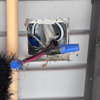
4 breakers hooked together

10 years ago

I was going to replace two fifty amp breakers that are not in use with two 20 amp breakers. When I removed them two other breakers were attached, not at the handles but they were all one piece. Here's the setup. The top breaker is a twenty amp with a red wire attached, the next two are the two 50 amp breakers, and the fourth is another 20 amp breaker with a black wire attached. I traced the wires from the 20 amp breakers and they come from the same cable. What exactly do I have here? The two 50 amp breakers were in the off position because the electric stove was replaced with a gas one. My first thought was that the two 20's were somehow associated with the stove but they are on and in use for something so that can't be the case. Why would an electrician separate two hot wires from the same cable while inserting a double 50 amp breaker in between, or why are they even attached? I want to put a single twenty amp breaker in but am concerned I would be messing up the setup for the current 20 amp breakers already there.

Comments (17)

  • 10 years ago

    I suspect we're talking about either the GE "thin breakers" or one of the other manufacturer TANDEM breakers where two breakers fit in one normal space. If you want a 240V circuit, you need to have a breaker on each leg, which for the tandems/skinnies means you have to use ones in different full size slots. The middle two get there handles tied and the outer two get there handles tie.

  • 10 years ago

    the two 50's were tied together but the two 20's, one above the 50's and one below the 50's are not tied together. Maybe they were but not now. If the two 20 amp breakers were in the first and fourth slot wouldn't they be on the same leg? This is why I don't want to change anything until I know for sure what they are for, whether they are supplying two separate 110v circuits or one 240v circuit. I guess I'll have to do some investigating but as I said in my first post, I don't know why they weren't put in in the first and second slots.

  • 10 years ago
    last modified: 10 years ago

    This is why I don't want to change anything until I know for sure what they are for.

    Good idea. Time to investigate what controls what. It is good to know that anyhow if you need to bring out an electrician they wont have to spend as much time trying to figure that out. Proper labeling is required for code now.

    If it is a 240v circuit it should be on a double pole breaker and not on tandems. Separate circuits can be on tandem breakers where they are acceptable in the panel. Not all panels can accept tandems. Here is more reading. http://www.startribune.com/how-to-know-when-tandem-circuit-breakers-can-be-used-aka-cheater-breakers/140688183/

    Here is a circuit breaker finder and accessories. Otherwise turn off the breaker and find out what is turned off and label accordingly.

    http://www.homedepot.com/p/Klein-Tools-Digital-Circuit-Breaker-Finder-ET300/202330830

    http://www.homedepot.com/p/Klein-Tools-Circuit-Breaker-Finder-Accessory-Kit-69411/202266613

  • 10 years ago

    ok, one of the 20 amp breakers is for the microwave oven, rated at around 1700 amps so I think the breaker is dedicated to it. The other breaker is for several outlets in the same vicinity. When finishing the basement I found another 14/3 wire that was used this way and it seems that the only reason was to save running two separate cables. It came into a basement junction box and then they used the two hots to service two different circuits. I'm thinking they did the same in this case. I was worried that it was for a 240v circuit but not so. Tomorrow I'll open the outlets to see how the wiring is. Does this make sense?

  • 10 years ago

    I think I will invest in one of those circuit breaker finders

  • 10 years ago
    last modified: 10 years ago

    I am not so sure that is kosher, but not totally sure. I believe this is called a multi-wire branch circuit where two hots share a neutral and in that case I believe it is supposed to use a double pole breaker. If you understand AC wiring it has a sine waveform and there are two poles in the alternating current and each hot needs to be on the separate pole so the neutral does not potentially get overloaded. Ron correct me if I am wrong. I have never done it, I like to keep things simple. :)

  • 10 years ago

    You have one of these.

    http://www.homedepot.com/p/Square-D-Homeline-2-20-Amp-Single-Pole-1-50-Amp-Two-Pole-Quad-Tandem-Circuit-Breaker-HOMT2020250CP/202495838

    It actually plugs into tte panel like this.

    On 1 & 3, not 1 through 4.

  • 10 years ago
    last modified: 10 years ago

    2008 NEC code change

    210.4

    (B). Disconnecting Means. Each multiwire branch circuit shall be provided with a means that will simultaneously disconnect all ungrounded conductors at the point where the branch circuit originates.

    .

    http://freenec.com/T22.html

  • 10 years ago

    This is what the outside breaker handle ties may look like.

  • 10 years ago

    the first photo is exactly what I have---20 50 50 20 on 1 and 3. So the two 20's are on different phases. I will get a breaker handle tie to hook them together. The two 20's have a shared neutral. Will I be ok as long as I replace this with two individual 20 amp breaker in the same positions for the circuits that are already there (keeping them on the same phases they are on now) and use the slots where the 50's are to put additional breakers in for my other needs?

  • 10 years ago
    last modified: 10 years ago

    It depends on what panel you have, but you would normally get a 20, 20-20, 20 breaker like the last photo and put the multiwire branch circuit on the center two positions without the outside handle ties.

    It doesn't do much good to ask questions without telling us the exact panel you have. Not just the brand, but the model number which probably has 16/32 or 20/40 in the number. I would also presume that all the spaces are already filled with thin or tandem breakers, are any of them actually single breakers, or just two molded together? There should be a list in the panel as to which breakers are listed for that panel.

  • 10 years ago

    Appreciate the help. I will take a look at the panel when I get back in town.

  • 10 years ago

    If one of those 20 amp breakers does your microwave and the other 20 amp breaker does other things then you do not need to bar them together because it is two separate 120 volt loads. If it were a 240 volt load then it must be barred together.

  • 10 years ago

    Because it's a three wire going to those breakers the two 20 amp breakers must be on opposite phases otherwire the load on you neutral will double not cancel

  • 10 years ago

    Peso, please read 210.4 (B) in an earlier post, and this article.

    http://www.ecmag.com/section/codes-standards/serious-decision

    Branch Circuit. - The circuit conductors between the final overcurrent device protecting the circuit and the outlet(s).

    .

    Branch Circuit, Multiwire. - A branch circuit that consists of two or more ungrounded conductors that have a voltage between them, and a grounded conductor that has equal voltage between it and each ungrounded conductor of the circuit and that is connected to the neutral or grounded conductor of the system.

  • 10 years ago

    Sorry I didn't realize that this was just an American site. As I am a Canadian electrician and our codes are different. So sorry for the confusion

  • 10 years ago

    Actually, we do field questions from Canadians here and your help would certainly be welcome then. If the poster is somewhere whether the later NEC applies, the handle tie is obligatory. In fact, if the MWBC serves devices on a single yoke (like you folks up north commonly do with your kitchen countertop recepatcles), just about any version of the NEC In use in the states requires the handle tie.