Software
Houzz Logo Print
mtvhike

Wiring a 3-way switch

10 years ago
last modified: 10 years ago

I know the principles of wiring 3-way (and 4-way) switches, but I would like guidance on the best way for my particular circumstances. The builder who wired most of my house put a double box near an outside door from the basement, with a single switch in it (no lights yet). For me, the simplest way would be to replace the single switch with a 3-way, run a 3-conductor (plus ground) cable to another switch, and then a 2-conductor cable to the box in the ceiling which will hold the light. All the wire for the existing basement lights are 12-2 or 12-3, including this new one. This seems to be a little overkill, so is there any reason I shouldn't use 14-3 for the cable between the two switches? Does the answer depend on whether the breaker for that circuit is 15 or 20 amp? Does this circuit need to be GFCI?

Comments (10)

  • 10 years ago
    last modified: 10 years ago

    Does the answer depend on whether the breaker for that circuit is 15 or 20 amp?

    Yep. Only 12 gauge is allowed if it's a 20 amp breaker. If you add 14 gauge, then you have to change the breaker to 15 amps.

    In general, mixing gauge size is kind of sloppy so even if it's on a 15 amp circuit for some reason, I'd still use 12 gauge to match the rest of the circuit. But that's just my personal preference.

    Does this circuit need to be GFCI?

    What's on the circuit? Is the basement finished?

  • 10 years ago

    To amplify on Greg's answer: only 115V 15/20A receptacles in UNFINISHED basements require GFCI protection outright (as well as those within six feet of a sink). Of course, some wet/damp rated fans/luminaires specify GFCI so if they the instructions require it, it's required.

  • 10 years ago

    Greg and Ron: The basement has studded walls, some with a finishing layer such as drywall some without; the ceiling is unfinished and will probably remain that way. So, I plan consider it unfinished and to put GFCI protection on all receptacles. Thus, if such protection is not required for lighting, then I will keep lighting and receptacle circuits independent. I shall use 12 gauge wire throughout.

  • 10 years ago

    So, I wired up one room. The contractor had run a 12/2 cable to a box for a wall switch. I put another box below that one, and put in a GFCI receptacle in it, and powered it from the upper box, using 12/3 wire. I connected the red wire to the GFCI-protected screw on the receptacle and connected that to a 3-way switch I installed in the upper box. I then ran 12/3 from that switch across the ceiling to another 3-way near the other door to that room. I then ran 12/2 from the second switch to a ceiling light. Do I have all my bases covered? Next step is to run a 12/2 cable from a new breaker to a series of duplex outlets on the walls of this same room, because I like my receptacles to be on a circuit separate from the lighting.

  • 10 years ago

    GFCI protection is not required for lighting. Except for some fixtures that are put in showers, due to the manufacturer's specifications to get a damp or wet rating from UL...

  • 10 years ago

    The neutral (white) and ground wires were connected to all devices (except the neutral is not connected to the switches). I was under the impression that the lighting had to be GFCI-protected also, because this room (and the rest of the basement) is unfinished, at least for now. Also, it is very easy to do it, in my case.

  • 10 years ago

    You will end up with too many wires in the SWITCH box by the time you get the gfci wired corectly.

    GFCI protection is NOT required. Not even outside lights or garage lights require GFCI protection.

    210.8 Ground-Fault Circuit-Interrupter Protection for Personnel

    (A) Dwelling Units. All 125-volt, single-phase, 15and 20-ampere receptacles installed in the locations specified in (1) through (8) shall have ground-fault circuit-interrupter protection for personnel.

    .

    Receptacle. A receptacle is a contact device installed at the outlet for the connection of an attachment plug. A single receptacle is a single contact device with no other contact device on the same yoke. A multiple receptacle is two or more contact devices on the same yoke.


  • 10 years ago

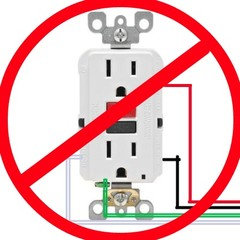
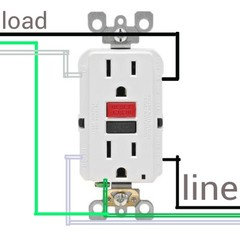
    So, Fred, in your drawing, the wire labeled Load goes to other outlets, but not to any lighting circuits, right? Does this lack of GFCI protection on lighting circuits apply to bathrooms - specifically the light over the vanity? Also, I may have a light in the ceiling over the shower.

  • 10 years ago

    Fred already answered those questions:

    GFCI protection is not required for lighting. Except for some fixtures
    that are put in showers, due to the manufacturer's specifications to get
    a damp or wet rating from UL

Sponsored
Hope Restoration & General Contracting
Average rating: 4.7 out of 5 stars35 Reviews
Columbus Design-Build, Kitchen & Bath Remodeling, Historic Renovations