Software
Houzz Logo Print
eli_arenas

live oaks in IL

8 years ago
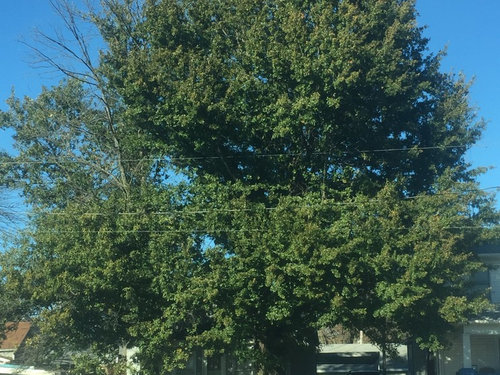
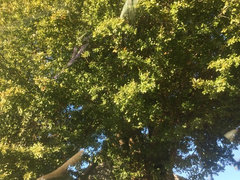
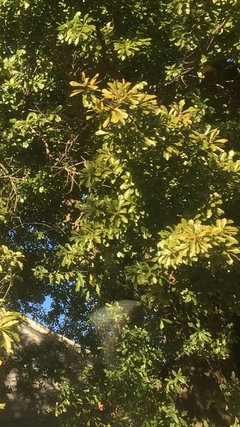
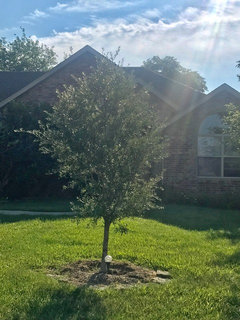
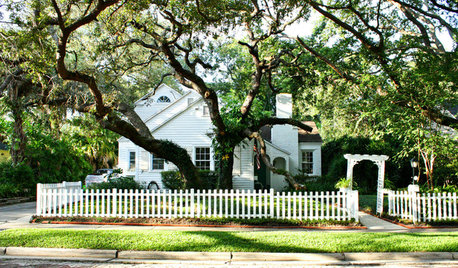
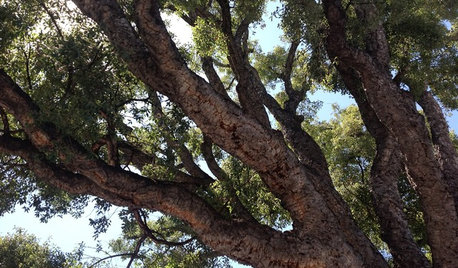
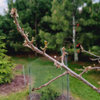
from a distance I thought these were shingle oaks or willow oaks, but now that most of the leaves have fallen you can clearly see that these trees haven’t chaged at all. A closer look showed me that these are live oaks. Does anybody else know of any growing this far north?

Comments (20)

  • 8 years ago

  • 8 years ago

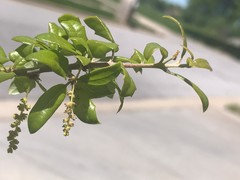
    Your second shot still doesn't actually provide a close look at the leaves.

  • 8 years ago

    My initial guess is either a very tardy version of a more common oak, or Q. laurifolia or hemispherica.

    Both will eventually lose leaves, but may stay partly evergreen in a mild winter in your zone.

    We need closer shots of the leaves, though.

  • 8 years ago

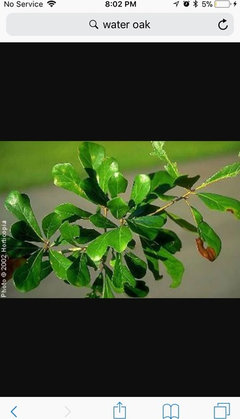
    Yeah, water oak is a distinct possibility.

  • 8 years ago
    i think it is water oak. when do water oaks lose their leaves?
  • 8 years ago

    My money's riding on it being a water oak, Q.nigra.

    There is a live oak (I presume Q.virginiana, but may be Q.fusiformis) growing on the campus of Hopkinsville Community College in Hopkinsville, KY - 20 miles or so north of the KY/TN border; planted around 1970, it's in a very protected spot, below grade, just outside the college maintenance shop. Was either frozen to the ground or mowed over at one point in time, and regrew... is now a 'copse' of a dozen or so trunks, but is about 20 ft tall and probably 30-40 ft wide. Farthest 'north' in an inland location that I've seen a Southern live oak survive for any significant length of time.

  • 8 years ago

    I’ve seen water oaks green past Christmas, FWIW.

  • 8 years ago

    Water oak drops leaves gradually all winter long down here, it makes it very aggravating as a yard tree.

  • 8 years ago
    last modified: 8 years ago

    Its 100% Water Oak ..and they will hold their leaves even into Jan.

    cairo Illinois is very far south well within their range. I have Texas Live Oaks (quercus fusiformis) growing in SW Missouri.

    the farthest known Live Oak I know of, not on a coast, is Poaky1 who posts here on gardenweb..in Pennsylvania.

    My Live oaks have done well here and have been in temps down to -11 below zero. I know there is one in Wichita, KS that has survived -18 below.

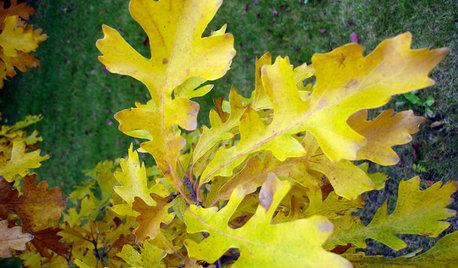
    Leaves of a Texas Live Oak

  • 8 years ago

    Joe, are yours virginiana or fusiformis?

    I've got one of each. My fusiformis came from a nursery in San Antonio that specializes in native plants. It was a gallon plant 6-8 years ago and is now 8-9 feet tall. It has never produced acorns, and last winter was the first winter it held green foliage. My low was around zero, but the winter as a whole was mild.

    My virginiana came from a place here in TN, now out of business, that specialized in zone pushing. Besides live oaks, he had laurel oaks and needle, windmill, and dwarf palmetto palms, along with a lot of native BLE's. I believe most of his stuff came from north FL. My virginiana is around 20 feet, has produced acorns at least once, which were taken by varmints. Like the fusi, last year was the first year it held green foliage. During the 'polar vortex' of 13-14 the temp at my place dropped to -3F at the house, probably a couple degrees lower out away where the trees are. The virginiana had tip dieback of a couple inches on all branches, but no bark split. That spring the tree was later than usual starting into growth and I thought it was dead, but it eventually leafed out normally. The fusi was fine except for foliage, and leafed out at the normal time.

    I've got a hemispherica that stays green most of the winter, the foliage is close to that of water oak, but a bright green. It is at least 10 years old but has never produced acorns. It is a handsome tree, and if I stay here I may plant more. The foliage is fine til lower single digits. It has never suffered any dieback from winter cold, but the devastating Easter freeze of '07 killed all branches back by 2-3 feet, the tree was in active growth. This tree is native in w TN.

    There is a virginiana that is in the next county at a nursery. I've watched it since '85. It is growing near a main road and is under power lines so gets topped regularly. It stays green but is a very slow grower. The tree originally came as a seedling mixed in with some liners the nursery got from FL. That location runs warmer than me, but the tree endured -15F in '85 with minimal foliage damage. I've never checked for acorns. It is possible it is a sand live oak, judging by it's growth.

    The champion TN live oak is at UTK. I've seen the tree. It is a large round headed tree that I've been told holds it's foliage most winters. The tree's form and foliage looks nothing like live oaks I've observed throughout the south for the last 30 years. It has been ID'ed by the PHD's at the school, so who am I to disagree? I, and others, believe it is a hybrid. I've got about 20 young trees grown from acorns collected from beneath the tree. The trees are about 8-10 years old now, and except for one, show no signs of being evergreen. They are however, a fascinating mix of growth habits and leaf shapes. At this age it is too early to say if they will be worth anything, but it is fun for me to try and figure the parentage. Only one has produced acorns, and they were stalked, indicating maybe Q. robur. A couple have spectacular copper-maroon-red foliage now. A couple look to be fastigiate, and a couple have thick leathery foliage that reminds of western species. I don't expect I'll live anywhere long enough to see these even close to maturity.

  • 8 years ago
    last modified: 8 years ago

    "It has been ID'ed by the PHD's at the school, so who am I to disagree?

    Unless they are specialist in Quercus taxonomy, there's no guarantee they are correct.

    " I've got about 20 young trees grown from acorns collected from beneath
    the tree. The trees are about 8-10 years old now, and except for one,
    show no signs of being evergreen."

    Seems to support a hypothesis that the parent tree is not a pure live oak!

  • 8 years ago

    I wonder if it’s actually a Compton Oak, Ken.

  • 8 years ago

    I've never seen a Compton oak in person, seen plenty of images of trees and foliage. The tree at UTK fits the shape, but when I saw it it was summer, and the tree is in a very public area of campus, so is limbed up and I wasn't able to see the leaves very well. I was able to see them well enough to tell they were not typical Q. virginiana though. One of the seedlings I mentioned has foliage that fits the description of Compton, but it isn't even close to being tardily deciduous. I'm in the country, in a large cold sink, so things like water oak tend to drop their foliage earlier than say ones in warmer spots, especially night temps. The fall color is yellow on my seedling.

  • 8 years ago
    last modified: 8 years ago

    Ken,

    my live oaks are all Quercus Fusiformis either from the Texas / Oklahoma Border or from Just northwest of OKC and are Oklahoma Quartz Mtn Variety.

    All of mine are producing acorns, however, my Texas Live Oak just started and they don't fully mature yet, while the 2 Quartz Mtn do and I already have seedlings growing from.


    just a note: Virginiana would croak here within a couple years

  • 8 years ago

    Hey guys, the tree in question is NOT a Compton oak, not a Live oak either. I have a Quartz mountain Live oak as Joe in Moe said. It is entering it's 3rd year of winter in my yard. I would have to say it's Q. Nigra for sure. A fast growing but short lived southern (usually) tree.

  • 6 years ago

    I have experimented with ever green oaks here in Daviess County Ky for years. Q. Virginia live grudgingly for about 10 years if you control bark burst and grow to a good size, but eventually die, will grow back from roots to bushes. Q hemispherica do very well , live for a long time and grow to very large, leaves stay fairly green all winter, no trouble from bark burst. Two Q. niagara live here don't loose leaves until 4 th week in January. Would like to try Q. fusiformis & Q.Ilex but have not purchased any seedlings. We live in Area 6B, not typical of Kentucky as we live in the Lower Green River Delta higher content of sand in soil and much lower elevation than most of KY. I have seen a Holm Oak( Q. ilex) growing in Rochester southern England probably over 100 years old.

  • 6 years ago

    Rochester in England probably hasn't been much below 10F in 100 years.


    Established Q ilex have surely survived single digits in the colder parts of the UK, in various cold winters like 62-63 or 95-96 in Scotland. But it's really a zone 8 tree...almost all of the British Isles are at least zone 8, if not zone 9. They are nothing new to horticulture...if they were even 7b hardy, they would be seen places like Williamsburg, VA, Washington DC, etc. The old Hill's Nursery in Arlington, VA had a grafted Q. X turneri imported from Belgium in the 60s. This is a robur/ilex cross and It was still very small over 30 years later when I saw it, smaller than Q. virginianas planted at the same time. The hardiest Q. virginiana, other natives, or Q. myrsinifolia are clearly better to experiment with in the eastern US.


    'bark burst' seems to be what is slowly killing the Q. virginiana at the University of Delaware.


  • 6 years ago

    I can confirm that water oak is pretty darn hardy -- just recently discovered a 60 footer on Hagerstown Maryland's Community College campus.

  • 6 years ago

    I had actually had a Q. Turneri several years ago. The person who sent it to me had to get "creative" in labeling the envelope they sent it to me in since sending it to the US was kinda possibly not so legal. BUT, unfortunately, I hadn't had a greenhouse back then and had directly planted it out in my zone 6a yard, so, It had died since it would have needed to be much larger to survive and thrive here in zone 6a, it had been a twig when I got it.


    Anyways, I now have 2 QMLO's, 1 is big and 1 is only about 3 inches tall, and was from an acorn last fall.

    I also have 1 TXLO from "Oaks of the wild west" that is actually about 4 -5 years old, and has kept dying back to the roots for several years, and growing new growth in spring/summer.


    As for last year, it had a mild winter in 2019-2020 and so now I have that growth up to my chin when I stand by it. I sent pics to Joe in Mo to post IF he wants to, because I can't seem to post pics myself. You can see the "pool noodles" that I have on the trunks (it has 2 of em) of my TXLO.

    I am thinking about wrapping up the top growth of that TXLO IF we are due for some REAL cold like anything from 18F and less, I REALLY want it to keep that new growth from this past growing season. And, now when it is still small, I CAN protect the buds and the new foliage, and as the trunks get more girth I THINK it will be hardier, at least I HOPE so. BUT, I guess the buds on the ends of the branches will STILL be sensitive on the TXLO more than the buds on the QMLO.


    BTW, as for my BIG ( about 9 feet tall) QMLO tree, it is FULLY hardy in my zone 6a, and has been for many years ever since I first got it. BUT, it was about 3 1/2 feet tall when I got it,. so, the very small QMLO trees will need time before they are most hardy, like my current BABY QMLO that just sprouted from an acorn last spring, I keep it in my Greenhouse.


    I do wish that I could get another Q Turneri baby now that I have a greenhouse, BUT, it is kinda TRICKY to get 1 sent in the mail to the USA now. I had been lucky enough to have been to the UK back in 2001 and had seen a Q. Ilex in person at "Cardiff Castle". It was very nice and BIG, BUT, not much like a Q. Virginiana, Q. Fusiformis, or QMLO in "form". BUT, still nice tree.

    later guys.