Software
Houzz Logo Print
gallagher0001

Please inspect these connections

7 years ago
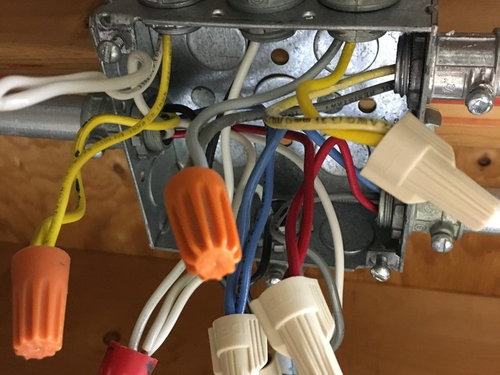
Needing an opinion. I may have miswired something. What you see is part of a MWBC, In an effort to check the connections I may have miswirled when reconnecting.

Specifically I’m wondering if the 2 pair of yellow wires shouldn’t be together. As it is now the breaker will trip. What do your trained eyes notice.


Happy 4th of July.

Comments (15)

  • 7 years ago

    Well there are red, white and blue wires so that fits the 4th theme! Looks like box overfill. Before disconnecting should have noted which wires were connected together or have taken a picture with the ubiquitous cell phone.

    gallagher0001 thanked pima74
  • 7 years ago

    Greg, Thanks for your willingness to help me learn. I’ll do my best to explain what you’re seeing. From the panel are 2 15 amp breakers connected to a 14-3 wire. The hot colors are black and red both of which travel along a 25 foot straight run in the basement with 4 boxes. In those boxes all whites are connected. Three blue might connect to a single black wire. Not everything is MWBC. Where you see 2 wires leaving the box it may be powering an outlet. There is a second MWBC for the second floor.

    What happened was that I rewired the box to run a dedicated line to the dishwasher. This involved the original yellow and neutral power supply that I removed twisting remaining wires together and then connected my new power source dedicated line. Every time the breaker trips. Each breaker separately is fine but not both together. The dishwasher works perfectly.

    I forgot to say that all is in conduit. Did I leave out anything? Thanks

  • 7 years ago

    In conduit wiring, any wire that isn't green, white, or light grey is a hot wire, unless some incompetent person has been messing with the wiring.

    I can't tell from your photo what might be your problem. I'd have to trace things out and/or get in there with some test gear. But based on the symptoms you describe, it sounds like you connected two hot (ungrounded) conductors from the source (breakers) together somewhere.

    To put this right, you'll need to determine which are the hot and neutral wires from the source, and which destination wires go where.

    One thing that I'm concerned about. Are these by any chance your countertop appliance receptacle circuits? AFAIK, code says those circuits can also serve a refrigerator, but not a dishwasher, and DEFINITELY not a dishwasher with installation instructions specifying that it needs a dedicated circuit.

    Some here may disagree, but even if your dishwasher doesn't require a dedicated circuit, I still recommend pulling a new homerun from the panel for it.

    Unfortunately I think you've picked a somewhat complex situation to cut your electrical teeth on. So, you may still want to consider getting some professional help for this one. Then you can try again on a simpler electrical installation chore, and gradually work your way through increasing complexity as you understand more. And don't skip reading that basic electrical principles book from the library!

  • 7 years ago
    last modified: 7 years ago

    What happened was that I rewired the box to run a dedicated line to the dishwasher. This involved the original yellow and neutral power supply that I removed twisting remaining wires together and then connected my new power source dedicated line.

    Do you know which wires you disconnected and changed? If so, can you put it back the way it was and confirm that everything works the way it did? If so, I'd do that and then re-examine what it is that you want to accomplish and investigate more about what wires are on what circuit and where they come and go before you start messing with things.

    And by the way, the line to the dishwasher isn't 'dedicated' if you connected it to an existing circuit with other things on it. Dedicated circuit means that it's the only thing on the circuit. Or are you saying that you are trying to remove the existing dishwasher branch from a non-dedicated circuit and connect it to a dedicated source, hence it is becoming a dedicated circuit?

  • 7 years ago

    I am saying the latter. Moved DW from a non-dedicated to a dedicated source. What I’m thinking is that the yellow pairs got mixed up in connecting my dedicated circuit and that they are actually on different breakers . Remember this is a MWBC.

  • 7 years ago

    Which wire set is the power source that you added? Which wire set is the original power source? Which sets of wires can we ignore because they are totally separate circuits that you didn't touch?

    Drawing a diagram and labeling the wires and taking a picture and posting it would be helpful.

    gallagher0001 thanked greg_2015
  • 7 years ago

    Interesting observation but might be meaningless. I was measuring voltage at the boxes. Everything look as expected except for a branch that first showed OL then the 120.6 voltage. Always OL first followed by the voltage.

  • 7 years ago

    gallegher-

    As I said in my other post, you really need to get an electrician in. You know just enough to be dangerous (not an insult...I was there once, too). There are so many chances of things being wrong with that overfilled box that I'm not even going to start speculating about what may be right and what's wrong.

  • 7 years ago
    last modified: 7 years ago

    I'm afraid I have to agree with Kudzu. You say you want to learn, and I'm all for that. I may be missing something, but from your posts so far, I don't see much indication that you're actually going there yet.

    This isn't like fixing a modern car. You can't just plug in the computer, look at the trouble code, and change the part the computer says to change. It's more like fixing, oh, say, a 1928 Porter. :)

    You have to do some good old fashioned troubleshooting. You can't do that without a basic understanding of how electricity works. We can't teach you that, and you can't learn it overnight.

    There are different ways to get the education you need, but in some ways I'm an old fashioned kinda guy, and IMO the best way is to read some introductory text on basic electrical principles. Demonstrate to yourself what you've learned by doing a few simple experiments with a battery, a couple of flashlight bulbs, a switch or two, and some hookup wire (clip leads are manna from heaven).

    Read some more, experiment some more.

    Do some small electrical jobs. Succeed. Do some slightly bigger ones. Succeed. Keep working up.

    You need to back up to solid ground that way, or you're just going to keep on spinning your wheels.

    If you have a friend who's into amateur radio, maybe he or she will roll in and be your coach, have a look over your shoulder. Otherwise, I suggest that you get out the checkbook and pick up the phone. I'm concerned that otherwise, someone's going to get hurt.

    And that's all I have to say in this thread.

    gallagher0001 thanked DavidR
  • 7 years ago

    I spent years working under the supervision of another electrician. At times he let me do my thing and only came over at the end and either nodded his head in approval or horrors shook his head like I was a complete idiot for missing something.

    Having been an amateur radio operator since 1974, I wouldn't put much stock in the electrical wiring knowledge of someone just because they are a ham. Sure they should know electrical theory, but that doesn't mean they understand all the rules for safe and legal wiring.

    gallagher0001 thanked Ron Natalie
  • 7 years ago

    Here’s the plan that makes sense to me how about you experts:

    - starting closest to the panel open all nodes in each box with power off

    -meter test each wire for ground continuity ( How should I do this?)

    - reconnect wires passing test

    - energize, if all good buy myself some tool as a present, if not let all you guys know and

    -proceed to next box along homerun path and repeat the process.

    I think I bought that present too soon.

    Thoughts and advice

  • 7 years ago

    The most sound advice has already been given... multiple times. Please, for your own good and safety, , just call in a pro to get you out of this jam. In the end, it will be money well spent. If there's one thing to take away, it's to learn what and when you should be takling something, and more importantly, when not to. This stuff can hurt you, or burn down your house. Is it worth it to you?

    gallagher0001 thanked Steve J
  • 7 years ago

    Ok, I get it. Time to admit defeat and call in an electrician. Thanks all.

  • 7 years ago

    Found the problem. Forgot to break the tab on an outlet I replaced. Think simple is part of the lesson here. Thanks to all who responded!