Software
Houzz Logo Print
trish_walter

Help me find Wall Range Hood

6 years ago
last modified: 6 years ago

It's for an induction 36" cooktop [I am not going larger because it will be between cabinets and 24" depth so should be good and trying to keep cost down]...

I do cook a lot and often set off smoke detector in current home [ha ha sadly truth].

Want stainless baffles; led lights [dimmable would be nice]; fairly quiet at least on 1st 2 settings;

at least 3-4 settings.

We have 9' ceilings and will be between cabinets so if I do depth close to 24" should be good...


I'm leaning towards the Zline

Can't figure out difference between Kf1 and kf2 ...

but they are both only 20.5 deep.

and say 6" duct. I thought I had read that 8" duct better for higher cfms but can't find and not sure if that could be done ....that's what the builder needs to know.


Here's the ZF1-36

https://www.build.com/zline-kf1-36/s1632410?uid=3873364


Comments (14)

  • 6 years ago

    I'll be following. You might change the living room to kitchens instead for where to post it.

  • 6 years ago

    If your cooking styles are setting off smoke alarms then you need something considerably better than the Zline you referenced. It has zero containment so the majority of the bursts that create all of that smoke will simply roll out from under it. With the blower in the hood itself (and considering the extremely low price) I'd guess this one will be quite loud on all settings.


    More info here: https://www.houzz.com/discussions/5161173/hood-faq

  • 6 years ago
    last modified: 6 years ago

    it's stated sones seem good and it has good reviews.

    My current situation is a gas stove and probably under-powered hood...

    And the smoke detector is probably too close [ha ha].

    Did you have a suggested hood ? I really don't want to learn all the ins and outs of how they work [tried to get through the link you posted], I just want a decent hood that will do the job for <$1k. Thanks.

  • 6 years ago

    it will be ducted and go straight up through the roof.

    Thanks.

  • 6 years ago

    @Trish Walter That's absolutely the best situation for a hood installation. Now, just make sure whatever you get doesn't have a completely flat bottom underneath, and you should be good. That under-hood capture area is critical for the best performance.

  • 6 years ago
    last modified: 6 years ago

    that's what I thought @Aglitter thanks. And also we do not have any gas in the house so I don't believe Make up air is as much a concern [could be wrong].

    I'll look for what you mentioned.


    I'd love to hear from anyone that has one and likes it. Thanks.

  • 6 years ago
    last modified: 6 years ago

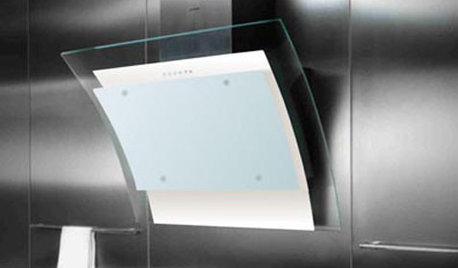
    @Trish Walter There are lots of great reviews on that particular GE hood I recommended. It's a very popular model for residential installations. We paid just a little more than this one would have cost to get our used floor model display Wolf hood which a next level up as far as the size of the under-hood capture and containment area is concerned, but the GE hood pictured will do a much better job than most residential hoods which typically feature flat bottom surface areas. The GE has a half-moon-shaped glass front in that curved area, so it really is a true, curved capture and containment space underneath even if a bit shallow compared to some pro-style hoods.

    If you're concerned about noise, you could mount a blower near your roof exit and have a virtually noiseless hood.

    About make-up air (MUA), it's the law in many jurisdictions to have an MUA system for blowers over 400 cfm. If it's not caught now, it might be when you tried to sell the house, and non-compliance could delay a sale and/or trigger a fine. Whether the house is all electric or has a fireplace or not isn't taken into consideration for jurisdictions that follow the National Electrical Code (NEC) that governs MUA with ducted ventilation, the latest version of the code being from 2017. If you live outside city limits, you probably aren't under any regulations concerning this.

    Trish Walter thanked Aglitter
  • 6 years ago

    It’s in the building code since 2012. MUA is not optional anywhere.

  • 6 years ago

    Perhaps in Samoa.


  • 6 years ago
    last modified: 6 years ago

    I meant there s not as much a concern about MUA. or maybe I read it wrong but I do know I read it's only necessary for higher cfms.


    thanks.

  • 6 years ago
    last modified: 6 years ago

    @Trish Walter Some jurisdictions, particularly in northern climates, specify lower cfm threshholds for MUA, like 350 cfm or even 300 cfm. It has to do with how tight those homes are to face colder weather and also the types of heating that are common in more northern climates. That's why it's important to check with your jurisdiction. I've even heard of the rare exception being made up to 600 cfm in more generous jurisdictions, but not beyond. The standard is 400 cfm (or maybe 401 cfm--I forget how that works) triggering the MUA requirement. That's why you see a lot of residential range hoods maxing out at 350 or 400 cfm. By the way, I also wanted to mention that it's not uncommon to pay many times more for an adequate ventilation system than for the stove itself. Strange phenomenon, but that's how it usually is.

  • 6 years ago
    last modified: 6 years ago

    @Aglitter The GE one you posted is too modern for my look unfortunately.

    I can't go over $1k. I'll just have to live with an inadequate one. I'm sure what I've had for 10+ years isn't as good as what you all recommend.


    Thanks.

  • 6 years ago

    I have the Zephyr monsoon and it works well. However in my jurisdiction I believe 600 or 800 requires MUA. We are in FL.