Software
Houzz Logo Print
karaintn

Contract/estimate question

5 years ago
Hi all,


I have a question about my construction invoice/quote. I received a 4 page quote from the general contractor, with a description of everything to be done (kitchen and bath remodel) and one lump sum total, let's call it $50,000. Within the description field there are allowances for things like tile, hardware, etc., with a $ amount for each. This is my first remodel project, but my assumption was that those amounts were INCLUDED in the lump sum of $50k. I thought if I spent more than $300 on hardware, I would only owe them the difference. So first question - am I understanding allowances correctly?

What has happened as we've progressed is that I've purchased almost all of these items directly - example, I found the hardware I liked at a store and just bought it myself. Same with the tile and some other items. So I asked the contractor if I would just get a credit back for those things in my final payment. They said no, that those figures are just estimates for my knowledge - like to help me budget - but are NOT factored in the large lump sum. Does that sound typical and normal?

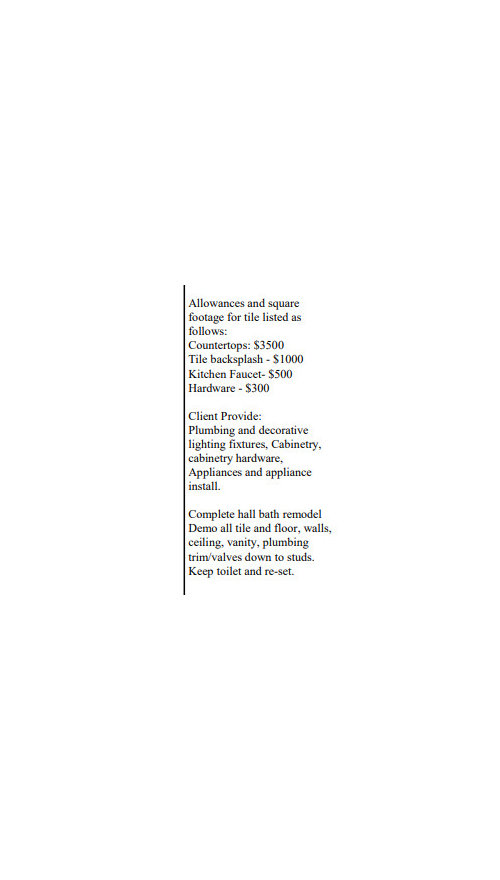
I should add that I have had a nearly perfect experience with this contractor since the project started a couple of months ago. I do not think they're trying to scam me. I'm just wondering if I was totally wrong to have the assumption I did or if I should argue the point. I've included just one small section of the 4 page quote.


Comments (16)

  • 5 years ago

    Unfortunately there is not really a typical from my knowledge, It really needed to be discussed on the front end exactly what was included and how. The contract should have stated exactly how the "allowances" were to be applied and work.

    Kara Barkley thanked millworkman
  • 5 years ago

    @millworkman - right, lesson learned that I shouldn't make assumptions.

  • 5 years ago

    @n k - it's true it says that I will provide several things, but the largest item is the Countertop. Allowance is $3,500. I purchased the countertop myself and paid the fabricator directly. So should they deduct that $3,500 from the lump sum quote? It doesn't say that I'll provide the countertop.

  • 5 years ago

    You only listed cabinet hardware in your OP, so your question makes more sense with that context. Yes, if it's listed as an allowance but you provided it I would also think that that cost was built into the contract. Maybe not 100% (since they may be listing the retail value but getting a contractor's discount) but at least a portion of it. I would have a very detailed and documented conversation about this so no surprises happen going forward.

  • 5 years ago

    Typically an allowance is an amount that will be included for purchase of materials, that you pay the G.C. and is included in your loan. You go through the G.C.'s vendors and choose from a "level" of materials that is within that allowance. If you pick say a cabinet, or a tile, that is beyond that allowance amount, you owe the difference (outside the loan too). The G.C. still provides the labor regardless (for the most part) of the material you selected.

    If prior to contract the owner has negotiated to provide or install certain things, then the G.C. should have eliminated those allowance amounts from the contract while explicitly stating which ones "provided or installed by owner." If estimate amounts are needed for a loan, then they can be listed but should be excluded from the G.C.'s OH&P. A construction drawing is critical.

    In your case, that snippet provided says:

    - You buy on your own: cabinets and cabinet hardware, faucets/drains, sinks, tub, surface-mounted lights, disposal, DW, ref, any other appliances

    - You buy through them: kitchen countertop and tile backsplash (bath counter unknown) through the normal allowance process.

    - G.C. installs: all the above except appliances.


  • PRO
    5 years ago

    I believe you are correct in your interpretation. If an allowance is included and you go over or under, adjustments are made accordingly both with a credit or by paying the difference.
    We are in the exact situation. Some things were allowances, some things we had to get on our own and some things were included in the general construction price. I found the allowances very off in some places and sourced things myself for those items. I was over some places and under in others and they adjusted the total.

  • PRO
    5 years ago

    Allowances can be the most contentious part of any home building or remodeling contract. While it's best to eliminate them to the greatest extent possible, you may find allowances included for choices you haven't (or couldn't have) made or for conditions that can't be calculated exactly, like the cost to drill a well, for example. Where allowances are included in a contract price, there should be clear language in the contract about what each particular allowance is for (e.g., a particular component(s) at the cost of the material only or the total installed cost,) and how items will be charged against the allowance (e.g., with or without a mark up.)


    If your contract is $50K for a complete tear out remodel of both a kitchen and bath, the contract price probably doesn't include much more than the cost of permits, supervision, maybe some of the remodeler's direct labor cost, and his/her overhead and profit.


  • 5 years ago

    A construction allowance is exactly like every other kind of allowance and your assumption seems correct for the default position.

    What happens to unused allowances is a bit more nuanced. The default position of the courts is that allowances constitute trust accounts within the contract and must be adjusted accordingly when they exceed the contractor's actual cost. There is no default requirement about the contractor buying things, or using a preferred supplier or design shop, etc. It is about contractor cost and nothing else. A contractor can't give himself a bonus by overestimating allowances or talking homeowners into saving money on material purchases.

    Although a contract could disclaim that away, it is not easy. The contractor still has to act in good faith. He can't stand idly by and let you spend money and then collect a bonus for not warning you.

    Having said that, contractors keeping excess allowances is not that rare, whether or not they are allowed to.

    ----

    To answer your other question... The allowance amounts are in the $50,000 price. You will not have an allowance account that is not in the contract price. That defeats the purpose of having an allowance to begin with.

    ----

    Personally, I would finish the remodel and try to reach some settlement at the end.

  • PRO
    5 years ago

    I agree there's no point to stating an allowance that isn't included in the contract amount, but your contract--at least as I understand it--appears to be unusual. As a "sanity check" I suggest you add up all of the stated allowance amounts and compare them with the total contract amount.

  • 5 years ago

    According that snippet, you are paying the contractor $49,200 ($50K-$500 for kitchen faucet and $300 hardware). But, the bathroom counter could be disputed depending on if it's an integral sink with counter or undermount//rim/vessel separate from a counter (he doesn't specify "Kitchen" countertop, just general "countertops").

    Paperwork mistakes happen all the time, and let's be honest, contractors are better hammer swingers than computer savants. Template contracts are copied all the time and things are not edited properly.

  • 5 years ago

    According that snippet, you are paying the contractor $49,200 ($50K-$500 for kitchen faucet and $300 hardware). But, the bathroom counter could be disputed depending on if it's an integral sink with counter or undermount//rim/vessel separate from a counter (he doesn't specify "Kitchen" countertop, just general "countertops").


    I am confused by your meaning. The OP has purchased the countertops and is concerned that the contractor doesn't want to reduce the contract price by the $3,500 the OP spent on countertops. The contract price should be the amount specified in the contract less any amounts the contractor didn't have to spend on allowances. In this case, that would be $50,000 - $3,500 for counters - $300 for hardware - any other allowance amounts not actually spent by the contractor.


    Allowances are placeholders for contractor cost, not for homeowner choice. The purpose of an allowance is a monetary amount inside a contract for amounts that are unknown at the execution of the contract. They are typically for things that can't be known (e.g. drilling a well) or things that it is impractical to know at the signing (e.g. appliance or fixture selection).

    -----

    Just for clarity... Production and tract builders with design centers or limited suppliers do not generally use allowances. They use a design credit which is different, the purpose of a design credit is to allow homeowners to upgrade a known choice.


  • 5 years ago

    he listed 4500.00 for counter and tile backsplash. that would be installed? and include bath? then you purchased your own counter. so it has to be arranged..who is bringing it on site...are the install materials appropriate/ now you may have to get different /other materials ..do you want him to find out on his time? the best would be if he had a designer or planner to go through all this and stay within his selections. You didn't.....for something like counters and tile....now there is extra time/ securing other materials and working this through. His time is money as well.

  • 5 years ago

    When a project has only one point of construction with a G.C., an "allowance" is an amount that they have included in their bid with labor + OH&P. It is based on a reasonable guess to what something of the same parameters typically cost. It covers the scope of work - they are scheduling, entering a subcontract, and taking responsibility for that line item. Their bid will be compared with that allowance, and you will award based on the total construction cost (which includes that amount). There is no reason to list an item on a contract if you are not providing materials and install, unless a bank is requiring it to be named to underwrite the out-of-pocket cost. If so the contractor should state they are not providing or warrantying those items.

    A tract home builder is a clear example of how allowances are used ("design credit" is just a fancy term). Say for tile backsplash, the builder has included an allowance of labor + materials + OHP for mesh-backed mosaic at $2/sf. You go to their vendor and get to choose from an array of $2/sf tiles. If you want the $15/sf large format, you have to pay the builder the difference in materials, labor, and OHP% as it was unexpected. The key point is you are paying the builder.

    If you are self-financing and doing some work and providing some materials, then the contractor's bid should not have those items listed.

    ---

    In this case the bid is very unclear (which is a sales tactic). The contractor addended only 2 of the allowances to state homeowner provides kitchen faucet and hardware, so those amounts should be subtracted. He did NOT addend countertops or backsplash whatsoever, so those should be purchased and installed through the contractor just like a tract home builder. Note that other items typically having allowances, like plumbing/lighting fixtures and cabinets, are not listed, because it was presumably discussed they would be provided by owner.


  • 5 years ago
    last modified: 5 years ago

    A tract home builder is a clear example of how allowances are used ("design credit" is just a fancy term).

    While a popular misconception, this is a misconception. I assure you that design credits are not allowances. The difference may be subtle but for the OP it would be significant. There are contradictory court decisions on whether allowances constitute a duty of due care or a fiduciary duty, but in either case a contractor will have certain legal duties associated with that account. In every single state, a contractor is required by law to supply a reconciliation of an allowance account in a timely manner at the request of the client.

    This is really not a stretch and shouldn't be hard to understand. It is simple agency law. Any time you can legally obligate someone or spend their money, you have a duty to act appropriately. Allowance accounts are quite literally the contractor being able to spend your money and they have a higher legal duty.

    This is not the case with production and tract home builders because they are not acting in any agency capacity. They own the home and are simply selling you the home after it is completed. Additionally, no decent sized production builder will have the default language on allowances in their contract. For most practical purposes it may be great to think of them as similar, but when you are in a contract dispute the differences can become significant.

    _______

    Courts, in every state I have seen, have generally held that the AIA definition for allowances is the default legal position. In other words, if allowances in your contract are vague then the courts will default to the position:

    1. Allowances shall cover the cost to the Contractor of materials and equipment delivered at the site and all required taxes, less applicable trade discounts;

    2. Contractor’s costs for unloading and handling at the site, labor, installation costs, overhead, profit, and other expenses contemplated for stated allowance amounts shall be included in the Contract Sum but not in the allowances; and

    3. whenever costs are more than or less than allowances, the Contract Sum shall be adjusted accordingly by Change Order. The amount of the Change Order shall reflect (1) the difference between actual costs and the allowances and (2) changes in Contractor’s costs.

    Please note: these allowances do not cover installation or other costs that may arise. The only costs that a contractor can deduct from allowances by default are material costs that were actually incurred. Installation costs are a separate line on the contract unless specified otherwise. Of course, contracts can be modified to change that default position and they often are, but unless changed in the contract that is the default.

    Vague contracts will always favor the consumer. The idea that you have a very unclear contract and you just have to figure it out is really not how contracts work. The courts have established a default clarity for contracts.

    This is not to say that contractors don't pull this crap, they do. However, the reason they do is because they get away with it.

  • 5 years ago

    A contract has to be read in context, as a whole. Interpreting the meaning of contract terms based on only two paragraphs is a fool’s errand.