Software
Houzz Logo Print
missylee56

Larvae eating unopened Lisianthus buds, help!

4 years ago
last modified: 4 years ago

Earlier today when looking at my lisianthus trying to figure out why it wasn't going any seed I found tiny larvae like caterpillar/worms and eggs inside the unopened flower buds. The dried flowers when split open will have a larger caterpillar/worm inside, with webs or sometimes a cocoon hanging outside of the dried bud. I started opening all the unopened buds to find eggs and larvae that has been burrowing into the flower bud and the little green pod inside the bud (which I'm not sure if that's what will be the seed pod or a new flower), eating around the inside. I even found some of the stems would have a hole near where the leaves branch off and be hollowed out straight down the stalk! I've searched high & low and all I can come up with is Budworms or plume moths but the photos don't look like what I saw and don't quite follow what the same behavior. Whatever I have is quite small, then obviously turn into small moths based on the tiny brown cocoons I'll find inside or hanging outside the dried flower heads. Any one have a clue what these could be? I had to open every single bud & tear off all the ones with eggs or larvae inside. The eggs were white & red, and larvae was either a pale green with a black head, or white with a black head. The empty cocoons are brown and maybe 1/4", same length as the bigger larvae. I'm kicking myself for not taking pictures.

As an aside, anyone know how/when lisianthus goes to seed? After the bloom is finished the petals will dry up and turn black, then I can peel away the dead petals to expose a green pod which seems to flower again after some time. Maybe I just haven't been paying attention and it turns to seed & drops, but I swear they keep reblooming.

Comments (15)

  • 4 years ago

    where are you .. big city name ...


    my first thought is that it is near october ... and how much of a season do you have left ... it may not be the time of year to be fighting much stuff .. if the plant is going to die soon otherwise ... knowledge is power of course... but you fight when its profitable to do so.. but sooner or later.. you just yank an annual out.. and throw it away ....


    i did note it a very warm zone perennial.. 8 to 10 ... that is actually grown as an annual in cooler climes ..so which are you growing it as ....


    also.. i dont understand your words... when you say you find a green seed pod.. but it flowers again .. you mean different parts of the plant ... ???


    finally ....i also wonder.. if if they will come true from seed .. whenever i see very fancy flowers like these... i figure seed growing might be fun.. because how knows what to expects with the next generation ... but i dont expect repetition of the same thing ...


    ken


    Julie Adair thanked ken_adrian Adrian MI cold Z5
  • 4 years ago

    I can't help you with your problem, unfortunately, but Ken's comment caught my eye...


    "... my first thought is that it is near october ... and how much of a season do you have left ..."


    If the poster is anywhere near me in New England (or perhaps any northern location) that's what makes it all the more pressing. I've tried lisianthus in the past and it is so slow and you work and wait and watch for months, and then when you finally start to get buds and blooms, if this happens it's heartbreaking.


    If that's the case Julie, like I said I can't help but I can commiserate and I really hope you get some answers soon to be able to save your blooms!


    :)

    Dee

    Julie Adair thanked diggerdee zone 6 CT
  • 4 years ago

    I'm going to dig them up and bring them inside at end of season as they are actually a tender perennial, and will survive if brought inside in my area. Otherwise like you said I wouldn't bother if I were growing as an annual. I want to: 1 make sure it survives, and 2 not bring bugs into the house. I'm in Ohio by the way.

    I'm not familiar with all of the proper names of the plant parts, so I apologize if it's hard to follow what I'm saying. I was trying to say I'm not sure if the green pod inside of the flower is a seed pod or a new flower bud, but that's what they are eating. From what I read, it sounds like a seed pod, but I never saw any ripe pods, just kept seeing more blooms, but maybe it ripens & drops quick and I just never noticed. Or maybe I've had these little buggers all season and that's why I didn't see any pods lol.

    I'm newer to outdoor gardening and it's my first Lisianthus, they are hard to come by in my area (and just too beautiful to not continue growing!) so I'd rather bring it in and replant next spring. Growing by seed as you pointed out may not yield the same attributes as the original plant, plus I have 2 different colors and I'm sure the bees were pollinating everything. I also read they take forever to germinate and grow, I may try for fun but definitely want to retain the original plants as long as possible.

    I was hoping someone may know what these horrible little pests are, or at least how I can treat them since they are inside the flowers. As I mentioned, I'm newer to outdoor gardening and I've never treated anything before. I mainly grow cacti & succulents indoors. It's also driving me crazy not being able to find any info on them, there's not much online about lisianthus and pests. It seems they may be some sort of moth larvae. I do have some neem oil based fungicide/insecticide but the direction label is missing. Should I try spraying it inside the flowers?

    Thank you for the responses either way!


  • 4 years ago

    Julie this might be a long shot, since that forum is rather slow, but maybe try posting this to the annuals forum. I know many people in colder areas grow these as annuals so perhaps there might be a bit more input there. Although you seem to have covered your bases with the forums you chose. You never know, though, who might pick up on it.


    Also, maybe try going to some sites for professional growers?? I know these are grown for the cut flower business so maybe if you dig around you can find something there. Good luck!


    :)

    Dee

    Julie Adair thanked diggerdee zone 6 CT
  • 4 years ago

    There are a few different moths and beetles that feed on Eustoma flowers and seeds. A photo would help narrow down the culprit. I was collecting seeds for Gentiana alba last year, and I discovered most of the seeds had been eaten by an insect that bored holes in the seed pods. Whether they made the holes on the way out, or way in,I don't know. Gentiana is closely related to Eustoma, so the same insects probably use both genera. There is also an endangered blue butterfly that uses Eustoma flowers as a host.


  • 4 years ago

    I'm not familiar with all of the proper names of the plant parts, so I apologize


    ===>>


    first.. no need to apologize.. just keep posting!!!!


    just use a search engine with whatever name you have.. then flip to images.. and find the one you do have.. and start using it ... i fought that for decades .. mostly because without the WWW i had no access to sources to look them up....


    in a proper 3 part latin name..... the part in 'quotes' is the least useful.. or necessary ... as every plant with the first two parts of the name... grow to the same cultural requirements ...


    sooo as an example.. all pine grow like pines ... but the second name indicates perhaps certain areas where some are a bit different than others ... after that.. the cultivar or third name.. is just some peep found it.. and propagated it because of some special trait.. like a slower or lower annual growth rate ... so its a dwarf ... or a cerain color ... etc ....


    a very simplistic explanation.. but hopefully it might encourage you to understand why its important to have a world wide discussion on a certain type plant..


    anyway.. it might be late to try potting it.. to bring it inside .. all the potting stress.. and then the stress of being inside.. etc ... but you may as well try .. and learn something.. whatever that might be ... even if they fail... perhaps you will grow some in pots next year.. to try bringing them in ...


    its saturday.. go blue...lol


    ken


    Julie Adair thanked ken_adrian Adrian MI cold Z5
  • 4 years ago

    If you find any more of the buggers take photos and send them and your questions to your state's county extension service. Every state has one, an "Extension Service"

    Julie Adair thanked Marie Tulin Boston burbs z 6a
  • 4 years ago

    I grew Lisianthus Echo White from seed this year. I grew them to use as a cut flower so I haven’t paid attention to the seed heads. I believe the green pod inside the spent flower is the seed head.


    I didn’t really find Lisianthus to be hard to grow, I just had to start the seeds super early. I started the seeds in mid-January under grow lights and moved them outside in mid-April. The plants stayed small until they were put outside. They had buds formed by the end of July.


    From my research the Echo series is suppose to be easier to grow and I believe are a part of the earlier blooming group. Johnny’s Select Seeds has information on their website about growing Lisianthus.


    Sorry that I can’t help you identify the bugs, but wanted to let you know my experience growing from seed in case you decide to go that route.

    Julie Adair thanked cab84
  • 4 years ago

    Also, I’m in southeast MI so these plants won’t overwinter outside for me as well.

  • 4 years ago

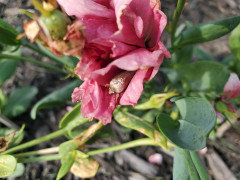
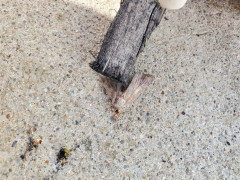
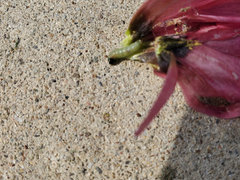
    I actually went out early enough today to find the culprit! It was a moth. Retched thing was just tucked into the petals laying eggs. I've put seven dust in the blooms and hopefully that kills the larvae. Not sure there is a way to get rid of moths. Maybe an electric light. I've added some photos of the moth and the larvae, hopefully this will help someone in the future. Thanks to cab, and a sacrificial green pod, I now know they are seed pods inside the spent flower, and that is what they are eating. They bore a hole right into them. Not sure if these are the same things that are drilling holes lengthwise down the middle of the flower stalks as well. They are nasty little things. I will reach out to my local agriculture department (thanks Marie) to identify the moth breed and how I can keep them at bay.


    Here's the little bugger in question laying eggs tucked right into the bud.


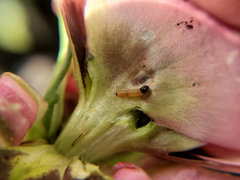
    Here are the photos of the larvae. They are so small I had to get out my macro lens to shoot them. You can see they start out white, then turn green as they get bigger. Possibly due to the diet of my precious green seed pods. You can see the hole they bore through the petals to get to the seed pod.


  • 4 years ago

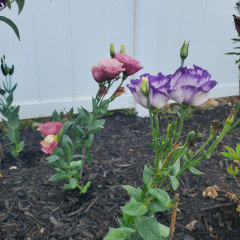
    Here's a photo of my beautiful flowers prior to the moth attack.


  • 4 years ago

    Lisianthus are bred from a native Texas wildflower, Eustoma grandiflorum. Seed pods are indeed the green chalice-shaped pods. They will start to turn brown when ripe. I haven't grown them from seed, but there should be plenty of online info on growing them. They are popular in the cut flower trade, and more profitable I believe, than roses, as the are lighter on resources to grow. Consider treating caterpillars with Bt since broad spectrum pesticides will kill as many or more beneficial insects, and commonly exacerbate pest problems.

  • 4 years ago

    @philipatx thank you for the info, I will look at getting my hands on some! I've got 1 seed pod that's ripening, I'll collect it once ripe and see what comes of it next year. I really enjoy growing from seed, so it will be interesting to see how they turn out.

  • 4 years ago

    Good luck with everything Julie! Post next year to let us know how it goes!

    :)

    Dee