
Search results for "Lobby" in Home Design Ideas


Find the right local pro for your project
 Tile Doctor Ltd
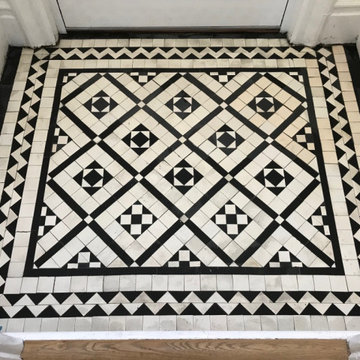
I visited this property in Lytham St Annes to survey a small Victorian tiled lobby which was in a sorry state. The client was keen to have it restored and wanted to know if it was possible. I discussed with them what we could do, and I gave them a quote for the work. Although it was only a small lobby, I could see the job could be quite involved and would be subject to the replacement tiles which I was confident we could source.
This is one of those jobs you wish you hadn’t started as there were a lot more tiles to remove than anticipated and it mushroomed into replacing half the floor. Once the area was cleaned up, I applied a self-levelling compound to bring up the height of the base.
Once the levelling compound had set, I was able relay the Victorian tiles using a combination of original tiles and replacements which had to be cut to shape. Cutting tiles to fit is quite intricate and time-consuming work especially when you consider new tiles are all metric in size and a 2mm difference becomes very telling after a foot or so! My solution was to use 150 mm tiles which are the biggest the stockist offers and then cut them down on my Rubi cutter using a template made from the original tiles. This the only way I could get it to look tight, it takes longer but it makes for a thorough job and a better finish.
I always use flexible floor adhesive when laying tiles, my preference is Keraquick Grey from Mapei. There are other brands off course but this one is quite easy to get hold of and as the term grouting is a relatively modern invention (in the past it was called pointing ) I find it looks right with this type of tile and similar to the screed cement the Victorians used in the past.
After the tiling had been completed, I left the floor to cure and fully dry and returned at a later date to give the floor an overall clean. For this I ran a coarse 200-grit diamond floor pad across the floor lubricated with water and used handheld diamond blocks for the edges where the pad can’t reach. The slurry was rinsed off with water and extracted with a wet vacuum.
With old floors like this, which don’t have a damp-proof membrane installed under the floor, efflorescence is always a concern and can lead to white salts appearing on the surface of the tile as moisture rises through the floor. To counter this, I finished cleaning the floor by scrubbing it with Tile Doctor Acid Gel. This was then rinsed off with water and the soil extracted using a wet vacuum.
The client was happy to seal the floor themselves (they wanted to save some money and it wasn’t a big area) so I supplied them with a bottle of Tile Doctor Colour Grow. I recommended this sealer as it will enhance the dark colours and being fully breathable it will cope with any moisture rising through the base. I recommended they apply two coats to start leaving time to allow the first coast to dry they could also then decide to leave it at that if they were happy with the finish.
Russell Taylor
Lancashire Tile Doctor
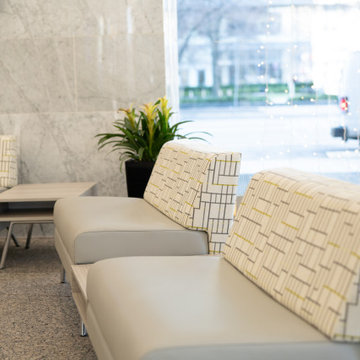
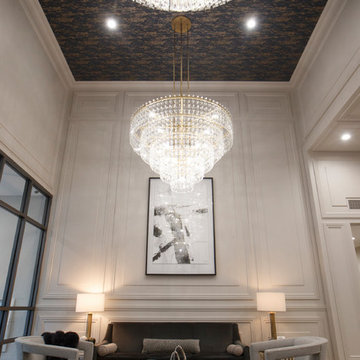
 Jennifer Backstein Interiors
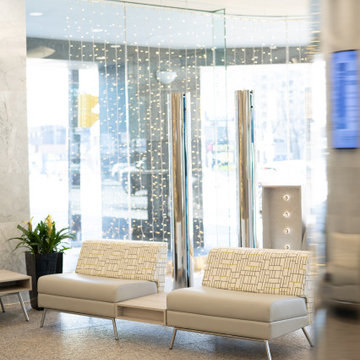
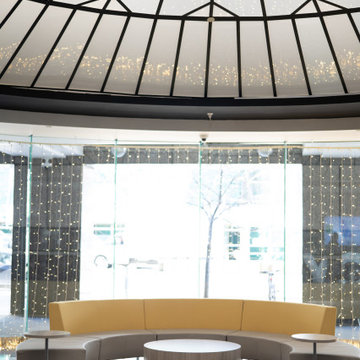
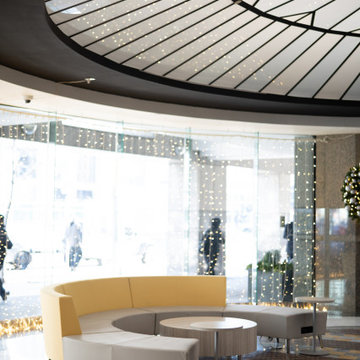
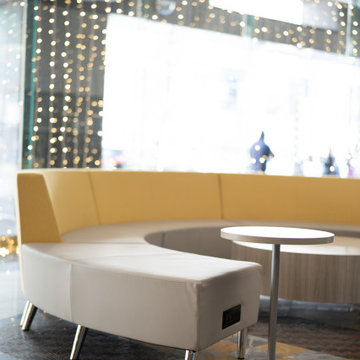
This Toronto condo lobby underwent extensive renovations with our design firm. We transformed the common space, reception area and lobby into a luxurious space with show-stopping features and high end finishes. From the detailed ceiling design to the gorgeous millwork this space truly morphed into a breathtaking condo lobby.
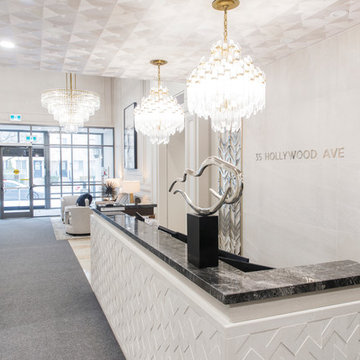 Jennifer Backstein Interiors
This Toronto condo lobby underwent extensive renovations with our design firm. We transformed the common space, reception area and lobby into a luxurious space with show-stopping features and high end finishes. From the detailed ceiling design to the gorgeous millwork this space truly morphed into a breathtaking condo lobby.
 Interior and Architecture
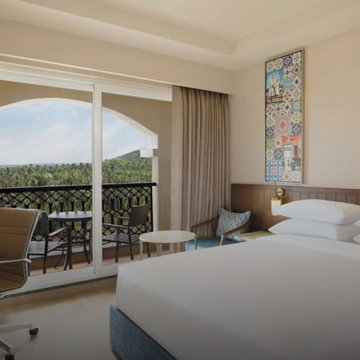
In hospitality design, no space carries as much weight or expectation as the hotel lobby. It is the handshake, the welcome note, the first frame of the guest experience. Within seconds of entering, guests form opinions not just about the space, but about the brand, the service, and the story. At its best, the hotel lobby isn’t just a transitional space; it’s a destination. A well-designed lobby invites, orients, calms, and excites, all at once. It acts as a stage where luxury is not merely seen, but sensed. In this article, Ar. Anil Badan, Founder and Principal Architect at Studio B Architects, shares how hotel lobbies go beyond functionality, becoming emotive spaces that leave a lasting impression from the very first step inside.
Designing for Emotion, Not Just Function
Every guest arrives with a subconscious expectation. Whether stepping into a serene resort or an urban boutique hotel, the lobby must immediately align with the tone of their stay. Lighting, for instance, isn’t just about visibility; it’s about setting mood. A warm, ambient glow suggests calm sophistication, while bold, sculptural fixtures can convey modern opulence. Seating arrangements must strike a balance between social energy and quiet retreat. Natural materials, wood, stone, and linen evoke authenticity and calm. These elements work collectively to influence how a guest feels within the first few moments.
Branding Through Architecture
A hotel lobby is also a silent storyteller. Every finish, curve, and fixture communicates something about the brand's identity. For us, design isn’t about imitation, it’s about interpretation. We interpret the soul of the property and translate it into spatial language. For instance, a curved wall might reference local landscapes. A palette of coastal hues might evoke a regional narrative. In doing so, the lobby becomes more than a threshold; it becomes an anchor of place and memory.
Fluidity, Function, and Flow
In luxury hospitality, the lobby is often a hybrid zone, part reception, part lounge, part co-working, part café. Designing for this fluidity means considering flow and flexibility. Wayfinding should be intuitive. Transitions between zones must be seamless, often achieved through changes in flooring, ceiling heights, or lighting zones. Materials must withstand footfall yet retain elegance. Every element must serve both beauty and purpose.
Ultimately, a successful hotel lobby lingers in memory long after check-out. It is not just a space, it is a statement! One that says: you’ve arrived. And in a world where hospitality is no longer just about service, but about feeling seen, understood, and inspired, the lobby is where that promise begins!
9