Software
Houzz Logo Print
k_l__enenra

Lighting Switch Help!

9 years ago
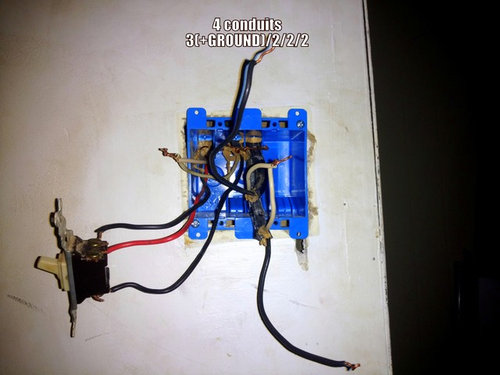

We have a 2-gang light switch box at the bottom of the stairs with a total of 4 conduits running to it. Its function is to control 1 light at the bottom of the stairs in conjunction with a switch at the top of the stairs, and to run a conduit to a box in a newly constructed partition wall, to control the lights in that room independently. It WAS working fine, but was practically hanging out of the wall because the original box (presumably from the 60s) was falling apart in the wall. After disconnecting everything and switching to a new plastic box, I can't seem to get the wiring right again. Please help!


P.S. I snapped the photo in the midst of splicing. The photo is only to show what I'm working with, I know it's not properly wired as shown.

Comments (13)

  • 9 years ago

    I think you need to step back and call an electrician.


    First, I don't see any conduits in that picture. If there are conduits involved, they are not properly terminated in that old work box you've installed. Further, I have a strange feeling we're not even looking at cables here. Some of the stuff on the right looks like CORDAGE, which isn't legal to use in walls/permanent wiring. It also appears you buggered the clamps on at least the right most cable.

    Do either of the lights that the switch controlled work now?

    I suspect what we have here is a power feed that runs to the three-way switch (the one dangling on the left side. The red and black wires from that are the travellers to the other switch. I suspect the far end comes back on the third wire in that cable and then should run up to the wire leading to the light fixture. There's more to wiring than just matching the colors. You should have identified the conductors before you disconnected them. Now it's going to take some detective work for which it is impossible to do just with a photograph of the half-finished wiring job.

  • PRO
    9 years ago

    Hard to tell from the photo but it look like old cloth romex. If it is MC cable or flex then year you need a metal tigerbox not a plastic one. I would second getting an licensed electrician out there. However, assuming everything was wired properly before, the first step would be to wire-nut all your neutrals together (white wires). For the other two black wires, based on your description, one is your line feed and the other is your out to the other room. If that's the care wire nut the two black wires together with no other wires connected to them. Hate to be harsh but I strongly urge you to just get a licensed electrician out there. If you take my advice instead you do so at your own risk.

  • 9 years ago
    last modified: 9 years ago

    In addition, I think might be possible (although maybe not likely) that we are looking at two circuits in this box. Wirenutting all the white wires together is also not advisable in that situation either.

  • PRO
    9 years ago

    If it was a switch loop then the outgoing white conductor is required by code to be permanently re-identified. From what I can see in the picture there is no re-identification of any kind. K.L. also said that the feed from this box to the other room is running through a separate switch that controls that load independent from this light meaning there is line and neutral going to that box and coming from this box.

  • 9 years ago

    In the current code yes, but alas this looks old enough to predate that absolute requirement. This changed in the 1999 version of the code. Prior to that it wasn't required. There's a note in the code specifically warning you about this.

    And of course, given the amateurish installation here, it's quite possible that even if it legally should have been remarked, that it wasn't.

    I don't agree with your assessment of what he said he has anyhow. He says (and that is reinforced by the fact that there's a three-way switch dangling from the wall and the fact he said one wire has 3+g conductors) that he's got the switches controlling the light over the stairs AND a separate independent switch controlling the lights in the new room.

    This further points out another bogosity in your instructions. You do **NOT** want to tie the neutrals from what are potentially different circuits together either. As I said, there's more to electric wiring than just sticking all the like color wires together.

    I don't believe for a minute you're an electrician at all.


  • 9 years ago

    outgoing white conductor is required by code to be permanently re-identified

    While that may be true, if you've ever done any work on old wiring you'd know that quite often this isn't done. So drawing any conclusions from that is wrong.

    K.L. also said that the feed from this box to the other room ...

    I don't see where the OP states that the light is fed from this box. They state that a cable goes between them, but nothing more than that. Added to that, even if they stated that, it doesn't make it true. It's pretty obvious that they are a novice and don't know the correct terms and may be mistaken.

    But the OP probably isn't coming back to answer questions, so we will never know for sure. They are most likely a drive-by poster.

  • 9 years ago

    I don't believe for a minute you're an electrician at all.

    He's a "Pro" but it's for Home Automation and Media. I don't think that necessarily means that he's an electrician.

  • 9 years ago

    The two separate switches are most likely not on the same circuit. The 3-way being fed from the upstairs 3-way (whites are still neutrals, but from unrelated circuit) No need to reidentify white to white.

    Therefore, "the first step would be to wire-nut all your neutrals together (white wires)." Could cause a dangerous overload on a white wire.

  • 9 years ago
    last modified: 9 years ago

    I agree that this had to have been done before safer practices were mandatory. I'm a total novice, but never had an issue doing something like gutting a box and upgrading to a newer box with a dimmer switch. This is just way over my experience level. About the conduit extension, or whatever the proper term is: There was a second switch controlling lights on the other side of the basement in the box we're discussing. I removed the switch and spliced in a "conduit extension", running the switch functionality into a newly created room which contains said lighting fixtures. Again, this was all functioning perfectly before the homeowner wanted me to make the box look more presentable. After taking everything apart, getting it back together has been like playing whackamole with a blindfold on. We're trying to get a professional to come sort it out for a reasonable price. Not really sure what a "reasonable price" would be for this, however. I've tried all of the conventional methods I know of, and following some diagrams online, but I feel that since none of those worked, something is funky with this situation and I'd rather not cause an electrical fire trying to replicate the original DIY job.


    Edit: Also, to my knowledge, they use the same power source. This was confirmed with a voltage tester. Only 1 hot wire (black) between all four bundles of wire. Apologies for my lack of proper terminology. My main electrical experience is in things like consumer electronics and audio. I'm a graphic designer by trade.

  • 9 years ago

    If there is a 3-way up the stairs, and another 3-way across the room, then you would have 2 3-way switches in that box. For that to happen, one of the black and white pairs would also have to be travellers (white not a neutral), probably across the basement. The black and red pair of travellers probably goes upstairs.

    "this was all functioning perfectly before the homeowner wanted me to make the box look more presentable." - If this is not your house, you can not legally touch the electrical system. Get an electrician.

  • 9 years ago

    It's not my house, but I live here. My fiance and I rent the basement and have permission from the homeowners who live upstairs. I'm not sure if that makes it legal or not. But all in the same, I agree. We've decided to get an actual electrician to sort things out.

  • 9 years ago

    Then what you are doing is almost certainly illegal. You're allowed to do dangerous DIY stuff to houses that you exclusively own and occupy in most cases, but rental property and that owned by others is right out.