
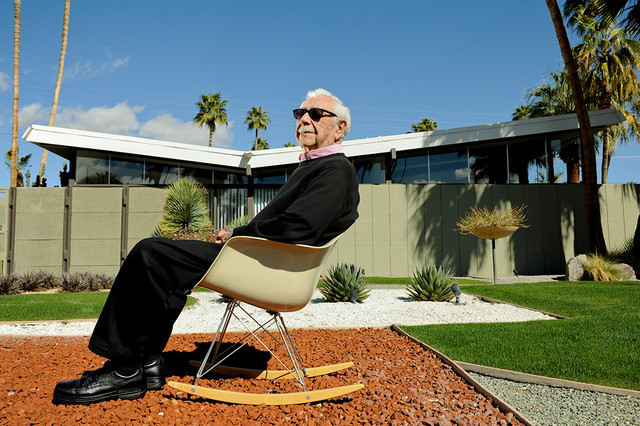

William Krisel | Twin Palms
Photo by James Schnepf for Palm Springs Modern Living
What Houzz contributors are saying:

Annie Thornton added this to William Krisel’s Twin Palms: A Modern American Dream
William Krisel sits in front of a home he designed in the Twin Palms neighborhood. Photo by James Schnepf for Palm Springs Modern LivingA Modernist for Southern California’s Postwar Middle ClassWilliam Krisel was born in Shanghai in 1924 and moved to Southern California as a child when his father took a job in film distribution. He attended architectural school at the University of Southern California in Los Angeles, where he met Robert Alexander, a classmate and son of large-scale residential developer George Alexander. Krisel’s studies were interrupted while he served overseas in China during World War II; he resumed his studies after the war and graduated in 1949. Upon his return to the United States, Krisel became aware of the acute housing shortage in Southern California. Robert and George Alexander, of Alexander Construction Co., whom Krisel would soon work with, had the know-how to economically mass-construct the houses needed by returning GIs and their families. These themes played out in the career of Krisel, who rejected the elite role typically assigned to architects. Unlike some of his peers in Southern California, including Richard Neutra and Donald Wexler, Krisel found designing custom homes for the wealthy tiresome. Within a year of starting his architectural practice with partner Dan Palmer, he was consistently working with developers on tract-style housing. He found that having one client for hundreds of houses suited him better than one client per house. Unlike the monotony usually associated with housing tracts, Krisel’s designs had modern flair. In the early 1950s, he started working with the Alexanders on tract-home projects in Southern California. He began to perfect his technique of combining a standard floor plan base with various options, much like the auto industry does with cars. The strategy allowed for a sense of individuality in a tract of dozens of houses.
What Houzzers are commenting on:

Steve Brander Architects added this to Twin Palms by William Krisel, Palm Springs
Wonderful Mid-Century planned development i Palm Springs, Ca.