

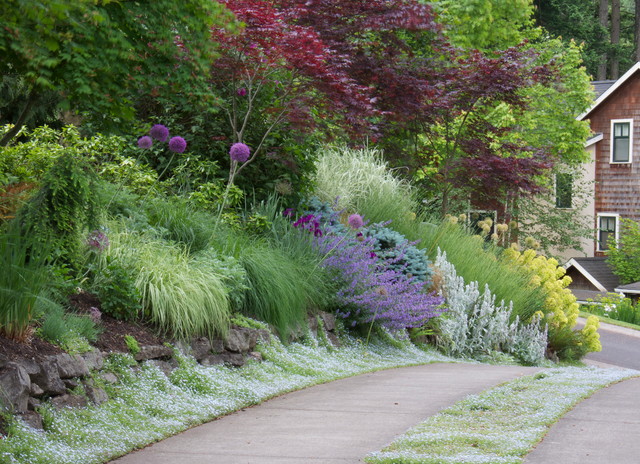

Suncatcher Traditional Landscape
This soft, pastel planting along a driveway draws influence from cottage gardens, although its plant palette was driven largely by voracious deer. This garden was featured in the March/April 2013 issue of Fine Gardening and pictured in the May 2012 issue of Sunset. See more photos of this garden at our website, mosaic-gardens.com.
photo: Buell Steelman, Mosaic Gardens
photo: Buell Steelman, Mosaic Gardens
Photo of a traditional front yard driveway in Other. — Houzz
This photo has 3 questions


What Houzz contributors are saying:

Lauren Dunec Hoang added this to How to Make Your Driveway Part of Your Garden
1. Colorful slope. Sloped gardens can be tricky to plant, sloped driveways even more so. Decrease runoff and soil-shifting from beds to the driveway by running a low rock wall a few feet back from the driveway down its length. This sloped planting in Oregon proves just how stunning a driveway strip can be. Layers of foliage — including burgundy Japanese maple (Acer palmatum), silver lamb’s ears (Stachys byzantina), wispy Japanese forest grass (Hakonechloa macra) and chartreuse spurge (Euphorbia characias) — and cool-toned blooms, such as globe allium and catmint (Nepeta sp.), create a tapestry of color. Bonus: The planting is pollinator-friendly and deer-resistant.

Gwendolyn Purdom added this to 5 Tick Safeguards for Your Yard
2. Tame tall plants. The tall grasses and shrubs that border yards or surround houses can be “prime tick resting areas,” O’Bell says. She suggests keeping the plants short or removing them altogether. If you love your naturalistic planting, consider a wide bark or gravel barrier between it and your favorite backyard gathering areas.
What Houzzers are commenting on:

HU-29121407573 added this to My Project
mass of varied foliage for privacy

Julia Galel added this to Pollinator Garden
layers of the plants, and the color mix




The ground cover looks like creeping thyme. I love the stuff. I use it for cooking too. It takes full sun and comes in white or pink-ish/purple flower colors.
https://www.houzz.com/products/6-light-candle-style-wooden-pendant-prvw-vr~93226622