

Attic by BHD (Basic Home Design/s)
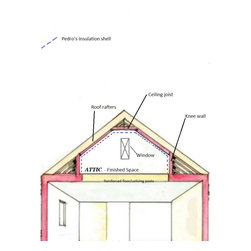
Introducing Pedro's proprietary drawing element:- The Insulation Shell.
What is the criteria or a good starting point when modeling or even remodeling an attic?
1. Firstly, to determine whether your future
attic is going to be an unfinished space
used for storage for instance or that you
have plans to turn it into a living space
ie. a finished space;
2. When deciding between unfinished and
a finished attic, this will give you a rough
idea on where and how to insulate. As
an ex. if the attic is to be unfinished then
starting with insulating the floor of the
attic would be a good start; on the other
hand for a finished living space, the roof
rafters provides an excellent point to
start insulating.
3. The goal is to provide an insulating
shell, whereby heat is kept in and
contained within the house which
includes the attic for a closed living
space especially cold winter months and
energy costs isn't high due to easy and/
excessive heat dissipation.
4. Will your attic have windows? Are they
energy efficient? Having windows in your
attic acts as a quick dissipator of heat
during hot summer months when you
can open them. And a cost saver in
keeping energy bills low if they are
energy efficient.
5. There many reasons why attic ceilings
that are going to be closed with drywall,
the area immediately above the ceiling
needs to be insulated, especially if you
are going with a floor attic that isn't
insulated. Insulating the area right
above and behind the attic ceiling
around recessed lights that are IC rated,
maybe the last line of defense to
preventing heat to warm your house
from escaping quickly.
6. Determine what kind of insulating
material that you'll be using as installing
can vary greatly when its going onto your
attic rafters or joist/ceiling bays. Batts
need baffles for ventilation for example.
If your attic ceiling is to be left exposed
or open then emphasis should be given
to insulating your rafters bays of your
roof truss well.
7. Determine your R-values. How thick of
an insulation do you need for your
climate zone your home is in? What does
code require as a minimum? Should you
double up on insulation especially above
floor/ceiling joist in storage areas just
right behind the knee wall of the attic?
8. Have a cost comparison. Do an estimate
of time it would take etc. How does that
fair in the larger project timeline to
complete your home.
What is the criteria or a good starting point when modeling or even remodeling an attic?
1. Firstly, to determine whether your future
attic is going to be an unfinished space
used for storage for instance or that you
have plans to turn it into a living space
ie. a finished space;
2. When deciding between unfinished and
a finished attic, this will give you a rough
idea on where and how to insulate. As
an ex. if the attic is to be unfinished then
starting with insulating the floor of the
attic would be a good start; on the other
hand for a finished living space, the roof
rafters provides an excellent point to
start insulating.
3. The goal is to provide an insulating
shell, whereby heat is kept in and
contained within the house which
includes the attic for a closed living
space especially cold winter months and
energy costs isn't high due to easy and/
excessive heat dissipation.
4. Will your attic have windows? Are they
energy efficient? Having windows in your
attic acts as a quick dissipator of heat
during hot summer months when you
can open them. And a cost saver in
keeping energy bills low if they are
energy efficient.
5. There many reasons why attic ceilings
that are going to be closed with drywall,
the area immediately above the ceiling
needs to be insulated, especially if you
are going with a floor attic that isn't
insulated. Insulating the area right
above and behind the attic ceiling
around recessed lights that are IC rated,
maybe the last line of defense to
preventing heat to warm your house
from escaping quickly.
6. Determine what kind of insulating
material that you'll be using as installing
can vary greatly when its going onto your
attic rafters or joist/ceiling bays. Batts
need baffles for ventilation for example.
If your attic ceiling is to be left exposed
or open then emphasis should be given
to insulating your rafters bays of your
roof truss well.
7. Determine your R-values. How thick of
an insulation do you need for your
climate zone your home is in? What does
code require as a minimum? Should you
double up on insulation especially above
floor/ceiling joist in storage areas just
right behind the knee wall of the attic?
8. Have a cost comparison. Do an estimate
of time it would take etc. How does that
fair in the larger project timeline to
complete your home.