
Carruthers Semi-Detached
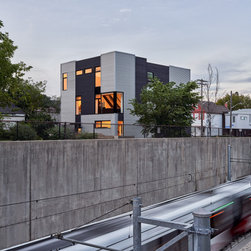
The site for the Carruthers Demi-Detached abuts a variety of “movement systems” including the Light Rail Transit (LRT), the Scott Street Arterial, bicycle, and pedestrian pathways. As a result, the built fabric is seen and visually “digested” at various speeds… this impacts how buildings are experienced.
In addition to the above noted, the site is somewhat of a gateway into the Mechanicsville Community.
Mechanicsville is historically a working-class residential neighbourhood interspersed with light industrial uses. Historically, the homes of Mechanicsville (as the name suggests), were built by the workers (mechanics) that serviced the CPR trains at the ‘roundhouse’ (presently the Tom Brown Arena site) and at the lumber mils along the Ottawa River.
The streets are composed of a variety of building types including small early 20th century singles, duplexes, apartments, townhouses as well as service garages, welding shops and other “industrial” uses.
The built forms in Mechanicsville are eclectic, generally small in scale and clad with a wide variety of materials but predominantly metal and wood siding.
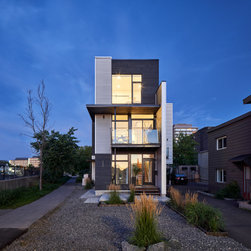
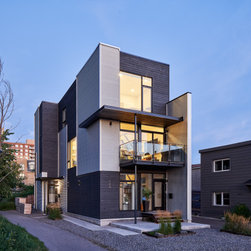
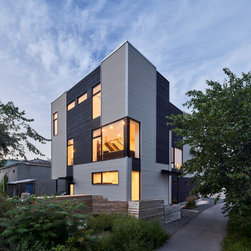
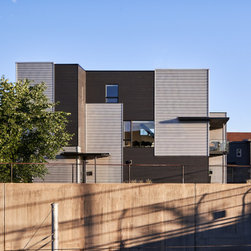
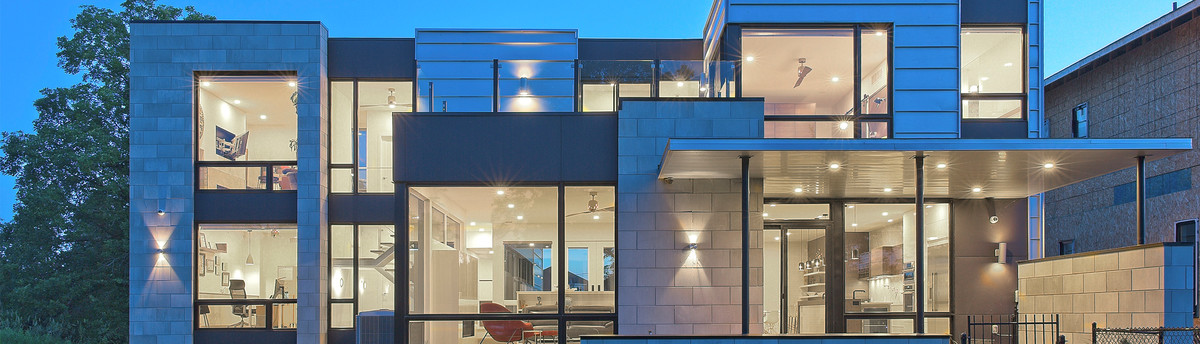
Conceptually, the design is seen as a collage of wood, metal and glass planes which appear to slide, shift, and reveal themselves in concert with the “movement speed” of the observer.
From an architectural point of view, the 2 bisecting forms are composed and fragmented to reflect the proportions of the smaller scale housing. The easterly unit is animated by a raised front porch that faces Carruthers and transitions the home from public to private realm. The westerly unit’s main entrance is an innocuous side door with a minimalist canopy that connects to and addresses the pathway.
Corrugated metal planes, inspired by the industrial context, slide up and down and slip forward and back animating the view from Scott Street, the LRT line and the pathway.
Dark wood cladding brings a sense of warmth and harkens back to the original wood clapboard found on the archetypal working-class houses of Mechanicsville and the lumberyards that were once a significant part of the urban fabric in the area.
In addition to the above noted, the site is somewhat of a gateway into the Mechanicsville Community.
Mechanicsville is historically a working-class residential neighbourhood interspersed with light industrial uses. Historically, the homes of Mechanicsville (as the name suggests), were built by the workers (mechanics) that serviced the CPR trains at the ‘roundhouse’ (presently the Tom Brown Arena site) and at the lumber mils along the Ottawa River.
The streets are composed of a variety of building types including small early 20th century singles, duplexes, apartments, townhouses as well as service garages, welding shops and other “industrial” uses.
The built forms in Mechanicsville are eclectic, generally small in scale and clad with a wide variety of materials but predominantly metal and wood siding.
Conceptually, the design is seen as a collage of wood, metal and glass planes which appear to slide, shift, and reveal themselves in concert with the “movement speed” of the observer.
From an architectural point of view, the 2 bisecting forms are composed and fragmented to reflect the proportions of the smaller scale housing. The easterly unit is animated by a raised front porch that faces Carruthers and transitions the home from public to private realm. The westerly unit’s main entrance is an innocuous side door with a minimalist canopy that connects to and addresses the pathway.
Corrugated metal planes, inspired by the industrial context, slide up and down and slip forward and back animating the view from Scott Street, the LRT line and the pathway.
Dark wood cladding brings a sense of warmth and harkens back to the original wood clapboard found on the archetypal working-class houses of Mechanicsville and the lumberyards that were once a significant part of the urban fabric in the area.
Project Year: 2018
Project Cost: $750,001 - $1,000,000