
Courtyard House
Courtyard House.
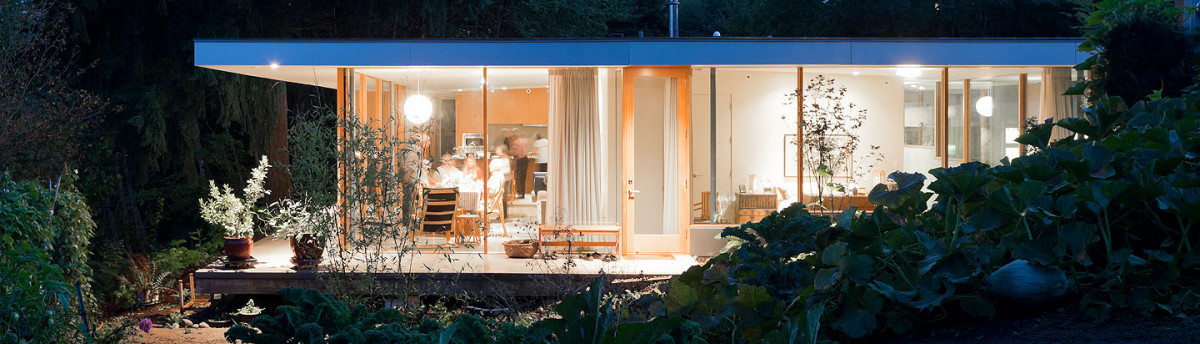
A semi-retired couple required that their new home resolve tensions between harmoniously “ageing in place” with nature on one hand while maintaining an urban desire for community on the other. Relocating from Eugene, Oregon to a more remote site overlooking protected wetlands, the clients realized the home itself, through innovative architecture, should become a destination, drawing out-of-town family and friends to visit. It was crucial the new home not only maintain, but also cultivate a connection to both nature and community.
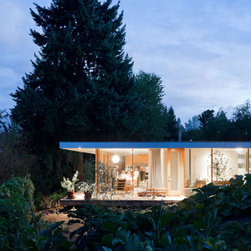
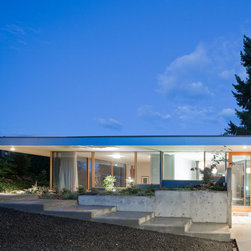
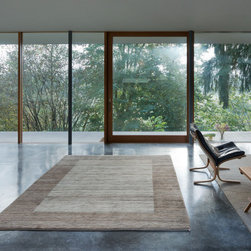
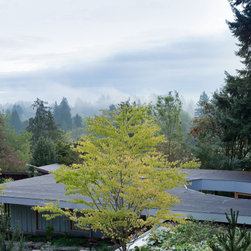
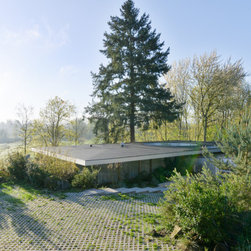
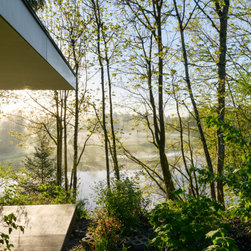
On the outskirts of a small town known for antique stores and historic homes, the project respects its context: burrowing the house into the land so that it remains unseen from the main street. To the west and north, this strategy minimizes the visual and acoustic connections between adjacent structures and increases thermal insulation. Spanning a terrace escarpment, however, the structure is only partially underground. To the east, the concrete floor slab cantilevers over the hillside, and through floor-to-ceiling windows, frames expansive views of the wild river and wetlands below.
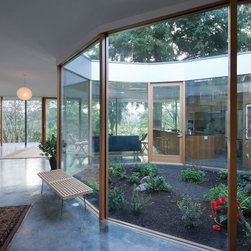
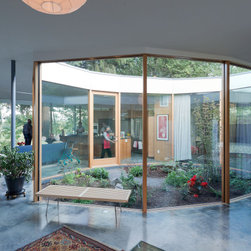
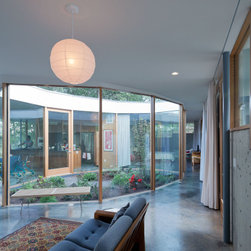
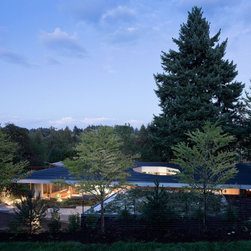
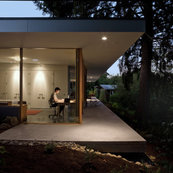
Anticipating the need for a walker or wheelchair, the clients sold their previous home that divided daily life into rooms isolated by hallways across multiple floors. The clients desired a new way of life organized on a single level by a more open and flexible plan. Environmentally and economically conscious, the couple would not accept an over-scaled home with bedrooms that remained unoccupied throughout most of the year. Here, every living space doubles as a bedroom as to welcome as few as two or as many as eight overnight guests with grace and intention. Departing from the compartmentalized “room-and-corridor” plan found in conventional homes, the interior flows in a continuous loop sculpted by a decagonal courtyard and two L-shaped storage cores. Piercing the center of the home, the fully-glazed courtyard planted with native deciduous trees conceives landscape as partition, shaping the interior through more porous and dynamic boundaries that transform with the seasons. In wintertime, the courtyard’s position increases passive solar heating, while in summertime, the courtyard stimulates passive cooling and natural ventilation.
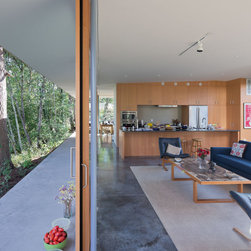
Unlike a conventional sturctural box with four contiguous shear walls, the two L-shaped cores create lateral bracing that carves the loft-like space into alcoves. Maximizing usable space while minimizing poché, the cores condense the fixtures necessary to support daily life, including: the kitchen, bathrooms, closets and mechanicals. Each core conceals sliding doors which allow the alcoves to be experienced communally when opened or privately when closed. Minimizing the home’s structural profile benefits not only the interior’s connection to the surrounding landscape, but also reduces the ecological costs associated with new construction.
A semi-retired couple required that their new home resolve tensions between harmoniously “ageing in place” with nature on one hand while maintaining an urban desire for community on the other. Relocating from Eugene, Oregon to a more remote site overlooking protected wetlands, the clients realized the home itself, through innovative architecture, should become a destination, drawing out-of-town family and friends to visit. It was crucial the new home not only maintain, but also cultivate a connection to both nature and community.
On the outskirts of a small town known for antique stores and historic homes, the project respects its context: burrowing the house into the land so that it remains unseen from the main street. To the west and north, this strategy minimizes the visual and acoustic connections between adjacent structures and increases thermal insulation. Spanning a terrace escarpment, however, the structure is only partially underground. To the east, the concrete floor slab cantilevers over the hillside, and through floor-to-ceiling windows, frames expansive views of the wild river and wetlands below.
Anticipating the need for a walker or wheelchair, the clients sold their previous home that divided daily life into rooms isolated by hallways across multiple floors. The clients desired a new way of life organized on a single level by a more open and flexible plan. Environmentally and economically conscious, the couple would not accept an over-scaled home with bedrooms that remained unoccupied throughout most of the year. Here, every living space doubles as a bedroom as to welcome as few as two or as many as eight overnight guests with grace and intention. Departing from the compartmentalized “room-and-corridor” plan found in conventional homes, the interior flows in a continuous loop sculpted by a decagonal courtyard and two L-shaped storage cores. Piercing the center of the home, the fully-glazed courtyard planted with native deciduous trees conceives landscape as partition, shaping the interior through more porous and dynamic boundaries that transform with the seasons. In wintertime, the courtyard’s position increases passive solar heating, while in summertime, the courtyard stimulates passive cooling and natural ventilation.
Unlike a conventional sturctural box with four contiguous shear walls, the two L-shaped cores create lateral bracing that carves the loft-like space into alcoves. Maximizing usable space while minimizing poché, the cores condense the fixtures necessary to support daily life, including: the kitchen, bathrooms, closets and mechanicals. Each core conceals sliding doors which allow the alcoves to be experienced communally when opened or privately when closed. Minimizing the home’s structural profile benefits not only the interior’s connection to the surrounding landscape, but also reduces the ecological costs associated with new construction.
Project Year: 2013
Project Cost: $500,001 - $750,000
Country: United States
Zip Code: 97002
Others who worked on this project: Aurora Landscape