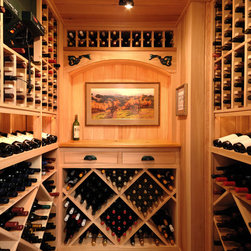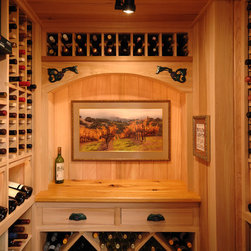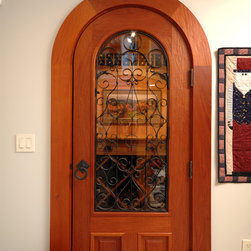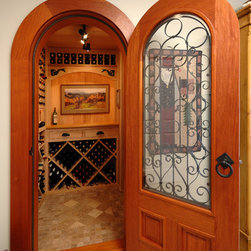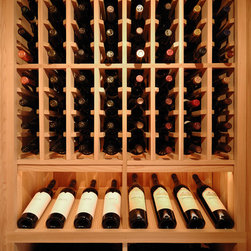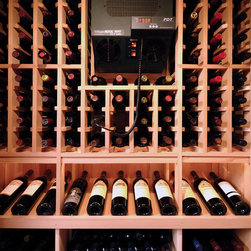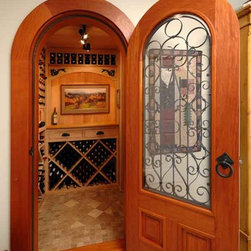


Harbor Haven Wine Cellar
For many years, my own “wine cellar” was a spare closet in the basement, a marginal solution at best. I became inspired to design and build my own real wine cellar after Robin and I attended a meeting in the Napa Valley area. We spent an extra five days touring the vineyards and sampling many wonderful wines. After seeing some incredible wine cellars and tasting rooms, our old closet in the basement no longer measured up! However, there was a 6’ by 7’ corner of my basement workshop next to the family room that I really wasn’t using to its potential . . .
I began my education on wine cellar construction. The three enemies of wine are heat, light and vibration. Of these, heat is the major concern. Most experts agree that a constant temperature of about 55 degrees Fahrenheit and a relative humidity of 60 to 70% are ideal for long-term wine storage. Temperature fluctuation can push wine past the cork as it expands and suck air into the bottle as it cools, increasing the ullage and therefore the amount of oxygen. The addition of oxygen can age wine prematurely.
As I started to gather information regarding wine cellars, I mistakenly believed that a basement area would be a suitable place to site a passively cooled cellar. I read the only book that I could find on wine cellar construction and the author convinced me that it is extremely difficult to regulate the temperature in a passively cooled wine cellar. In fact he recommends insulating all walls equally, even the side facing the foundation. The book, “How and Why to Build a Wine Cellar, 3rd Edition” by Richard M. Gold, Ph.D. is available on Amazon.COM and is full of great information. I also gleaned many details for wine racking from racking suppliers on the Internet.
Cheers!
I began my education on wine cellar construction. The three enemies of wine are heat, light and vibration. Of these, heat is the major concern. Most experts agree that a constant temperature of about 55 degrees Fahrenheit and a relative humidity of 60 to 70% are ideal for long-term wine storage. Temperature fluctuation can push wine past the cork as it expands and suck air into the bottle as it cools, increasing the ullage and therefore the amount of oxygen. The addition of oxygen can age wine prematurely.
As I started to gather information regarding wine cellars, I mistakenly believed that a basement area would be a suitable place to site a passively cooled cellar. I read the only book that I could find on wine cellar construction and the author convinced me that it is extremely difficult to regulate the temperature in a passively cooled wine cellar. In fact he recommends insulating all walls equally, even the side facing the foundation. The book, “How and Why to Build a Wine Cellar, 3rd Edition” by Richard M. Gold, Ph.D. is available on Amazon.COM and is full of great information. I also gleaned many details for wine racking from racking suppliers on the Internet.
Cheers!
Country: United States