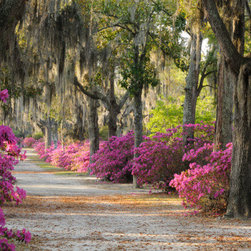


In Hollywood, zip code 29449
I’m putting this one in the middle to demonstrate that the “Gone with the Wind” Charleston look is part of my repertoire. I feel the need to make that clear; here’s why:
When I was interviewing contractors to install my designs a few years ago, I asked each of them to describe in a few words the overall “look” I go for. One said “coastal contemporary”. (Where’s the facepalm emoji?)
No, “coastal contemporary” could refer to a modern beach house anywhere in the world…I live and breathe NATIVE, LOW-MAINTENANCE LOWCOUNTRY LANDSCAPE DESIGN concepts. Needless to say, I don’t work with that particular contractor.
Although a lot of “iconic” Southern plants such as azaleas, camellias, and crepe myrtles are actually from Asia, they’ve been a staple of the Lowcountry for centuries…they might as well be native. You often see these species planted in formal gardens, such as the ones found in the Historic District of the Charleston peninsula.
Although I like the formal gardens of the Historic District (FYI, you can enjoy them on the Charleston Gallery Association’s First Friday Artwalks), I think these “native-nonnative” Southern icons look best when they’re allowed to grow wild as part of the native ecosystem. The azaleas and camellias I interspersed along this private road in Hollywood exemplify this. (Again, I try to design as if Mother Nature herself were a landscape designer in the South Carolina Lowcountry.)
When I was interviewing contractors to install my designs a few years ago, I asked each of them to describe in a few words the overall “look” I go for. One said “coastal contemporary”. (Where’s the facepalm emoji?)
No, “coastal contemporary” could refer to a modern beach house anywhere in the world…I live and breathe NATIVE, LOW-MAINTENANCE LOWCOUNTRY LANDSCAPE DESIGN concepts. Needless to say, I don’t work with that particular contractor.
Although a lot of “iconic” Southern plants such as azaleas, camellias, and crepe myrtles are actually from Asia, they’ve been a staple of the Lowcountry for centuries…they might as well be native. You often see these species planted in formal gardens, such as the ones found in the Historic District of the Charleston peninsula.
Although I like the formal gardens of the Historic District (FYI, you can enjoy them on the Charleston Gallery Association’s First Friday Artwalks), I think these “native-nonnative” Southern icons look best when they’re allowed to grow wild as part of the native ecosystem. The azaleas and camellias I interspersed along this private road in Hollywood exemplify this. (Again, I try to design as if Mother Nature herself were a landscape designer in the South Carolina Lowcountry.)