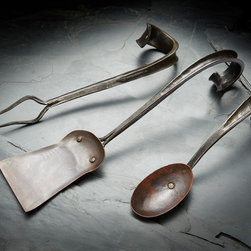

Kitchen accessories
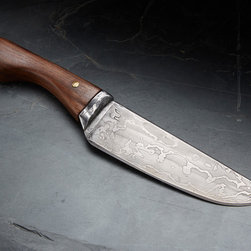
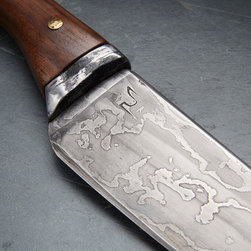
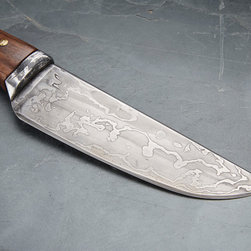
Damascus is a term used to describe the process of "Pattern welded" steel. Ancient swordmakers exploited the aesthetic qualities of pattern welded steel. The Vikings in particular were fond of twisting bars of steel around each other, welding the bars together by hammering and then repeating the process with the resulting bars, to create complex patterns in the final steel bar. Two bars twisted in opposite directions created the common chevron pattern. Often, the center of the blade was a core of soft steel, and the edges were solid high carbon steel, similar to the laminates of the Japanese.
The American Bladesmith Society's Master Smith test, for example, requires a 300 layer blade to be forged. Large numbers of layers are generally produced by folding, where a small number of layers are welded together, then the blank is cut in half, stacked, and welded again, with each operation doubling the number of layers. Starting with just two layers, eight folding operations will yield 512 layers in the blank. A blade ground from such a blank will show a grain much like an object cut from a block of wood, with similar random variations in pattern. Some manufactured objects can be re-purposed into pattern welded blanks. "Cable Damascus", forged from high carbon multi-strand cable, is a popular item for bladesmiths to produce, producing a finely grained, twisted pattern, while chainsaw chains produce a pattern of randomly positioned blobs of color.
Some modern bladesmiths have taken pattern welding to new heights, with elaborate applications of traditional pattern welding techniques, as well as with new technology. A layered billet of steel rods with the blade blank cut perpendicular to the layers can also produce some spectacular patterns, including mosaics or even writing. Powder metallurgy allows alloys that would not normally be compatible to be combined into solid bars. Different treatments of the steel after it is ground and polished, such as bluing, etching, or various other chemical surface treatments that react differently to the different metals used can create bright, high-contrast finishes on the steel. Some master smiths go as far as to use techniques such as electrical discharge machining to cut interlocking patterns out of different steels, fit them together, then weld the resulting assembly into a solid block of steel.
The American Bladesmith Society's Master Smith test, for example, requires a 300 layer blade to be forged. Large numbers of layers are generally produced by folding, where a small number of layers are welded together, then the blank is cut in half, stacked, and welded again, with each operation doubling the number of layers. Starting with just two layers, eight folding operations will yield 512 layers in the blank. A blade ground from such a blank will show a grain much like an object cut from a block of wood, with similar random variations in pattern. Some manufactured objects can be re-purposed into pattern welded blanks. "Cable Damascus", forged from high carbon multi-strand cable, is a popular item for bladesmiths to produce, producing a finely grained, twisted pattern, while chainsaw chains produce a pattern of randomly positioned blobs of color.
Some modern bladesmiths have taken pattern welding to new heights, with elaborate applications of traditional pattern welding techniques, as well as with new technology. A layered billet of steel rods with the blade blank cut perpendicular to the layers can also produce some spectacular patterns, including mosaics or even writing. Powder metallurgy allows alloys that would not normally be compatible to be combined into solid bars. Different treatments of the steel after it is ground and polished, such as bluing, etching, or various other chemical surface treatments that react differently to the different metals used can create bright, high-contrast finishes on the steel. Some master smiths go as far as to use techniques such as electrical discharge machining to cut interlocking patterns out of different steels, fit them together, then weld the resulting assembly into a solid block of steel.
Country: United States