

Lavender Fusion
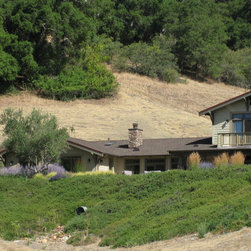
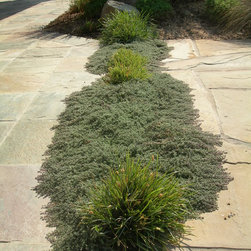
Drawing deeply from the house’s Craftsman style architecture, the landscape nestles the house into the site through form, color and scale. Trailing rosemary was planted in two swales for erosion control during the house construction.
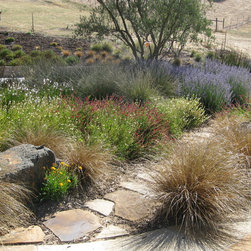
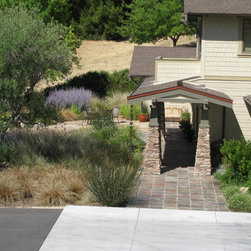
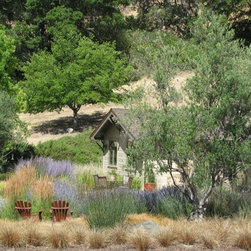
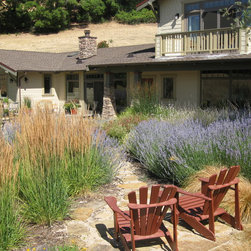
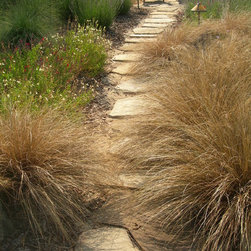
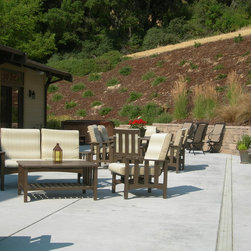
Sixty yards of soil was imported to create topography in the front yard. These berms sculpted and divided the large space into garden rooms which were paved in dry-laid flagstone. Three specimen olive trees were craned into place to frame the house and bridge its two story scale. The olives also were used to frame distant views from inside the house. A color palette of brown, gold, olive, and gray drew from the colors of the house as well as the surrounding native landscape. Large swaths of the same plant including Carex bucchanii, Stipa tenuissima, Perovskia atriplicifolia, Lavandula augustifolia, and Calamagrostis ‘Avalanche,’ Nepeta, and Gaura provided a contemporary boldness and instantly lush landscape—all with low use of water and without the ubiquitous lawn. Additional trailing rosemary was used to unify and enlarge the two disparate rosemary swales. Quick growing plants played the major role in this design, but small, 5-gallon Quercus agrifolia and Quercus lobata were added to the hills for a second generation planting.
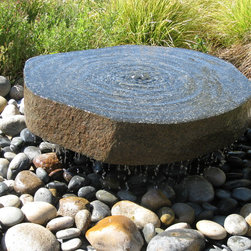
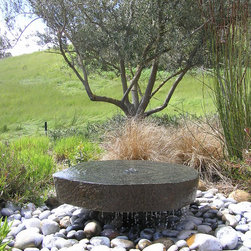
Additional new site elements include a mill stone fountain in the front which toys with both a natural and contemporary feel. A dry creek in the backyard serves as a major focal point and unifies the hillside and house while also providing drainage. Pots were designed in contemporary colors and plants such as black dahlias, reeds and succulents.
This project received 2011 CLCA San Luis Obispo Chapter: Beautification Awards Xeriscape: First Place
Sixty yards of soil was imported to create topography in the front yard. These berms sculpted and divided the large space into garden rooms which were paved in dry-laid flagstone. Three specimen olive trees were craned into place to frame the house and bridge its two story scale. The olives also were used to frame distant views from inside the house. A color palette of brown, gold, olive, and gray drew from the colors of the house as well as the surrounding native landscape. Large swaths of the same plant including Carex bucchanii, Stipa tenuissima, Perovskia atriplicifolia, Lavandula augustifolia, and Calamagrostis ‘Avalanche,’ Nepeta, and Gaura provided a contemporary boldness and instantly lush landscape—all with low use of water and without the ubiquitous lawn. Additional trailing rosemary was used to unify and enlarge the two disparate rosemary swales. Quick growing plants played the major role in this design, but small, 5-gallon Quercus agrifolia and Quercus lobata were added to the hills for a second generation planting.
Additional new site elements include a mill stone fountain in the front which toys with both a natural and contemporary feel. A dry creek in the backyard serves as a major focal point and unifies the hillside and house while also providing drainage. Pots were designed in contemporary colors and plants such as black dahlias, reeds and succulents.
This project received 2011 CLCA San Luis Obispo Chapter: Beautification Awards Xeriscape: First Place
Country: United States