
Live Edge Walnut Front Sideboard
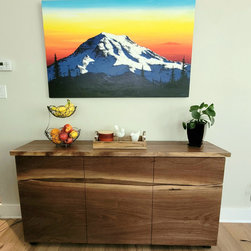
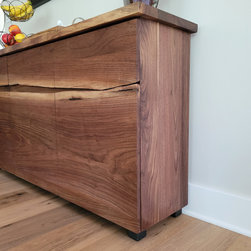
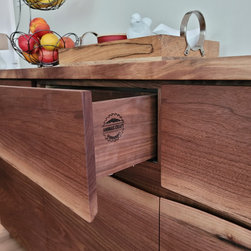
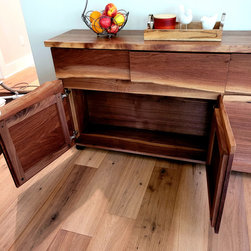
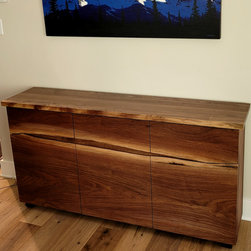
Solid hardwood Walnut construction. 3 live edge drawer fronts and 3 live edge doors. Divided cabinet with adjustable hardwood shelf. Square tube steel feet, painted to match the clients’ wood burning stove. Soft close hardware. Solid hardwood Walnut top.
The "cabinet" for this sideboard was made of solid hardwood, but the real challenge was making those slab doors. The plan for this piece was to use a live edge slab for the doors and drawer fronts, and that inward angled live edge would serve as the door and drawer pulls. But to get to this point, I had to start with a single slab that was both too thick and too narrow to meet the dimensions needed. The solution was to rip the slab into 4 boards on the table saw, then "re-saw" each of those 4 boards to get 8 boards half as thick. I used those resawn boards to glue up to the dimensions I needed. Then, a tedious amount of nervous effort to get the panels cut into the perfect widths - a 1 shot deal. The result was enough thin panels for functional doors and drawers, and a totally cohesive look in color and texture.
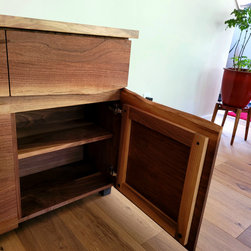
In short... it worked. And it looks fantastic. But there was another problem... wood movement. Wood always wants to move by expanding and contracting, which in turn can cause the wood to warp in undesirable ways. So I made this "internal door frames" to hold the panels flat over time. They allow the wood to expand and contract without twisting, cupping, or bowing. I also had to customize the door hinges to allow for this movement.
All said, this is a one-of-a-kind, heirloom, show-stopper piece, and one of the greatest challenges I've had in woodworking so far. Now on to the next.
The "cabinet" for this sideboard was made of solid hardwood, but the real challenge was making those slab doors. The plan for this piece was to use a live edge slab for the doors and drawer fronts, and that inward angled live edge would serve as the door and drawer pulls. But to get to this point, I had to start with a single slab that was both too thick and too narrow to meet the dimensions needed. The solution was to rip the slab into 4 boards on the table saw, then "re-saw" each of those 4 boards to get 8 boards half as thick. I used those resawn boards to glue up to the dimensions I needed. Then, a tedious amount of nervous effort to get the panels cut into the perfect widths - a 1 shot deal. The result was enough thin panels for functional doors and drawers, and a totally cohesive look in color and texture.
In short... it worked. And it looks fantastic. But there was another problem... wood movement. Wood always wants to move by expanding and contracting, which in turn can cause the wood to warp in undesirable ways. So I made this "internal door frames" to hold the panels flat over time. They allow the wood to expand and contract without twisting, cupping, or bowing. I also had to customize the door hinges to allow for this movement.
All said, this is a one-of-a-kind, heirloom, show-stopper piece, and one of the greatest challenges I've had in woodworking so far. Now on to the next.
Project Year: 2021
Project Cost: $5,001 - $7,500
Country: United States