
Manhattan Loft
• Industrial loft conversion for residential use
• 3,000 sq.ft. (280m2)
The project involved the complete reconstruction and furnishing of one entire floor of a converted 19th century industrial building situated near Manhattan’s Soho area.
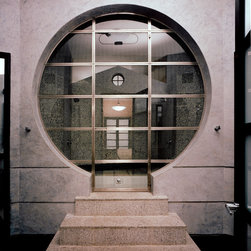
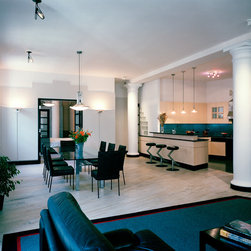
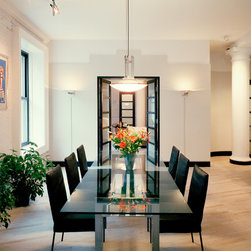
The new design creates a series of formal spaces for individual uses such as eating, entertaining, sleeping, etc., but can also be completely opened up into one breathtaking space for entertaining large parties, via a series of axially located doors.
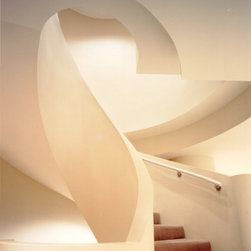
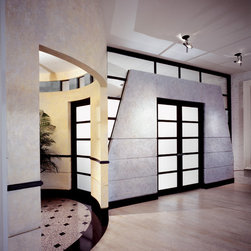
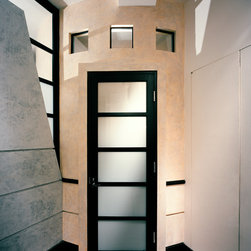
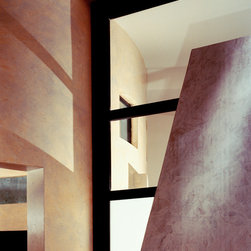
The elevator opens directly into a private circular hall, creating a pocket between private and public realms. The cylindrical form of this vestibule becomes part of a sculptural wall which serves as the main organizational element for the plan. This wall weaves its way through the entire space in a constantly changing narrative, carving clear geometric shapes out of the irregular floor plate. It differentiates and describes the various living spaces in front of it or separated by it: entrance hall, study, living area, screening room, dining space, kitchen and finally, the most private area, the bedroom. The concealed spaces left behind this wall are filled with functional uses such as storage and bathrooms.
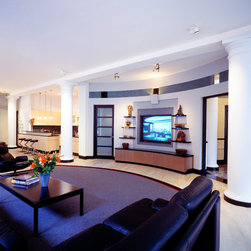
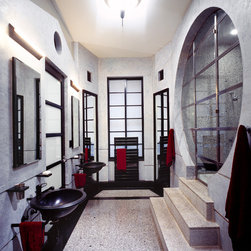
A giant-screen television, built into a proscenium type wall, creates a kind of screening room. The formal geometry of the bedroom is carved out from the existing shell with extensive closets which both define its shape and provide a buffer from the more public spaces. A disused service shaft was filled in to create space for the dressing room and bathroom, the design of which was based on a motif for flowing water.
The vocabulary expresses the nature of the loft as a place for both entertainment and privacy. Interior walls appear like individual architectural building forms, and yet their design allows complete flexibility of use for the space.
• 3,000 sq.ft. (280m2)
The project involved the complete reconstruction and furnishing of one entire floor of a converted 19th century industrial building situated near Manhattan’s Soho area.
The new design creates a series of formal spaces for individual uses such as eating, entertaining, sleeping, etc., but can also be completely opened up into one breathtaking space for entertaining large parties, via a series of axially located doors.
The elevator opens directly into a private circular hall, creating a pocket between private and public realms. The cylindrical form of this vestibule becomes part of a sculptural wall which serves as the main organizational element for the plan. This wall weaves its way through the entire space in a constantly changing narrative, carving clear geometric shapes out of the irregular floor plate. It differentiates and describes the various living spaces in front of it or separated by it: entrance hall, study, living area, screening room, dining space, kitchen and finally, the most private area, the bedroom. The concealed spaces left behind this wall are filled with functional uses such as storage and bathrooms.
A giant-screen television, built into a proscenium type wall, creates a kind of screening room. The formal geometry of the bedroom is carved out from the existing shell with extensive closets which both define its shape and provide a buffer from the more public spaces. A disused service shaft was filled in to create space for the dressing room and bathroom, the design of which was based on a motif for flowing water.
The vocabulary expresses the nature of the loft as a place for both entertainment and privacy. Interior walls appear like individual architectural building forms, and yet their design allows complete flexibility of use for the space.
Country: United States