

Myco Home
One of the challenges faced by designers today is to develop design solutions that address multiple environmental, social and economic crises. In fact, our built environment is so important in either contributing to or mitigating these crises that it has become irresponsible for a design to address only one at a time.
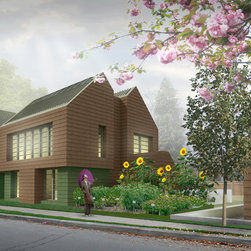
Our proposal for 100 Mile House puts this philosophy into practice. The competition brief requested a home built entirely of materials sourced within a 100-mile radius of Vancouver. This reduces emissions created in transport and supports local manufacturing but doesn”t go far enough. Our design also diverts waste from landfills, generates food, further reduces carbon emissions, increases energy efficiency, creates affordable housing, and brings communities together.
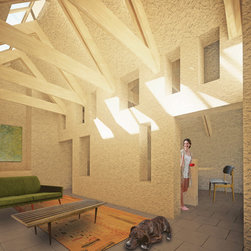
The idea is to create a wall system of blocks made from pulverized, reclaimed wood that has been colonized with mushroom mycelium. The mycelium binds the wood fibres together and provides two crops of edible mushrooms in the process. The blocks are then baked to make the mycelium inert, creating a fire-resistant, mould-resistant, structurally-stable, highly-insulating building material. (The technology already exists but its full potential in building systems has yet to be explored.)
The form of the blocks is similar to insulated concrete forms (ICFs), used widely in the building industry, and are as easy to assemble as Lego. Once a portion of the wall is built, the voids are filled with a natural pozzolan concrete to make them rigid and structurally stable. The remaining wall components (shingle-style wall membrane and a unitized rainscreen) are designed for easy assembly without any specialized skill. The interior is finished with a coating of lime-hemp plaster to complete the breathable yet weather-tight assembly.
To maximize affordability, the project has been phased over the life of an average family. It starts when a young couple purchase the land to build a laneway house on a typical Vancouver lot. The small scale of the structure and plot, and the reduced cost of the construction system help to minimize their mortgage. When they”re ready, they can purchase the existing house on the lot and disassemble it for conversion into building blocks for their new home, a 1,200 sf, energy-efficient house, suitable for their family of four. The laneway house can then be rented to supplement their income. In the final phase, a small home office with rental suite is added in the front yard. From there, the couple is able to operate a home-business, eliminating the transportation miles from a commute. When they reach retirement, the couple is able to move back into the laneway house and to sell the other two structures, leaving them financially and physically comfortable in their golden years.
Our proposal for 100 Mile House puts this philosophy into practice. The competition brief requested a home built entirely of materials sourced within a 100-mile radius of Vancouver. This reduces emissions created in transport and supports local manufacturing but doesn”t go far enough. Our design also diverts waste from landfills, generates food, further reduces carbon emissions, increases energy efficiency, creates affordable housing, and brings communities together.
The idea is to create a wall system of blocks made from pulverized, reclaimed wood that has been colonized with mushroom mycelium. The mycelium binds the wood fibres together and provides two crops of edible mushrooms in the process. The blocks are then baked to make the mycelium inert, creating a fire-resistant, mould-resistant, structurally-stable, highly-insulating building material. (The technology already exists but its full potential in building systems has yet to be explored.)
The form of the blocks is similar to insulated concrete forms (ICFs), used widely in the building industry, and are as easy to assemble as Lego. Once a portion of the wall is built, the voids are filled with a natural pozzolan concrete to make them rigid and structurally stable. The remaining wall components (shingle-style wall membrane and a unitized rainscreen) are designed for easy assembly without any specialized skill. The interior is finished with a coating of lime-hemp plaster to complete the breathable yet weather-tight assembly.
To maximize affordability, the project has been phased over the life of an average family. It starts when a young couple purchase the land to build a laneway house on a typical Vancouver lot. The small scale of the structure and plot, and the reduced cost of the construction system help to minimize their mortgage. When they”re ready, they can purchase the existing house on the lot and disassemble it for conversion into building blocks for their new home, a 1,200 sf, energy-efficient house, suitable for their family of four. The laneway house can then be rented to supplement their income. In the final phase, a small home office with rental suite is added in the front yard. From there, the couple is able to operate a home-business, eliminating the transportation miles from a commute. When they reach retirement, the couple is able to move back into the laneway house and to sell the other two structures, leaving them financially and physically comfortable in their golden years.
Country: Canada